Quick answer
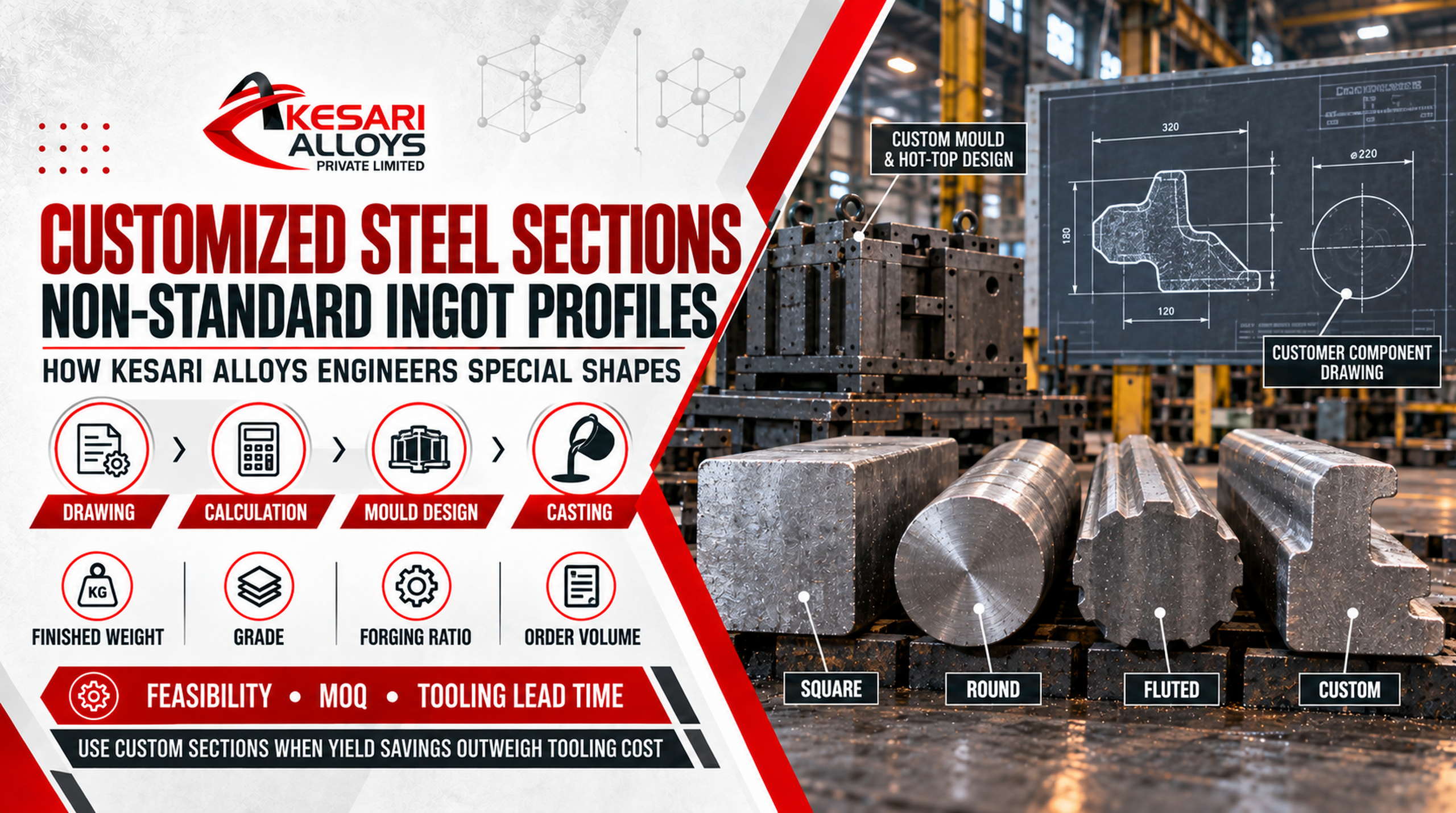
A customized steel section covers any requirement outside Kesari Alloys’ standard catalogue – a size that falls between two standard ingot or billet steps, a profile that is neither square, fluted nor round, or a specific hot-top and mould design engineered for a particular part. Getting a feasibility answer takes the same information as sizing a standard ingot: the component drawing, finished weight, grade and forging ratio requirement – plus realistic expectations on minimum order quantity and mould tooling lead time, since a custom size genuinely costs and takes longer than a catalogue one.
Why standard ranges don’t cover every job
Forging ingots (M1.5 to M22) and continuous cast billets (100×100 to 250×250 SQ mm, plus the new 200 mm round) cover the overwhelming majority of what forging shops and re-rollers need, and for good reason – standard sizes mean predictable mould availability and no tooling lead time. But “most jobs” is not “every job,” and two situations come up regularly enough to be worth explaining properly rather than handling case by case with no public information available:
• A finished part’s ideal starting weight falls between two standard ingot sizes – close enough to the smaller size that it fails the forging ratio, and wasteful enough at the larger size that yield suffers materially
• A part’s geometry doesn’t map cleanly onto square, fluted or round – an unusual cross-section, or a specific hot-top/mould design tuned to a particular forging sequence
Both are what “Customized Steel Sections” – one of Kesari Alloys’ four core products – actually means in practice.
The request process is the same method used for standard ingot sizing
Our guide to choosing the right forging ingot size walks through working backwards from the finished part: machined weight, plus machining allowance, plus forging and scale loss, plus test prolongation, plus hot-top and bottom discard, checked against the required forging ratio. A custom size request uses exactly this method – the only difference is that the answer doesn’t land on an existing catalogue size, so a mould and hot-top design has to be engineered specifically for it.
1. Send the component drawing and finished machined weight
2. State the grade and any specified forging ratio
3. Our metallurgical team runs the same weight-plus-losses calculation used for standard sizing
4. If the result doesn’t match a standard size, we confirm whether a custom mould and hot-top can be engineered – this draws on the same mould-design principles covered in our guide to fluted, square and round ingot moulds
5. We confirm feasibility, minimum order quantity and lead time before tooling begins
Realistic constraints on a custom size
• Minimum order quantity is typically higher than for a standard size, because mould tooling has to be engineered and, in most cases, is not reused across unrelated orders the way a standard-size mould is.
• Lead time is longer, driven primarily by mould design and tooling time rather than melting or casting itself – build this into your project schedule from the start, particularly if your order falls near the Oct–Nov festive-season window covered in our procurement planning guide.
• Cost per tonne is typically higher than an equivalent standard size, reflecting the tooling investment rather than any difference in the steel itself.
• A custom size is generally worthwhile when the yield or forging-ratio benefit over the nearest standard size, multiplied across your expected order volume, outweighs the tooling cost – this is a calculation worth running explicitly rather than assuming either way.
A representative scenario (illustrative)
A forging shop needs a finished part weighing 950 kg with a specified forging ratio of 4:1. Working through the standard sizing method lands on a required ingot weight that falls almost exactly between the M3 and M4 standard sizes – the smaller size doesn’t quite deliver the forging ratio at this shop’s press capacity, and the larger size represents roughly 12% wasted material across their annual order volume. In a case like this, a custom size engineered specifically for the required weight can pay back its tooling cost within the first year of ordering, purely on reduced material waste – which is exactly the kind of calculation worth running with actual numbers before committing either way.
Frequently asked questions
Can Kesari Alloys manufacture ingot or billet sizes outside the standard range?
Yes, subject to a feasibility review. Share your component drawing, finished weight, grade and forging ratio requirement, and our metallurgical team will confirm whether a custom size can be engineered and on what terms.
What information is needed to get a quote for a custom steel section?
The same core information used for standard ingot sizing – component drawing, finished machined weight, grade, and any specified forging ratio – plus your expected order volume, since that affects whether a custom size is worthwhile against its tooling cost.
Is there a minimum order quantity for a custom ingot size?
Typically yes, and it is generally higher than for a standard size, reflecting the mould tooling investment. Confirm minimum order quantity as part of the feasibility discussion before committing to a custom size.
How much longer does a custom size take compared to a standard one?
Lead time is longer primarily because of mould design and tooling time rather than the melting and casting process itself. Build this into your project schedule and discuss timeline expectations at the enquiry stage.
Is a custom section always more expensive than the nearest standard size?
Per-tonne cost is typically higher due to tooling investment, but a custom size can still be the more economical choice overall if it meaningfully improves yield or forging ratio across your expected order volume. This is worth calculating explicitly for your specific case rather than assuming either way.
The short version
“Customized Steel Sections” means engineering a size or profile that falls outside the standard catalogue, using the same weight-and-losses method as standard ingot sizing – just landing on an answer that needs its own mould and hot-top design. It costs more and takes longer than a standard size, and it’s worth it exactly when the yield or forging-ratio improvement outweighs that tooling investment across your order volume.
Talk to our metallurgical team
Send your component drawing, finished weight, grade and expected order volume, and we’ll confirm whether a custom size makes sense – and what it would take to tool it.
Kesari Alloys Private Limited | IBR Approved | ISO 9001, 14001, 45001 | PED 2014/68/EU | AD-2000 Merkblatt
Plant: Bhiwadi, Rajasthan | Office: 152, JMD Megapolis, Sector 48, Gurugram, Haryana