Quick answer
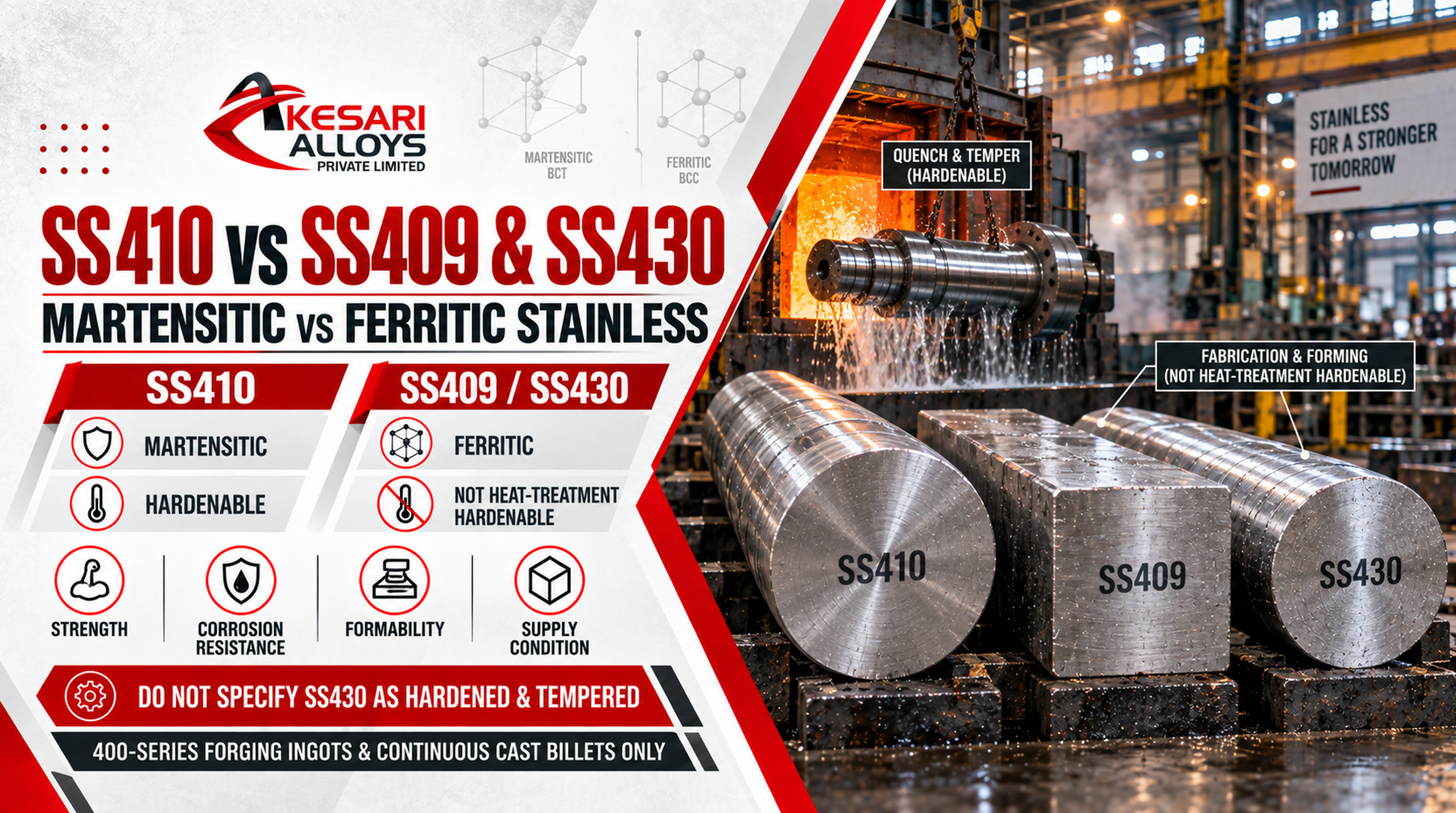
SS410 is martensitic and hardenable – the right choice when a part needs strength plus moderate corrosion resistance, such as pump and valve shafts. SS409 and SS430 are ferritic and cannot be hardened by heat treatment – they’re chosen instead for corrosion resistance and formability at lower cost, such as exhaust systems and general fabrication. Kesari Alloys supplies these as forging ingots and continuous cast billets across the 400-series (martensitic and ferritic) range – not flat or sheet product, and not austenitic 300-series stainless.
Two structurally different families under one “stainless steel” label
“Stainless steel” is not one material – it’s a family of alloys grouped by crystal structure, and that structure decides what heat treatment can and can’t do to the steel. The 400-series stainless grades split into two structurally different groups that behave nothing alike under heat treatment, despite both being called “stainless.”
• Martensitic (SS410) – enough carbon content that the steel can be hardened by heating and quenching, exactly like a carbon or alloy steel, while chromium provides moderate corrosion resistance.
• Ferritic (SS409, SS430) – low carbon content means these grades cannot be hardened by heat treatment at all. Their strength comes from the as-supplied condition and, where needed, cold work – not quench-and-temper.
This is the single most important fact to get right before specifying any of these three grades: asking for SS430 to be “hardened and tempered” the way SS410 would be is a specification error, because the metallurgy simply doesn’t support it.
Composition and properties
| Grade | Type | Carbon (%) | Chromium (%) | Hardenable? |
| SS410 | Martensitic | 0.08–0.15 | 11.5–13.5 | Yes – by quench and temper |
| SS409 | Ferritic | 0.08 max | 10.5–11.75 | No |
| SS430 | Ferritic | 0.12 max | 16.0–18.0 | No |
Note the chromium jump between SS409 (around 11%, the minimum generally accepted as “stainless”) and SS430 (16–18%) – SS430 gives meaningfully better corrosion resistance than SS409 at the cost of being a more expensive alloy, while neither can be strengthened by heat treatment the way SS410 can.
Applications by grade
| Grade | Typical applications |
| SS410 | Pump and valve shafts, cutlery-grade components, fasteners needing both strength and moderate corrosion resistance |
| SS409 | Automotive exhaust systems, general fabrication where cost and formability matter more than high corrosion resistance |
| SS430 | Decorative and architectural fabrication, appliance trim, mild corrosive-service components needing better resistance than SS409 |
Scope note: what Kesari Alloys actually supplies in stainless
This is worth stating precisely rather than leaving implied. Kesari Alloys manufactures 400-series stainless – martensitic SS410 and ferritic SS409/SS430 – as forging ingots and continuous cast billets. This does not extend to austenitic 300-series stainless (such as SS304 or SS316), and it does not extend to flat, sheet or coil products. If your requirement is specifically for 300-series or for sheet-form stainless, say so at the enquiry stage so we can tell you plainly rather than you finding out later.
What to specify when ordering
1. Grade – SS410, SS409 or SS430
2. Supply condition – annealed is standard for ferritic grades; state hardened-and-tempered condition and target hardness for SS410 if required
3. Section form – forging ingot or continuous cast billet, and size
4. Corrosive-service detail, if the application is more demanding than general atmospheric exposure
Frequently asked questions
What is the difference between martensitic and ferritic stainless steel?
Martensitic stainless (SS410) has enough carbon to be hardened by heat treatment, like a carbon steel, while retaining moderate corrosion resistance from its chromium content. Ferritic stainless (SS409, SS430) has very low carbon and cannot be hardened by heat treatment at all – its properties come from the as-supplied condition.
Can SS410 be hardened, and can SS430 be hardened the same way?
SS410 can be hardened by quenching and tempering, similar to a carbon or alloy steel. SS430 cannot – it is a ferritic grade with too little carbon to form a hardenable structure. Specifying a heat-treated condition for SS430 is a common and avoidable error.
Does Kesari Alloys supply 300-series (austenitic) stainless steel?
No. Our stainless range covers 400-series martensitic (SS410) and ferritic (SS409, SS430) grades as forging ingots and continuous cast billets. If your requirement is for 300-series austenitic stainless, let us know at the inquiry stage and we will confirm this isn’t something we currently manufacture.
Which 400-series grade is best for a corrosive but low-stress application?
SS430 generally offers better corrosion resistance than SS409 due to its higher chromium content, and is a common choice where moderate corrosion resistance is needed without the strength or hardenability of SS410. The right choice still depends on the specific service environment – share the details and we can advise.
Is SS410 suitable for fully corrosive/wet environments?
SS410’s corrosion resistance is moderate relative to higher-chromium or austenitic stainless grades. For genuinely aggressive corrosive service, a different stainless family may be more appropriate – confirm your service environment against grade capability before specifying.
The short version
SS410, SS409 and SS430 are all “400-series stainless,” but only SS410 can be hardened by heat treatment – SS409 and SS430 are ferritic grades chosen for corrosion resistance and cost, not strength through quench-and-temper. And our stainless range is scoped to this 400-series family in ingot and billet form, not 300-series or sheet product.
Talk to our metallurgical team
Share your grade, supply condition and service environment, and our metallurgical team will confirm feasibility and specification.
Kesari Alloys Private Limited | IBR Approved | ISO 9001, 14001, 45001 | PED 2014/68/EU | AD-2000 Merkblatt
Plant: Bhiwadi, Rajasthan | Office: 152, JMD Megapolis, Sector 48, Gurugram, Haryana