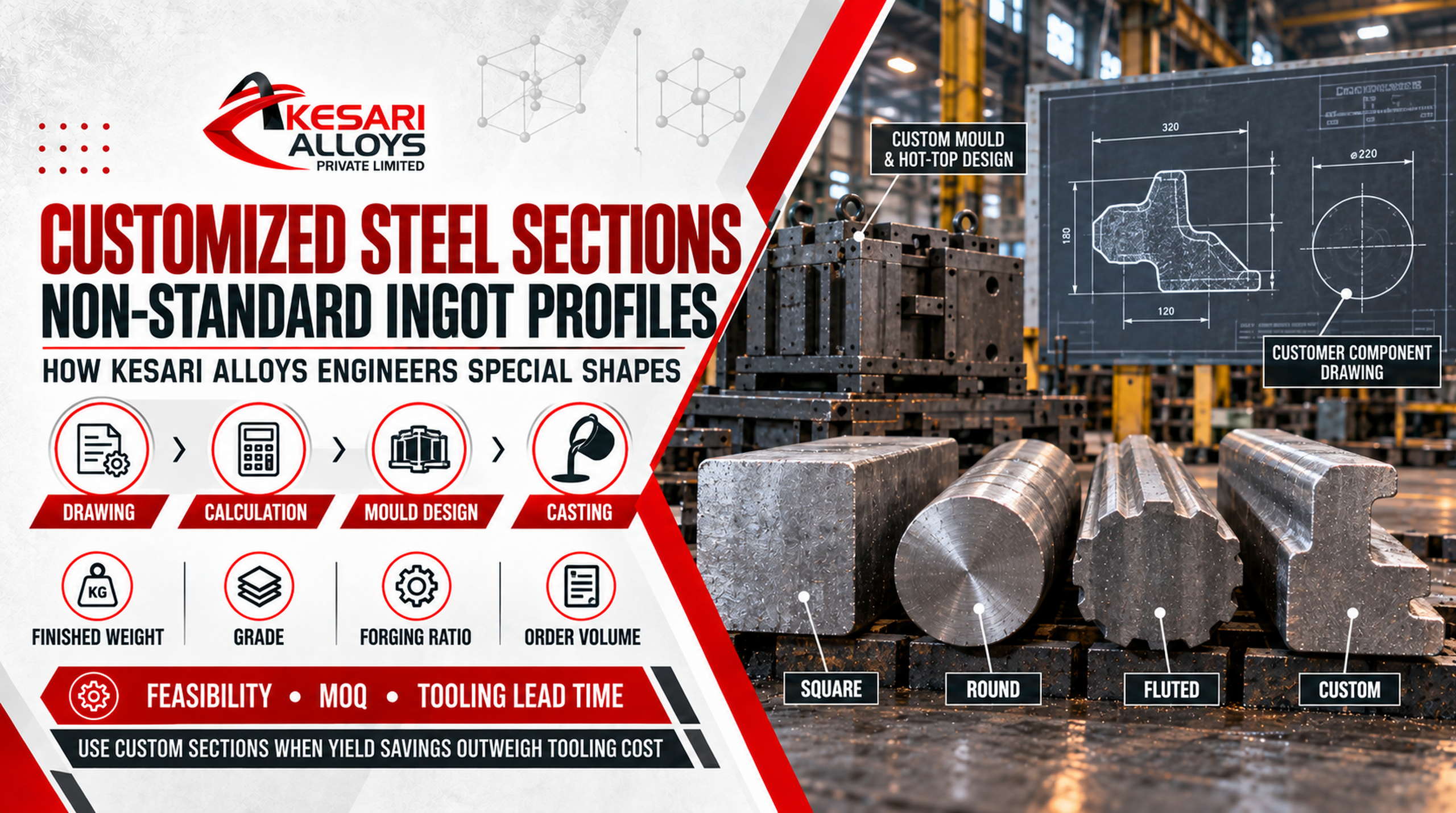
Customized Steel Sections and Non-Standard Ingot Profiles: How Kesari Alloys Engineers Special Shapes

Quick answer A customized steel section covers any requirement outside Kesari Alloys’ standard catalogue –  a size that falls between two standard ingot or billet steps, a profile that is neither square, fluted nor round, or a specific hot-top and mould design engineered for a particular part. Getting a feasibility answer takes the same information … Read more

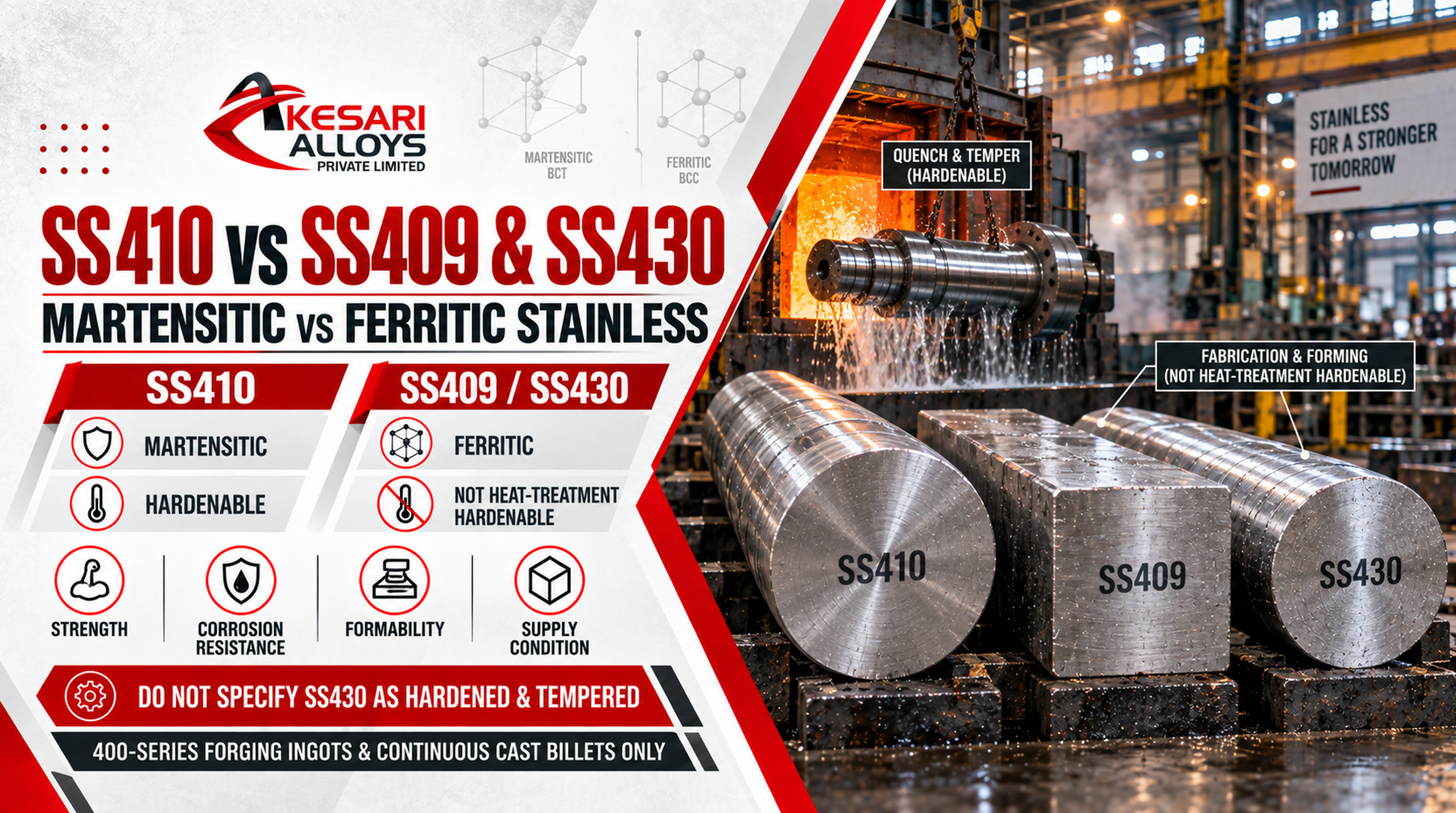
SS410, SS409 and SS430 Stainless Steel Ingots: Martensitic vs Ferritic Grade Selection

Quick answer SS410 is martensitic and hardenable –  the right choice when a part needs strength plus moderate corrosion resistance, such as pump and valve shafts. SS409 and SS430 are ferritic and cannot be hardened by heat treatment –  they’re chosen instead for corrosion resistance and formability at lower cost, such as exhaust systems and … Read more

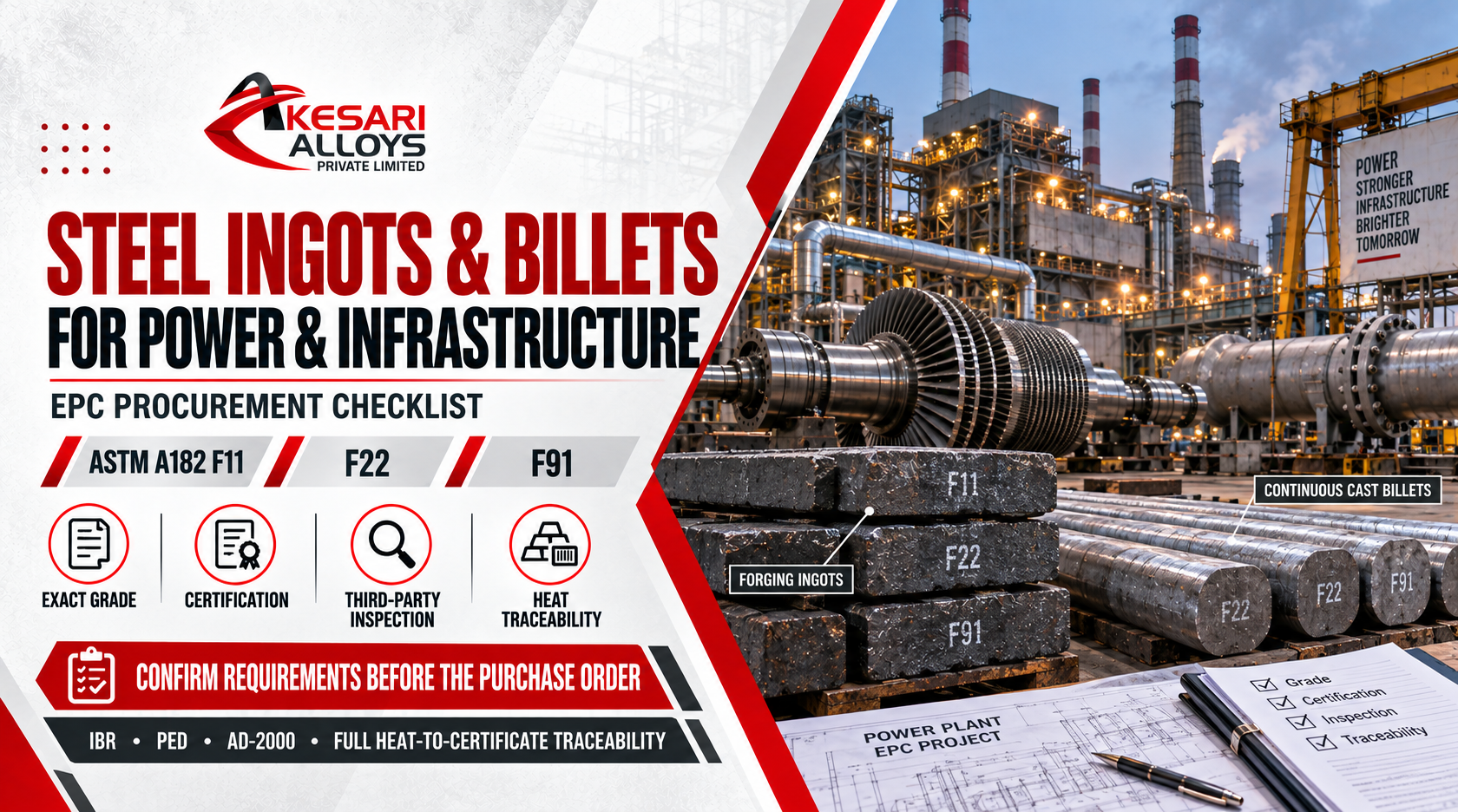
Steel Ingots and Billets for Power Plants and Heavy Infrastructure: A Procurement Checklist for EPC Buyers

Quick answer Power and heavy-infrastructure buyers typically need chromium-molybdenum grades (ASTM A182 F11, F22, F91) for steam and high-temperature service, IBR-compliant material wherever a boiler or steam pressure part is involved, and full heat-to-certificate traceability to satisfy EPC quality audits –  the same technical bar as the oil & gas and valve sector, applied to … Read more

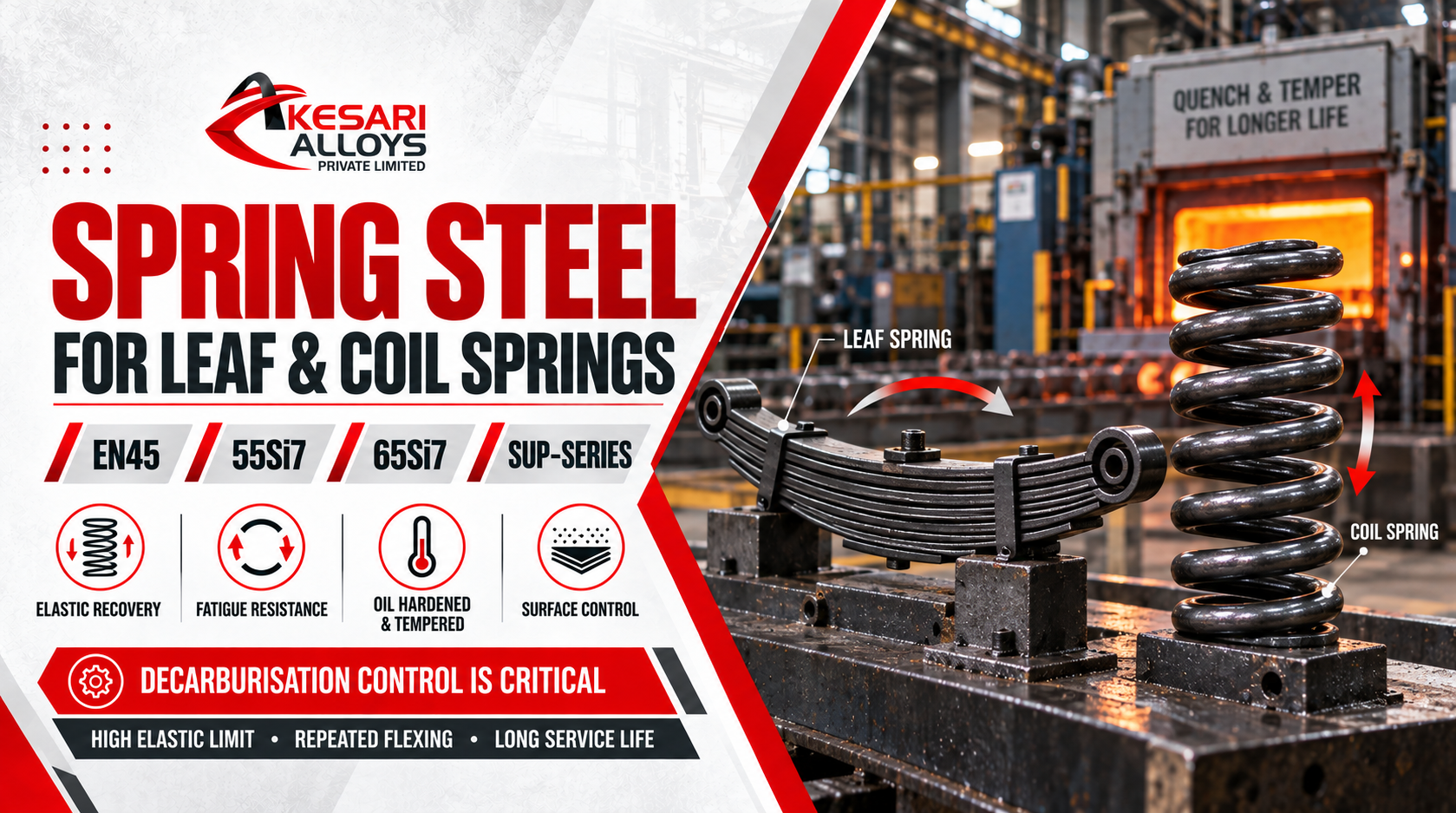
Spring Steel for Leaf and Coil Springs: EN45, 55Si7, 65Si7 and SUP- Series

Quick answer Spring steel (EN45, 55Si7, 65Si7, SUP-series) uses silicon-manganese alloying combined with a precise quench-and-temper cycle to raise the elastic limit high enough that a part returns fully to shape after repeated flexing instead of taking a permanent set. Grade and section choice depend mainly on whether the spring is a heavy-duty automotive leaf … Read more

SAE 4140 vs SAE 4340 vs EN19 vs EN24: Choosing the Right Through-Hardened Alloy Steel for Shafts and Structural Forgings

Quick answer SAE 4140 and EN19 (both chromium-molybdenum steels) suit medium-section shafts and structural forgings needing good strength and toughness at moderate cost. SAE 4340 and EN24 add nickel, which raises hardenability significantly and lets larger sections through-harden without a severe water quench –  the right choice when section thickness, or the need for a … Read more

Planning Q3 (Oct–Dec) Steel Ingot and Billet Procurement: Lead Times and the Festive-Season Supply Gap

Quick answer Navratri, Dussehra and Diwali fall across September and November and bring overlapping short shutdowns –  not one clean holiday but several partial stoppages stacked close together –  across melt shops, transporters and labour throughout the NCR–Rajasthan manufacturing belt. The reliable way to avoid a supply gap is to place your Q3 order 3–4 … Read more

Free-Cutting Steel for High-Volume Machining: EN1A, SAE 1117 and EN8DM

Quick answer Free-cutting steel (EN1A, SAE 1117, EN8DM) has controlled sulphur –  and in some grades, lead –  deliberately added to make the steel break chips cleanly and machine faster on automatic lathes. The trade-off is lower weldability and slightly reduced toughness compared with an equivalent plain-carbon grade, which is why free-cutting steel is chosen … Read more

200 MM Round As-Cast Billets: What Kesari Alloys’ New Product Means for Seamless Tube, Round Bar and Shaft Forging Buyers

200 mm round as-cast billets are now part of Kesari Alloys’ billet and bloom range, alongside the existing square sections from 100×100 to 250×250 SQ mm. Supplied as-cast at approximately 240 kg per metre, these continuous cast round billets are designed for seamless tube and pipe production, round-bar re-rolling, and shaft or ring forging applications. … Read more

Buying Forging Ingots and Billets in Delhi NCR: A Complete Checklist for Bhiwadi and Gurugram Buyers

When sourcing forging ingots, billets or blooms in Delhi NCR, check ten things before you compare price: certifications, grade range, size range, melting route, heat number traceability, in-house testing, heat treatment capability, existing vendor approvals, lead time and freight cost. Proximity to your plant matters but only after the material is right. A cheap local … Read more

Fluted, Square or Round Ingot Moulds: How Mould Design Controls Cracking and Segregation

The mould does far more than hold the shape. It controls how fast and in which direction the steel solidifies, and that decides grain structure, the extent of centreline segregation, and whether the surface cracks. Fluted molds increase surface area and speed up heat extraction. Square moulds are the general-purpose choice for drawing down. Round … Read more