Quick answer
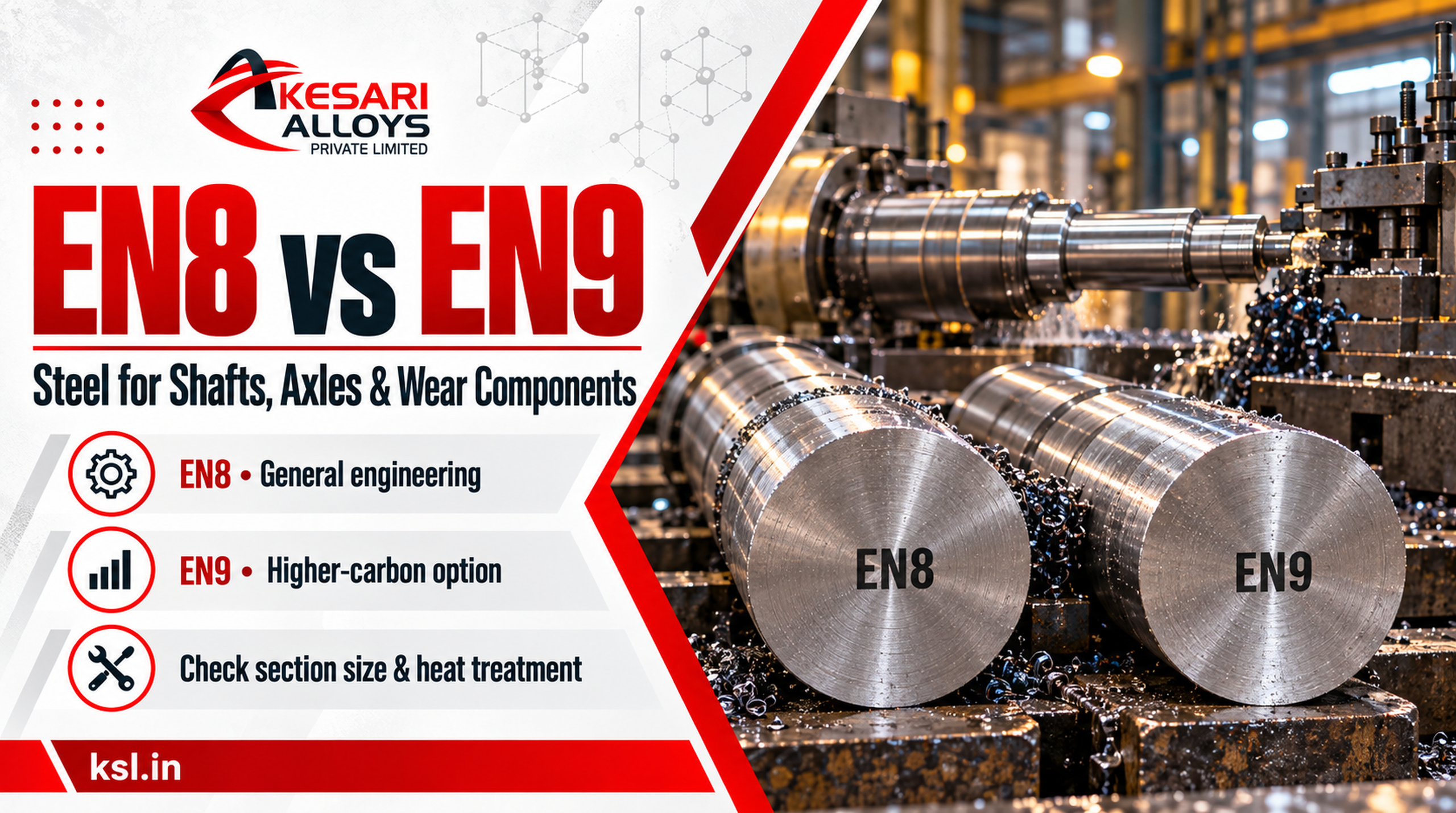
EN8 is a useful starting point for general engineering shafts and axles where strength, machinability and cost must be balanced. EN9 has higher carbon content and can be considered when the design gives greater importance to hardness and wear resistance. Neither grade is a universal upgrade over the other. The correct choice depends on section size, loading and the required heat-treated condition. [1–4]
Start with the component requirement
A purchasing request that says only “EN8 shaft material” leaves several important decisions open. Is the shaft supplied for immediate machining, or will it be forged and heat treated first? Does the drawing require a hard journal with a tougher centre? Are impact loads significant? The answers determine what the raw material must achieve.
Consider two enquiries for shafts of the same finished diameter. One could be a lightly loaded conveyor shaft; the other could carry repeated shock loads and tight bearing fits. Their appearance does not establish identical material requirements. Give the supplier the drawing specification and the processing sequence rather than relying on the component name alone.
What the grade names tell you
EN8 and EN9 are familiar legacy British steel designations. Commercial references commonly associate EN8 with 080M40 and EN9 with 070M55. These names help identify the general grade family, but the order should state the governing standard and agreed chemistry rather than assume that every cross-reference is interchangeable. [1, 2]
KSL lists both EN8 and EN9 in its carbon steel range. Its grade pages describe EN8 for medium to high-strength engineering applications and EN9 for applications with greater hardness and wear demands. Exact acceptance requirements should still come from the purchase specification. [3, 4]
EN8 and EN9 compared
| Selection point | EN8 | EN9 |
| Carbon level | Lower than EN9 | Higher than EN8 |
| Typical starting application | General shafts, axles and engineering parts | Wear-loaded parts such as cams, sprockets and selected shafts |
| Main purchasing question | Does the specified condition meet the strength and machining requirement | Does the required hardness retain enough toughness for the duty |
| Through hardening | Section size limits must be considered | Section size limits must also be considered |
| Welding | Requires assessment and an appropriate procedure | Poor weldability makes repair planning especially important |
The table is a selection guide, not a set of guaranteed mechanical properties. A tensile strength or hardness figure has meaning only when its test condition and applicable section are known. [1, 2]
Section size changes the decision
Both grades can respond to quenching and tempering, but through hardening is limited by section size. Results from a small test piece should not be assumed to describe the centre of a large shaft. [1, 2]
For a thick component, ask the design and heat-treatment teams where the required properties must be demonstrated. A surface hardness reading may satisfy one drawing but provide insufficient evidence for another. If the required core properties exceed what a carbon steel can reliably deliver at the actual section, assess an appropriate alloy steel instead of simply increasing the surface hardness target.
Plan machining and heat treatment together
The supply condition should support the next operation. A machine shop buying stock for extensive rough machining needs a different discussion from a forge shop buying an ingot for further deformation. Specify the required condition, machining allowance and any hardness acceptance range before material is dispatched.
For an existing component, compare the new order with the last accepted material certificate and process route. If a supplier proposes a substitution, request a written comparison against the drawing requirements. A similar carbon content or a familiar equivalent-grade label is not enough to approve a change.
Information to include in the enquiry
· Grade designation, governing specification and permitted substitution rules.
· Starting material form, section dimensions, length and quantity.
· Final component size and intended forging or machining route.
· Required supply condition and final mechanical-property requirements.
· Inspection requirements, certificate type and heat-number traceability.
This information helps suppliers quote against the same requirement. It also makes a price comparison more meaningful because the offers cover the same material condition and testing scope.
Frequently asked questions
Is EN9 always stronger than EN8
EN9 contains more carbon, but the delivered properties depend on processing and heat treatment. Compare certified results in the specified condition rather than treating the grade name as a guaranteed strength value.
Can EN8 and EN9 be substituted without approval
No. A substitution should be assessed against the drawing, governing material specification and required properties. Obtain the customer’s or design authority’s acceptance before changing grades.
Which grade is better for a large shaft
The finished section and core-property requirement decide the answer. Both are carbon steels with limited through-hardening capability. A large shaft may need a different grade and heat-treatment route.
What should a buyer check on delivery
Match the grade, heat number, dimensions and supply condition to the order and material certificate. Check that any required test reports belong to the delivered heat and agreed test condition.
Discuss your carbon steel requirement with KSL
Explore KSL’s EN8 steel, EN9 steel and forging ingot range. Send the specified grade, section, quantity and processing requirement through the KSL enquiry page to discuss a suitable supply option.