Quick answer
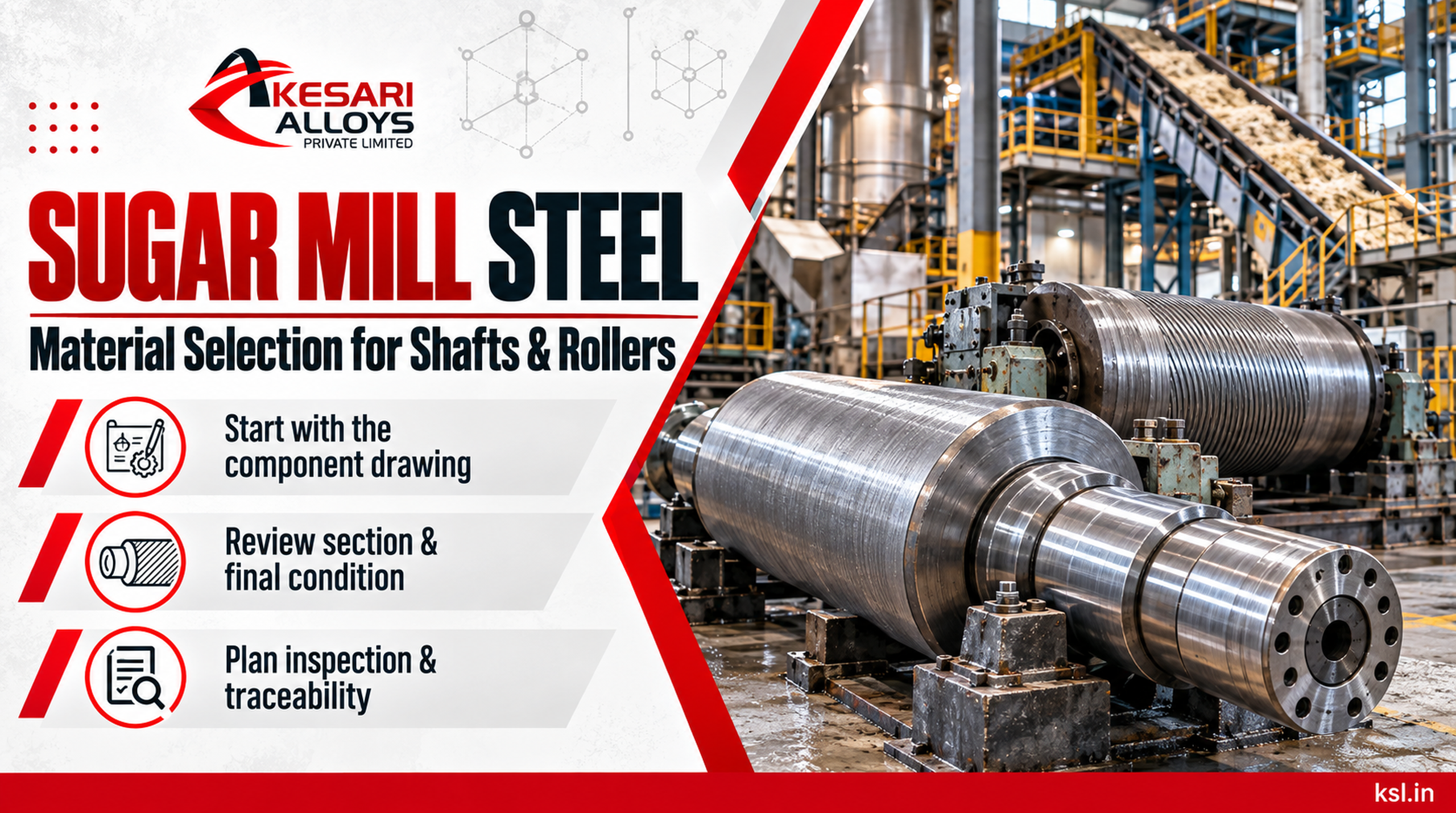
Steel for sugar mill shafts and rollers should be selected from the approved component specification, actual section and service requirements. Material procurement must also address internal soundness, heat treatment and traceability. KSL lists sugar mill shafts and rollers among applications for its billet range and offers ingots and rolled bars for downstream manufacturing. These are starting materials; final component manufacture and inspection require their own agreed scope. [1–3]
Treat the shaft and roller assembly as different requirements
The term “sugar mill roller” can refer to an assembly rather than one uniform steel part. Establish whether the enquiry concerns a roller shaft, a roller body, a sleeve or another component. Identify the drawing number and material requirement for each item instead of applying a single grade to the entire assembly.
For replacement work, compare the drawing revision with the existing component record. A workshop may reproduce the dimensions of a worn part without having its full material history. Resolve the specified grade and final condition before ordering raw steel, particularly where the original certificate is missing.
Consider service history alongside the drawing
Sugar mill roller shafts work in conditions where fatigue and wear can be important. Published failure research has also investigated internal cracks and non-metallic inclusions in roller shafts, linking material quality and inspection to rejection of the manufactured component. [4]
For a failed shaft, provide the component manufacturer with the fracture location, operating history and maintenance records. Ask whether the replacement should retain the original specification or whether an engineering change is required. Material procurement should follow that decision rather than use a stronger-sounding grade as an automatic remedy.
Review carbon and alloy steel options
KSL’s grade family includes carbon steels such as EN8 and C45 and alloy steels such as EN19 and EN24. These names are possible starting points for an engineering discussion; they are not interchangeable recommendations for every mill shaft. [5]
The decision should account for required strength, toughness, wear performance and properties through the finished section. If a component needs a hard surface and a different core condition, specify those requirements separately. A grade selected for a smaller shaft should not be assumed to meet the same requirements in a much thicker part.
Match the starting product to the manufacturing route
| Starting material | Manufacturing situation to discuss | Information to provide |
| Forging ingot | Heavy components requiring substantial downstream forging | Finished weight, critical sections and proposed forging route |
| Billet or bloom | Suitable component sections entering an established forging route | Blank dimensions, grade and process requirements |
| Rolled bar | Components manufactured from a suitable available bar section | Diameter, length, machining allowance and final condition |
The chosen starting form should be reviewed by the component manufacturer. Required reduction, allowances and internal-quality requirements affect the decision. Price per tonne does not capture the cost of stock removal, additional treatment or a late-stage rejection.
KSL publishes round rolled bars from 16 to 180 mm and square billet or bloom sections from 100 by 100 to 250 by 250 mm, alongside its other product forms. These catalogue dimensions describe starting products, not the size of every finished shaft that can be manufactured from them. Confirm the required section and product route with KSL. [1, 2]
Set inspection requirements before expensive processing
Specify the incoming material inspections and the examinations required after forging, heat treatment or machining. For a critical shaft, define the applicable ultrasonic procedure and acceptance criteria at the agreed stage. Also identify any required surface examination, mechanical testing or dimensional checks in the component inspection plan.
The research on roller-shaft rejection shows why internal-quality questions deserve attention before a large amount of processing cost is added. It should not be used to promise that one test eliminates every failure mechanism or that findings from a particular case apply to every sugar mill. [4]
Build a complete replacement material enquiry
· Identify the shaft or roller component and drawing revision.
· State the specified grade and governing material requirements.
· Provide finished dimensions, starting material needs and quantity.
· Define the delivery condition and planned downstream treatment.
· Include required inspection methods, acceptance criteria and certificate type.
· State the delivery date and any inspection hold points that affect release.
Request a quotation that identifies what is included at the raw-material stage and what remains with the forge shop or machine shop. For a shutdown replacement, coordinate material release, component processing and final inspection as separate milestones.
Frequently asked questions
Can EN8 be used for every sugar mill shaft
No. The approved design and required properties determine suitability. Component section and service conditions must be assessed before selecting a carbon or alloy steel.
Does a roller body always use the same material as its shaft
No. The assembly may contain components with different material and wear requirements. Follow the drawing specification for each item.
Is an ingot the same as a finished forged shaft
No. An ingot is a starting material. Forging, treatment, machining and component inspection require a separately defined manufacturing route.
What records should accompany a replacement shaft
Keep the material certificate, processing and heat-treatment records, agreed test reports and final dimensional inspection linked to the component identification. The contract determines the required records.
Discuss sugar industry steel requirements with KSL
Review KSL’sbillets and blooms,forging ingotsandrolled bars. Share the component drawing, grade, starting section and inspection requirements through theKSL enquiry pageto discuss raw material supply.