Quick answer
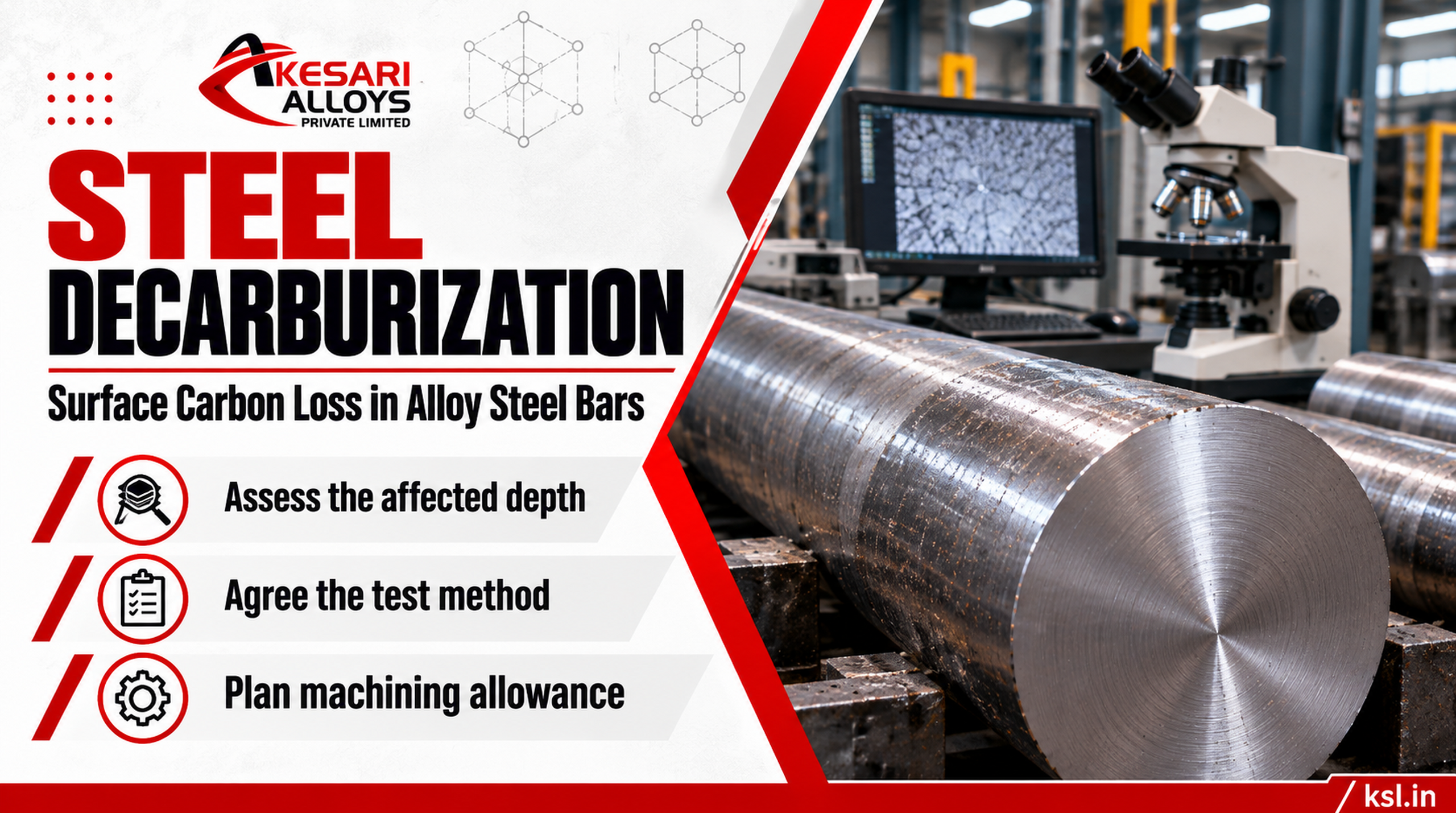
Decarburization is a loss of carbon from the surface region of steel. Exposure during high-temperature processing can leave a surface layer with a different hardening response from the underlying material. Buyers should agree how decarburization depth is defined and measured, then relate the permitted depth to the remaining machining allowance and finished-part requirements. [3, 4]
Why steel bar surface condition deserves attention
A bar can meet its bulk chemical composition requirement while still needing a separate surface assessment. Bulk chemistry and the condition of the outer layer are different acceptance questions. For a component whose working surface is close to the original bar surface, that distinction can affect the manufacturing plan.
Consider a workshop buying near-finish stock to reduce turning time. The saving is useful only if the available removal allowance also accommodates the agreed surface condition, dimensional variation and subsequent processing. A smaller starting diameter should therefore be approved with quality and production, rather than on material weight alone.
Decarburization is different from scale
Scale is an oxide layer on the outside of the steel. Decarburization concerns carbon loss in the steel below or near that surface. Removing visible scale does not by itself prove that the affected metallic layer has been removed. [4]
Inspection planning should distinguish the condition observed, the depth measured and the final surface that must satisfy the drawing. Avoid using the words clean surface as a substitute for a measurable requirement.
How decarburization depth is assessed
ASTM E1077 describes methods for estimating decarburization depth. Depending on the selected procedure, assessment can involve metallographic examination, hardness measurements or chemical analysis. Different methods can reveal different aspects of the carbon-depleted region, so the test method and definition must accompany the result. [3]
Specify whether the requirement concerns complete or total decarburization and how sampling will be performed. Identify the relevant supply condition and processing stage. An incoming-bar result describes the bar at receipt; later heating must also be controlled if the finished surface has a decarburization requirement.
How to decide machining allowance
There is no single removal allowance suitable for every grade and bar size. Work backwards from the finished diameter and acceptable surface properties. Review the agreed decarburization limit alongside ovality, straightness, size tolerance, surface defects and any finishing after heat treatment.
Illustrative geometry only: if testing identifies an affected depth of 0.30 mm radially on a round bar, removing that depth around the full circumference reduces the diameter by 0.60 mm. That calculation is not a recommended acceptance limit or a complete allowance. Production still needs sufficient stock for its other dimensional and finishing requirements.
What to include in the purchase order
State grade, product form, dimensions, delivery condition, surface condition, maximum permitted decarburization, test method and sampling requirement. Agree how a nonconforming result will be handled before material enters production.
When the part is sensitive to its surface condition, ask the heat treater to review the full route. Increasing incoming stock allowance will not resolve a later furnace practice that creates a new affected layer.
Frequently asked questions
Can bulk chemistry confirm that a bar has no decarburization
No. Assess the surface condition with an appropriate agreed method; a bulk composition result does not describe the carbon profile at the surface.
Can machining remove a decarburized layer
It can remove an affected layer when its depth is established and sufficient stock remains. Verify the resulting dimensions and the final surface requirements rather than assuming any turning pass is enough.
Is one machining allowance suitable for all steel bars
No. The allowance must suit the measured or specified surface condition, stock tolerances and actual production route.
Make the surface requirement part of your enquiry
For a KSL steel bar enquiry, provide the starting size, finished size, delivery condition and surface acceptance criteria. Review the available grades at https://ksl.in/steel-grades-family.html and send the specification to info@ksl.in. Confirm any special inspection requirement before purchase.