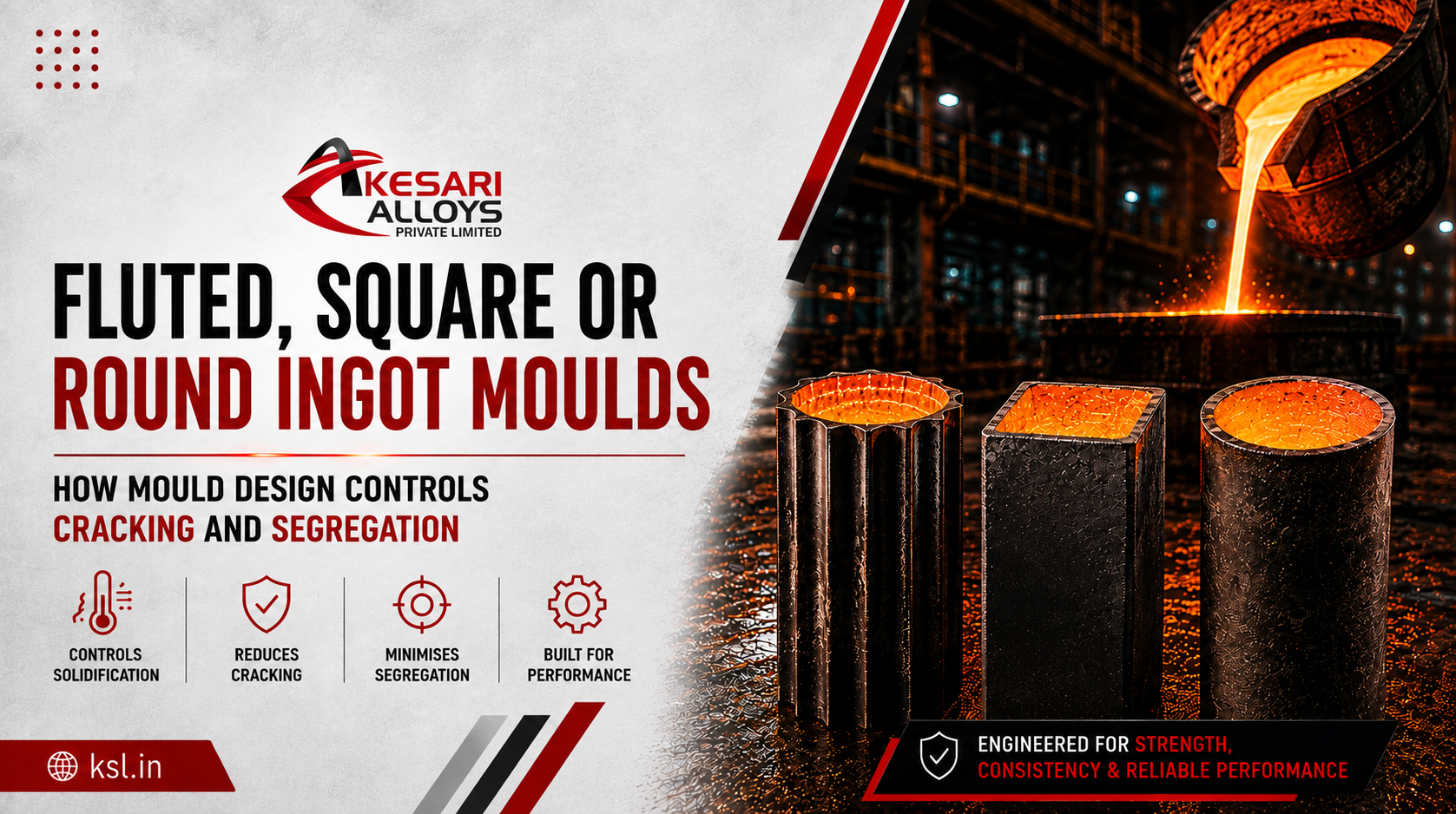
The mould does far more than hold the shape. It controls how fast and in which direction the steel solidifies, and that decides grain structure, the extent of centreline segregation, and whether the surface cracks. Fluted molds increase surface area and speed up heat extraction. Square moulds are the general-purpose choice for drawing down. Round moulds suit ring rolling and upsetting. Taper prevents sticking and reduces cracking from uneven contraction. The hot top feeds liquid metal downward so shrinkage porosity ends up in the discard rather than in your forging.
Solidification is where the forging is really made
By the time steel is poured, two things are already fixed: the chemistry and the cleanliness. Nothing that happens in the mold can improve either.
What is still open is the structure and that is decided almost entirely in the mould over the next few hours.
Get it right and you get a sound ingot with a clean surface, controlled segregation, and shrinkage confined to the hot top where it belongs. Get it wrong and you get surface cracks, subsurface blowholes, heavy centreline segregation, or a shrinkage cavity extending down into the ingot body.
None of that can be fixed afterwards. Forging can break down a coarse structure and close some porosity that is precisely what forging ratio is for but it cannot remove a crack, and it cannot undo segregation that is severe enough to sit outside specification.
At Kesari Alloys, mould selection is a deliberate engineering decision made against the grade, the ingot size and the customer’s downstream process. It is not a default setting.
The five jobs a mould has to do
A well-chosen mould achieves five things simultaneously:
1. Ensures complete solidification with a directional, controlled freezing pattern
2. Produces a suitable grain structure, since the freezing rate determines the physical properties of the as-cast metal
3. Facilitates handling and downstream processing stripping, transport, reheating and forging
4. Minimises liquid metal wastage, which directly reduces manufacturing cost
5. Prevents cracking caused by uneven cooling and volume change during contraction
Any mould design is a compromise across those five. Optimising one at the expense of the others is how defects appear.
Fluted moulds more surface, faster heat transfer
A fluted mould has a corrugated or lobed internal profile rather than flat faces. That one change increases the contact area between the solidifying steel and the mould wall considerably.
What the extra surface buys you:
▪ Faster heat extraction, because there is more area for heat to flow through
▪ A finer solidification structure near the surface, where the cooling rate is highest
▪ Reduced risk of surface cracking, because contraction is distributed across many small lobes rather than concentrated at flat faces and sharp corners
▪ Better handling of crack-sensitive grades, particularly higher alloy content steels
▪ Improved as-cast surface, reducing the amount of grinding required before forging
As a fluted forging ingots manufacturer, we use this profile particularly for alloy grades prone to surface defects, and where the customer needs a good as-cast surface with minimal conditioning.
The trade-off is that the fluted geometry is slightly less convenient to manipulate on the press than a clean square section, and the lobes have to be worked out during the first passes.
Square moulds the general-purpose workhorse
Square section ingots remain the most widely used profile in open die forging, and for good reasons.
Why they work:
▪ A square section is straightforward to draw down into shafts, bars and rectangular blocks
▪ Handling and manipulation on the press is simple and familiar
▪ Die contact is even, and turning through 90° during cogging is natural
▪ Practice is well established in every forging shop, so there are fewer surprises
The trade-off is at the corners. Corners have two faces losing heat instead of one, so they cool faster than the flat faces. That differential creates local stress, and stress at a corner is where cracks start.
This is managed with corner radii rather than sharp geometry, and with appropriate taper. A square ingot mould with genuinely sharp corners is a crack waiting to happen.
Round moulds for ring rolling and upsetting
Round ingots suit processes where a round starting section reduces the amount of working required.
Best suited to:
▪ Ring rolling, where a round blank is upset and pierced before rolling
▪ Upsetting operations, where a round section deforms symmetrically
▪ Parts whose finished geometry is fundamentally round, saving forging passes and heating cycles
Round sections also avoid the corner cooling problem entirely, since there are no corners. The trade-off is that they are less convenient for drawing down long parts, where a square section gives the press better purchase.
Taper a small detail with a large effect
Ingot molds are tapered rather than parallel-sided. There are two distinct reasons, and both matter.
Stripping. A tapered ingot releases from the mould as it contracts. A parallel-sided one can grip, making stripping difficult and risking damage to both ingot and mould.
Crack prevention. Volume changes during solidification generate stress. Taper allows the solidifying shell to move relative to the mould instead of being mechanically restrained, which reduces the tensile stress that causes cracking.
The direction of taper wide end up or wide end down is chosen together with the hot top design and the intended feeding pattern, and the two decisions cannot be made independently.
Solid moulds versus water-cooled shells
Depending on the heat extraction rate required, moulds can be solid cast iron or water-cooled shells.
| Mould type | Heat extraction character | Where it is used |
| Solid cast iron | Slower, more gradual | Most conventional ingot casting |
| Water-cooled shell | Much faster, finer structure | Where a specific higher solidification rate is required |
Faster is not automatically better. Too rapid an extraction rate increases thermal gradient and therefore thermal stress, which raises crack risk. The rate is matched to the grade and the section, not maximised.
The hot top where the shrinkage is sent
When steel solidifies it contracts. That volume has to be fed from somewhere, or a cavity forms.
The hot top is a reservoir of liquid steel sitting above the ingot body, insulated so that it stays molten longest. As the body below solidifies and contracts, liquid metal is drawn down from the hot top to fill the gap. Shrinkage porosity therefore concentrates in the hot top which is cut off and discarded.
Two designs are in common use:
▪ Over-imposed hot top mounted above the mould, giving a large feeding reservoir and strong, sustained feeding
▪ Semi-inserted hot top partly set into the mould, giving a different balance between feeding capacity and yield
The trade-off nobody escapes
A larger hot top feeds better and produces a sounder ingot but it increases discard and reduces yield.
A smaller hot top improves yield but risks the shrinkage cavity extending down into the ingot body, into exactly the metal you intended to forge.
Which side of this trade-off is correct depends on the grade, the section size, and how critical internal soundness is for the end component. For a general engineering part the balance sits differently than for a rotor forging that will be ultrasonically inspected to a tight acceptance standard.
Bottom pouring how the steel enters matters
The filling method is part of the same conversation.
In bottom pouring, steel enters the mould from beneath through a runner system and rises quietly up the mould. On top of pouring, steel falls from above into the mould.
Bottom pouring gives:
▪ No splashing, so no cold shuts or surface defects from splashed metal freezing on the mould wall
▪ Less reoxidation, because the metal stream is not exposed to air during a long fall
▪ A cleaner as-cast surface
▪ Better retention of the cleanliness achieved during ladle refining and vacuum degassing
There is little point in vacuum degassing steel and then reoxidising it during pouring. Bottom pouring protects the investment made upstream.
Segregation what mould design can and cannot control
As steel solidifies, alloying elements and impurities are rejected by the growing crystals into the remaining liquid. That enriched liquid ends up concentrated toward the centre and top of the ingot. This is centreline segregation, and it is an inherent feature of ingot casting rather than a defect.
Mould design influences it:
▪ Faster, more directional solidification reduces the time available for segregation to develop
▪ Correct hot top design keeps the worst-affected metal in the discard zone
▪ Section shape affects the geometry of the solidification front
Mould design cannot eliminate it. That is what the forging ratio is for. Mechanical working breaks down the segregated structure, disperses it, and closes residual porosity.
Mould design and forging ratio are two halves of the same solution. A shop that optimises one and ignores the other will keep finding defects it cannot explain.
Common as-cast defects and their usual mould-related causes
| Defect | Typical mould-related cause |
| Surface cracking | Sharp corners, insufficient taper, excessive cooling rate, restrained contraction |
| Cold shuts on surface | Top pouring with splashing, low pouring temperature |
| Shrinkage cavity in ingot body | Hot top too small or poorly insulated, inadequate feeding |
| Subsurface blowholes | Damp mould coating, inadequate deoxidation |
| Severe centreline segregation | Slow solidification, oversized section for the grade, poor hot top design |
| Sticking during stripping | Insufficient taper, mould wear, coating problems |
What Kesari Alloys supplies
▪ Forging ingots from M1.5 to M22 (1,450 kg to 22,500 kg)
▪ Square, fluted and round profiles
▪ Over-imposed and semi-inserted hot top designs
▪ Bottom pouring into moulds
▪ Ingots free from surface defects and cracks, available in spot ground or fully ground condition
▪ Suitable for sawing in cold condition
▪ Marked with grade, size and heat number
▪ Available across carbon steel, alloy steel and stainless steel 10 grade families, over 100 grades
Frequently asked questions
Why is a fluted mould better for some grades?
It increases the contact area, which increases heat transfer and distributes contraction stress across many small lobes rather than flat faces and sharp corners reducing surface cracking risk on sensitive grades.
Does the mould shape change the mechanical properties?
Not directly. Properties come from chemistry and heat treatment. The mould affects as-cast structure, internal soundness and surface condition, which then affect how the material behaves through forging and inspection.
What happens if the hot top is too small?
Feeding is insufficient and the shrinkage cavity extends down into the ingot body into the metal you intended to forge. It typically shows up at ultrasonic testing or during machining.
Can centreline segregation be removed completely?
No. It can be reduced and dispersed. Good mould and hot top design limit it; adequate forging ratio breaks it down.
Which profile should I order for my part?
Square for general drawing down, round for ring rolling and upsetting, fluted where surface quality and a faster solidification rate matter. Tell us your grade and downstream process and we will recommend it.
What is the difference between over-imposed and semi-inserted hot tops?
An over-imposed hot top sits above the mould and gives a larger feeding reservoir. A semi-inserted one is partly set into the mould, giving a different balance between feeding and yield.
Why are ingot molds made of cast iron?
Cast iron combines adequate thermal conductivity, good thermal shock resistance and reasonable cost, and tolerates repeated heating and cooling cycles over a long service life.
Does mold temperature before pouring matter?
Yes. A mold that is too cold increases thermal shock and crack risk; one that is too hot slows heat extraction and coarsens the structure. Mould preparation is part of the process, not a side task.
Is bottom pouring always better than top pouring?
For quality-critical forging ingots, bottom pouring gives a cleaner surface and less reoxidation. Top pouring is simpler and remains in use for less demanding applications.
How many times can an ingot mould be used?
Mould life depends on size, grade cast, thermal cycling and handling. Moulds are inspected and retired when wear or cracking would begin to affect ingot quality.
The short version
The mold is not packaging. It is the last process step that shapes the metallurgy of your ingot and the first place to look when surface cracks, shrinkage or segregation appear in a forging that should have been sound.
Let us match the mould to your process
Share your grade, finished component and forging route. We will recommend the ingot size, profile and hot top design that gives you the soundest material for the job.
Kesari Alloys Private Limited | IBR Approved | ISO 9001, 14001, 45001 | PED | AD-2000 Merkblatt
Plant: Bhiwadi, Rajasthan | Office: Sector 48, Gurugram, Haryana