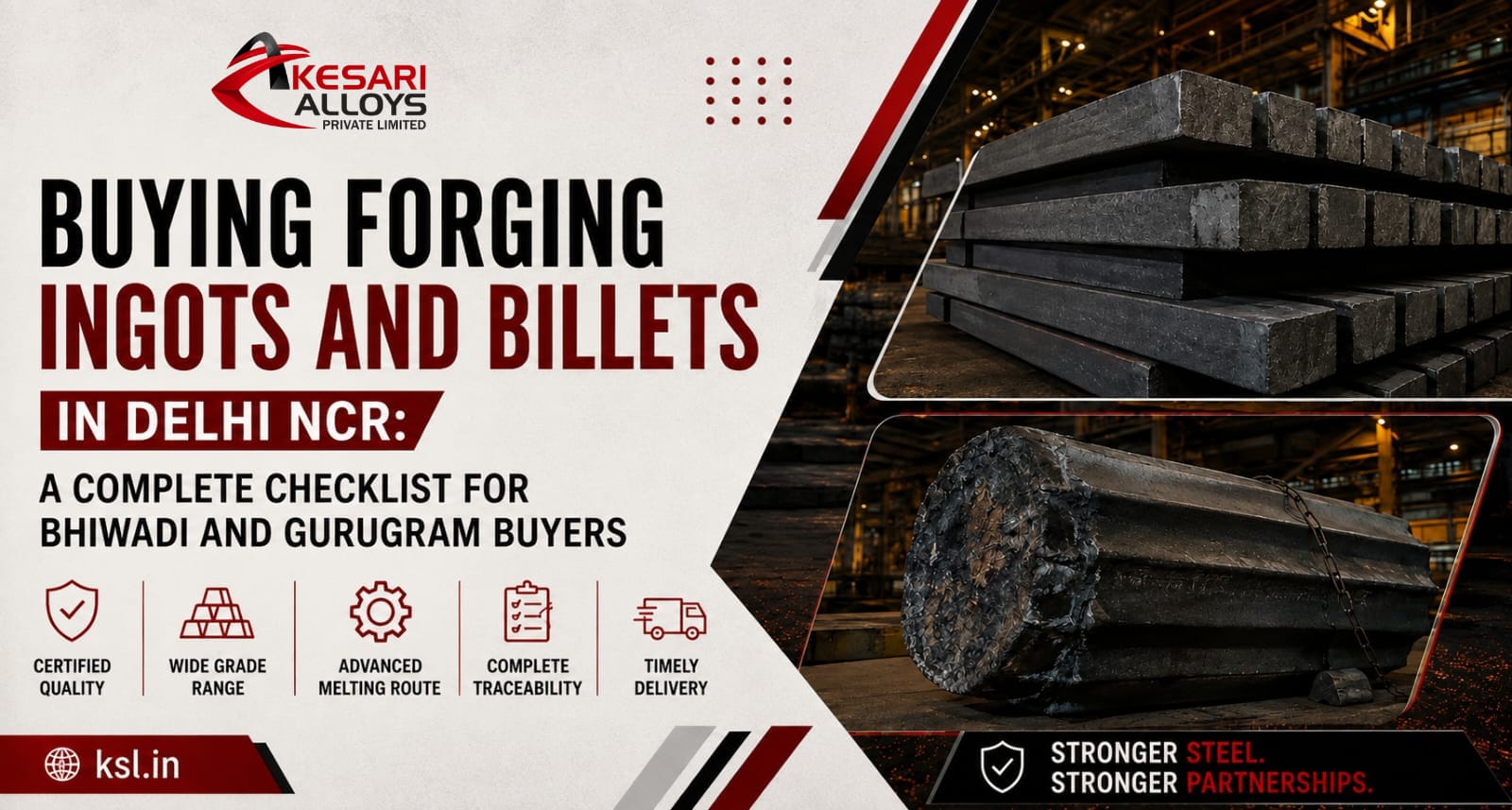
When sourcing forging ingots, billets or blooms in Delhi NCR, check ten things before you compare price: certifications, grade range, size range, melting route, heat number traceability, in-house testing, heat treatment capability, existing vendor approvals, lead time and freight cost. Proximity to your plant matters but only after the material is right. A cheap local supplier who cannot produce a valid certificate costs far more than a slightly dearer one who can.
Why NCR is the natural sourcing region for North Indian forging
The Delhi NCR belt Gurugram, Faridabad, Bhiwadi, Manesar, Ghaziabad and the Neemrana – Bhiwadi corridor in Rajasthan is one of India’s densest concentrations of forging, automotive components and general engineering manufacturing.
For a forging house in this region, sourcing steel locally carries real and measurable advantages:
▪ Shorter transit hours rather than days, which matters a great deal on heavy consignments
▪ Lower freight cost per tonne, which on steel is a genuine line item rather than a rounding error
▪ Easier plant visits and audits you can inspect the melt shop and be back the same day
▪ Faster problem resolution when a heat needs to be checked or a document reissued
▪ Simpler emergency and top-up supply when a schedule slips
▪ Better working relationship, because face-to-face meetings are practical
Kesari Alloys operates from Bhiwadi, Rajasthan, with our office at Sector 48, Gurugram placing us inside this belt and within easy reach of forging clusters across NCR, Rajasthan, Haryana, Punjab and western Uttar Pradesh.
But being a top forging manufacturer and supplier in Delhi NCR is a tiebreaker, not a qualifier. Location should decide between two suppliers who both meet the technical bar. It should never be the reason one of them clears it.
Here is the bar.
The 10-point supplier checklist
1. Certifications the hard filter
Ask for current certificates, not logos on a website:
▪ IBR approval mandatory if any part goes into a boiler or steam pressure application
▪ ISO 9001 quality management
▪ ISO 14001 environmental management
▪ ISO 45001 occupational health and safety
▪ PED 2014/68/EU if you export into Europe
▪ AD-2000 Merkblatt frequently demanded by German and European OEMs
If your order book includes any pressure or boiler work, a supplier without IBR is simply not on the list, regardless of price. This filter takes five minutes and eliminates most of the risk.
2. Grade range can they actually make what you need?
Many suppliers quote broadly at enquiry and narrow down after the order. Confirm the specific grades in writing:
| Grade family | Typical grades to confirm |
| Plain carbon | EN8, EN8D, EN9, C45, SAE 1045, AISI 1008, A105 |
| Through hardened | EN19, EN24, SAE 4140, SAE 4340, 42CrMo4, EN18 |
| Case hardening | 20MnCr5, 16MnCr5, SAE 8620, EN353, SCM-420 |
| Ball bearing | EN31, SAE 52100 |
| Free cutting | EN1A, EN8DM, SAE 1117 |
| Spring | EN45, 55Si7, 65Si7 |
| Stainless | SS410, SS409, SS430 |
| Tool steel | H-11, H-13, D2, D3 |
| Pressure grades | LF2, LF3, LF6, ASTM A182 F1, F5, F9, F11, F22, F91 |
We manufacture across 10 grade families covering more than 100 grades of carbon, alloy and stainless steel.
3. Size range does it fit your press and your part?
| Product | Range to confirm |
| Forging ingots | M1.5 to M23.5 1,450 kg to 22,500 kg, square, fluted, round |
| Billets and blooms | 100×100, 125×125, 160×160, 200×200, 250×250 SQ mm, up to 12 m length |
| Rolled bars | Section range and surface finish |
Ask for the actual manufactured range, not “we can arrange it”. Arranged material comes from somewhere else, and the traceability chain gets longer.
4. Melting route this is where quality is decided
Ask exactly what the steel passes through, stage by stage:
▪ Electric melting furnace for the initial melt
▪ Argon purging to homogenise the bath
▪ Ladle refining furnace to desulphurise, deoxidise and trim chemistry
▪ Vacuum degassing to remove hydrogen, oxygen and nitrogen
▪ Bottom pouring into ingot moulds, or continuous casting for billets
For heavy forgings and alloy grades, vacuum degassing is the difference between a sound forging and internal flaking discovered after machining. A supplier who is vague about their route is telling you something worth hearing.
5. Heat number traceability
Every piece should carry a grade, size and heat number marking, and the mill test certificate should trace directly back to that heat without a break.
This becomes non-negotiable the moment your customer is in automotive, defence, power or pressure equipment and increasingly, it is being asked for even in general engineering.
6. In-house testing capability
Ask what equipment is physically on site:
▪ Optical emission spectrometer chemistry
▪ Simultaneous ONH gas analyser oxygen, nitrogen, hydrogen
▪ PMI mobile spectrometer positive material identification
▪ Mechanical testing tensile, impact, hardness
▪ Metallographic testing microstructure, grain size, inclusion rating
▪ Radioactive contamination testing increasingly required for export consignments
A supplier who sends every sample to an outside laboratory will be slower and, more importantly, less able to catch a problem before the material ships.
7. Heat treatment capability
If you need material supplied in a specific condition annealed, normalised, normalised and tempered, hardened and tempered, spheroidise annealed confirm they own the furnaces rather than sub-contracting.
Our facility includes electric heat treatment with car-bottom furnaces operating up to 1150 °C, taking lengths up to 6.5 metres.
8. Existing vendor approvals
Certificates prove compliance. Vendor approvals prove performance.
A supplier already registered with organisations such as BHEL, Bharat Forge, Adani Defence, Jindal Defence, CHW Forge and Sunil Forging has been through demanding incoming inspection repeatedly, across many heats, over years.
Ask any supplier you are evaluating for their approved vendor list. It is considerably harder to obtain than a certificate, and it tells you more.
9. Lead time and order flexibility
Agree before the order, not after:
▪ Standard lead time for your grade and size
▪ Minimum order quantity
▪ Whether partial dispatches are possible
▪ How urgent and top-up requirements are handled
▪ Whether campaign melting affects availability of your particular grade
▪ What happens to your schedule if a heat fails re-test
10. Freight, delivery and total landed cost
Compare delivered cost, never ex-works price:
▪ Distance and transit time to your plant
▪ Freight cost per tonne
▪ Loading and unloading arrangement, and who bears it
▪ Whether material can be sawn cold on arrival
▪ Surface condition on arrival spot ground or fully ground
▪ Packing and protection for the monsoon months
A quick red-flag list
Slow down, or walk away, if a supplier:
▪ Cannot produce a sample mill test certificate on request
▪ Will not name their melting route stage by stage
▪ Does not mark heat numbers on the material
▪ Quotes only ex-works and avoids discussing delivered cost
▪ Is vague about which grades are actually produced in-house versus traded
▪ Has no in-house testing at all
▪ Cannot name a single approved customer
▪ Discourages a plant visit
Any one of these on its own may have an explanation. Two or more together rarely do.
Why NCR buyers work with Kesari Alloys
| What you get | Detail |
| Location | Bhiwadi plant, Gurugram office — inside the NCR belt |
| Certifications | IBR approved, ISO 9001 / 14001 / 45001, PED 2014/68/EU, AD-2000 Merkblatt |
| Products | Forging ingots M1.5 to M23.5, billets and blooms 100 to 250 SQ mm, rolled bars, square bars, flat bars |
| Grade coverage | 10 grade families, over 100 grades of carbon, alloy and stainless steel |
| Melting route | EMF → argon purging → LRF → vacuum degassing → bottom pouring / continuous casting |
| Heat treatment | Electric car-bottom furnaces to 1150 °C, lengths to 6.5 m |
| Testing | In-house chemical, mechanical and metallographic testing |
| Traceability | Grade, size and heat number marked on every piece |
| Track record | Registered vendor with leading forging, power and defence organisations; over three decades of group experience |
Before you place the first order do this
Visit the plant. Not the office. The melt shop and the testing lab.
Twenty minutes in a melt shop tells you more than twenty pages of documentation. Look at how the charge is stored, whether the scrap is under cover, how the ladle is handled, whether the lab is actually being used or is a display. Ask to see a certificate being generated for a heat that ran that week.
Then place a trial order on a non-critical part, and check the material against every point on the checklist above when it arrives. If it clears, you have a supplier. If it does not, you have learned it on a part that did not matter.
Frequently asked questions
Where is your plant located?
Our manufacturing facility is in Bhiwadi, Rajasthan, with our office at 152, JMD Megapolis, Sector 48, Gurugram, Haryana.
Do you supply outside NCR?
Yes. We supply across India and export internationally. Our location simply makes us particularly convenient for the NCR, Rajasthan, Haryana, Punjab and western Uttar Pradesh belt.
What is your minimum order quantity?
It depends on the grade and product form. Share your requirements and we will confirm.
Can we visit the plant before placing an order?
Yes, and we recommend it. Seeing the melt shop and the testing lab tells you more than any document.
Do you supply IBR material?
Yes, we are IBR approved. Share your specification and intended service and we will confirm what can be supplied under IBR.
How quickly can you deliver in NCR?
Lead time depends on grade, size and the current melting schedule. Being in Bhiwadi means transit to most NCR plants is short once material is ready.
Do you supply small quantities for trial orders?
Trial quantities can be discussed. Tell us the grade, section and quantity you have in mind.
Can you supply material in a specific heat treatment condition?
Yes. We have in-house electric heat treatment with car-bottom furnaces. State the condition required at the enquiry stage.
Do you handle export documentation?
Yes. We export internationally and hold PED and AD-2000 approvals for European supply.
What grades do you most commonly supply to NCR forging shops?
EN8, EN8D, EN9, EN19, EN24, 20MnCr5, SAE 8620, SAE 4140 and EN31 are among the most frequently ordered in this belt, but the full range is available.
The short version
Run the checklist first and compare prices second. In a region as well supplied as NCR, there is no reason to accept a supplier who cannot answer ten straightforward questions about their own material.
Start with a plant visit, not a price list
If you are sourcing forging ingots, billets or blooms in Delhi NCR, come and see the melt shop. Bring your specification, and we will walk you through exactly how your material would be made, tested and certified.
Kesari Alloys Private Limited
152, JMD Megapolis, Sector 48, Gurugram, 122001, Ha ryana | Plant: Bhiwadi, Rajasthan
IBR Approved | ISO 9001, 14001, 45001 | PED 2014/68/EU | AD-2000 Merkblatt