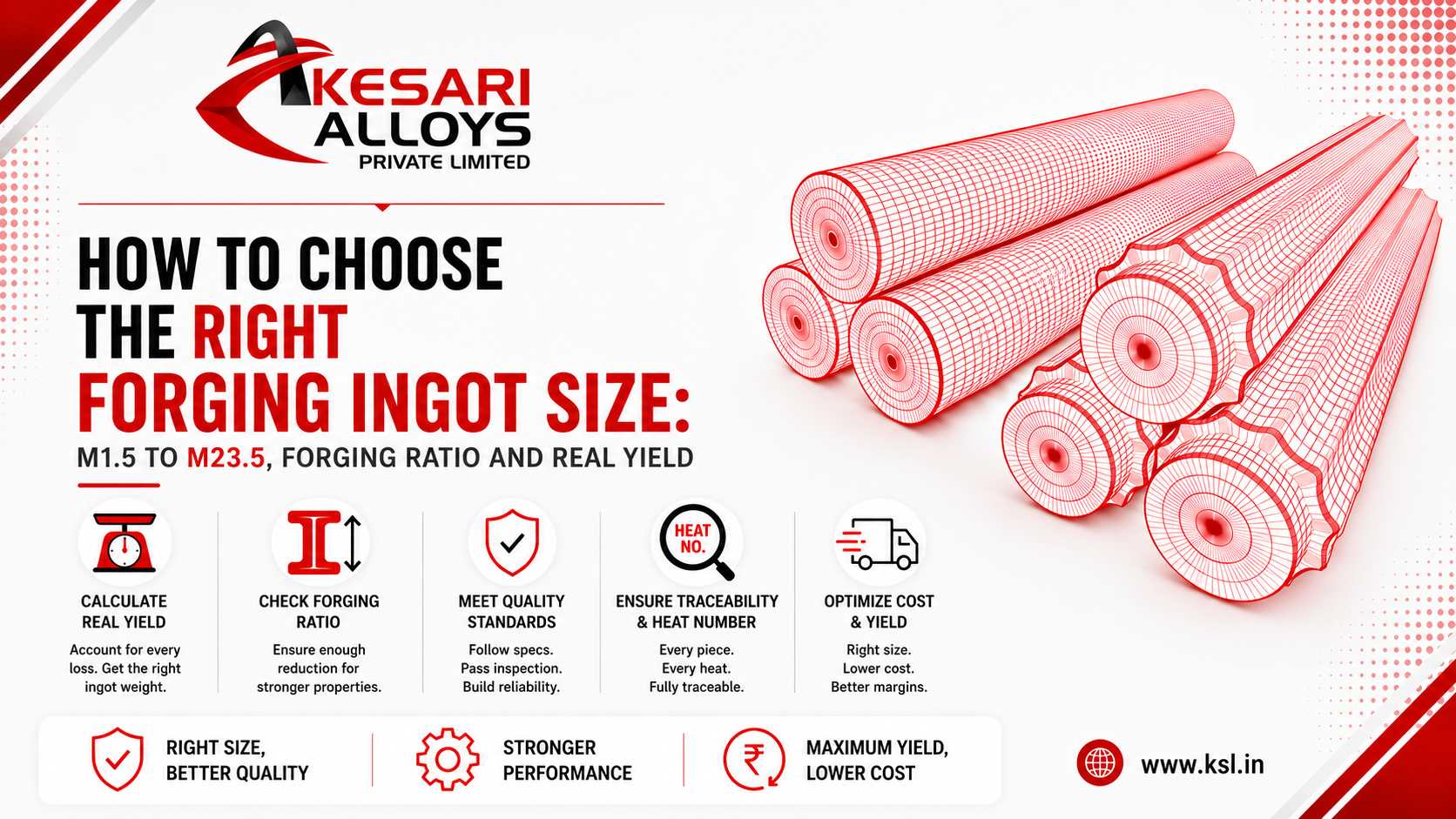
Choosing the right forging ingot size is not simply a matter of matching the ingot weight to the finished component. The size and profile of the starting forging ingot directly influence material yield, forging reduction, internal soundness, machining cost and the final inspection outcome.
An ingot that is too small may not provide the required forging ratio, while an oversized ingot can increase material waste, heating time, machining losses and overall manufacturing cost.
So, how do you determine the right ingot size before placing an order?
The answer comes down to two checks: how much steel you need, and how much the steel needs to be worked. This guide explains both, starting from the finished component and working backwards to the appropriate ingot size.
Why Choosing the Right Forging Ingot Size Matters
Forging Ingot selection is one of the few decisions in forging that affects cost, metallurgy and inspection outcome at the same time. Most decisions affect one. This one affects all three.
Choose too small, and the forging ratio drops. The as-cast structure is not fully broken down, centreline segregation and residual porosity survive into the finished part, grain flow is poor, and the component may fail ultrasonic testing or the customer’s macro etch requirement. You find out at inspection, which is the worst possible time.
Choose too large, and everything technically passes but you have bought steel you will remove in machining, paid extra furnace time to heat it, occupied press capacity longer than necessary, and given away margin on every single piece for the life of the order.
Neither failure is dramatic. Both are expensive.
As forging ingots manufacturers in India, Kesari Alloys produces forging ingots from M1.5 to M23.5, covering 1,450 kg to 23,500 kg, in square, fluted and round profiles with over-imposed and semi-inserted hot top designs. Having that range is only useful if the right size gets selected so here is the method we walk customers through.
Step 1 : Calculate the Right Forging Ingot Size
Start with the number you are certain about: the finished machined weight of the component. Then add every loss between the ingot and that finished part.
| Item to add | What it accounts for |
| Finished machined weight | Your fixed starting number |
| Machining allowance | Stock removal to reach final dimensions and surface finish |
| Forging and scale loss | Material lost as scale during heating and as flash during forging |
| Test prolongation | Sacrificial test blocks or prolongations, where the specification requires them |
| Hot top discard | Cut from the top of the ingot, where shrinkage porosity collects |
| Bottom discard | Cut from the bottom of the ingot |
Add all of them. That total is your required ingot weight.
One important caution. Every one of these allowances varies with your press capacity, your die design, your heating practice, your furnace atmosphere and your customer’s specification. Do not use somebody else’s percentages, including ours. Use your own shop’s historic figures, applied consistently.
The value of this method is not in the numbers. It is in the discipline of adding all the losses, every time, instead of the two or three that come to mind.
Step 2 : Check the forging ratio separately
Weight tells you whether there is enough steel. The forging ratio tells you whether the steel will be worked enough. These are two different questions and they can give two different answers.
Forging ratio = starting cross-sectional area ÷ final forged cross-sectional area
Typical practice across the industry:
| Application | Minimum forging ratio commonly specified |
| General engineering parts | 3:1 |
| Critical rotating components shafts, crankshafts, rotors | 5:1 or higher |
| Pressure-containing parts | As per the governing code, commonly 3:1 to 4:1 |
| Ring rolling from ingot | Upset ratio and rolling reduction considered together |
| Parts requiring grain flow examination | Per drawing, often higher |
Always defer to the customer specification or the governing code where one exists. Where none exists, 3:1 is a sensible floor for anything structural.
If your chosen ingot does not deliver the required ratio, you have two routes:
1. Step up to a larger ingot simpler, more predictable
2. Add an upsetting and drawing sequence to increase effective reduction cheaper on material, more expensive on press time and heating
Most shops take the first route unless material cost is dominant.
Step 3 : A worked example, step by step
Suppose you are forging a shaft with a finished machined weight of 800 kg.
| Step | Calculation | Running total |
| 1. Finished weight | — | 800 kg |
| 2. Machining allowance say 25% for this part | 800 × 1.25 | 1,000 kg |
| 3. Forging and scale loss say 8% | 1,000 × 1.08 | 1,080 kg |
| 4. Test prolongation say 40 kg | 1,080 + 40 | 1,120 kg |
| 5. Hot top and bottom discard say 25% combined | 1,120 ÷ 0.75 | approx. 1,490 kg |
So the required ingot is roughly 1,500 kg on a weight basis.
Now the second check. Does the cross-section of that ingot, against the final forged shaft diameter, give you 5:1? If it does, you are done. If it does not, you step up a size not because the weight demands it, but because the metallurgy and the specification do.
The percentages above are illustrative. They are here to show the method, not to be copied. Substitute your own shop’s figures.
Step 4 : Choose the profile
Ingot shape is not cosmetic. It changes how the steel solidifies and how easily it forges.
| Profile | When to use it |
| Square | General purpose. Good for drawing down to shafts, bars and rectangular blocks. Easy to manipulate and turn through 90° during cogging. |
| Fluted | Larger surface area means faster and more uniform heat extraction. Helps reduce surface cracking and gives a finer near-surface structure. Useful for crack-sensitive alloy grades. |
| Round | Suited to ring rolling and upsetting, and to parts whose finished geometry is round saving forging passes. Avoids the corner cooling issue of square sections entirely. |
Hot top design also matters, and involves a genuine trade-off:
▪ Over-imposed hot top mounted above the mould, giving a large feeding reservoir and strong feeding. Better internal soundness, more discard.
▪ Semi-inserted hot top partly set into the mould, giving a different balance between feeding capacity and yield.
A larger hot top feeds better and gives a sounder ingot, but increases discard and reduces yield. Which side of that trade-off is right depends on the grade, the section and how critical internal soundness is for the end part.
Step 5 : Confirm the commercial and quality details before ordering
Before the purchase order goes out, agree:
▪ Grade and specification, including heat treatment condition at supply
▪ Surface condition spot ground or fully ground
▪ Marking every Kesari Alloys ingot is marked with grade, size and heat number
▪ Sawing our ingots are suitable for sawing in cold condition
▪ Testing chemistry, mechanical, and where required gas content and metallography
▪ Certification IBR, PED or AD-2000 where the application demands it
▪ Delivery schedule and whether partial dispatches are acceptable
Five Common Forging Ingot Size Mistakes to Avoid
1. Choosing the wrong forging ingot size and ignoring cross-section. Two ingots of the same weight can have very different sections, and the section is what determines the forging ratio. This is the most common error, and the most expensive when it surfaces at inspection.
2. Using the supplier’s yield figures instead of your own. Yield depends on your press, your dies, your heating practice and your operators. Track it for six months and use your own numbers thereafter.
3. Forgetting the test prolongation. A small number that becomes a large problem when the customer asks for a sacrificial test block that was never allowed for.
4. Assuming a bigger ingot is always safer. It costs more, heats slower, occupies press capacity longer, and on some presses simply cannot be handled efficiently. The safety margin is not free.
5. Never re-running the calculation. Shops often size ingots the way they always have, even after changing presses, dies or heating practice. It is worth re-checking once a year against actual yield data.
When a billet or bloom is the better answer
Not every part needs an ingot. If your finished component is small to medium and your process is closed die forging or re-rolling, a continuous cast billet or bloom will usually give you higher yield and better dimensional consistency at a lower delivered cost per finished kilogram.
Our billets and blooms cover 100×100 to 250×250 SQ mm, in weights from 75 kg to 480 kg and lengths up to 12 metres. Beyond that section, an ingot is the only practical route.
If you are unsure which side of that line your part falls on, that comparison deserves its own calculation and we cover it in detail in our guide to ingots versus continuous cast billets.
Frequently asked questions
What is the largest forging ingot you supply?
Our range extends to 23.5 MT, approximately 23,500 kg.
What is the smallest forging ingot you supply?
M1.5, approximately 1,450 kg. Below that, a continuous cast billet or bloom is usually the better and more economical route.
How do I choose the right forging ingot size?
The right forging ingot size depends on the required ingot weight, forging ratio, final forged dimensions and the material losses involved in the process. Start with the finished component and work backwards, then confirm that the selected ingot provides the required forging ratio.
Should I choose a forging ingot size or a billet for my part?
As a rule of thumb, ingots for larger finished parts and high forging ratios, billets and blooms for smaller parts and re-rolling. The full comparison is covered in our dedicated guide.
Can you recommend an ingot size if I send my drawing?
Yes. Send the component drawing, finished weight, grade and any specified forging ratio, and our team will recommend a size and profile.
Do fluted ingots cost more than square?
Mould design is selected on technical grounds rather than as a price option. Discuss your grade and process with us and we will advise what is appropriate.
What is a typical hot top discard percentage?
It varies with ingot size, mold design and grade. Use your own historic data rather than a general figure, and ask your supplier what mold design is being used.
Can I reduce discard by using a smaller hot top?
Yes, and you will reduce internal soundness at the same time. It is a trade-off, not a free saving. Discuss it against the criticality of the end part.
Does ingot size affect delivery time?
It can, depending on mold availability and melt scheduling. Confirm at the inquiry stage.
How does ingot size affect heating cost?
Larger sections take longer to reach temperature and hold longer, which increases furnace time and fuel or power cost per part. This is a real cost of oversizing that rarely appears in the material comparison.
The short version
Two checks, always. Weight is there enough steel after every loss? Ratio will the steel be worked enough? Pass both, and you have the right forging ingot. Skip the second, and you will find out at ultrasonic testing.
Send us the part, we will size the ingot
Share the drawing, finished weight, grade and specification. We will come back with a recommended forging ingot size, profile and mould design and tell you plainly if a billet would serve you better.
Kesari Alloys Private Limited | IBR Approved | ISO 9001, 14001, 45001 | PED | AD-2000 Merkblatt
Plant: Bhiwadi, Rajasthan | Office: Sector 48, Gurugram, Haryana