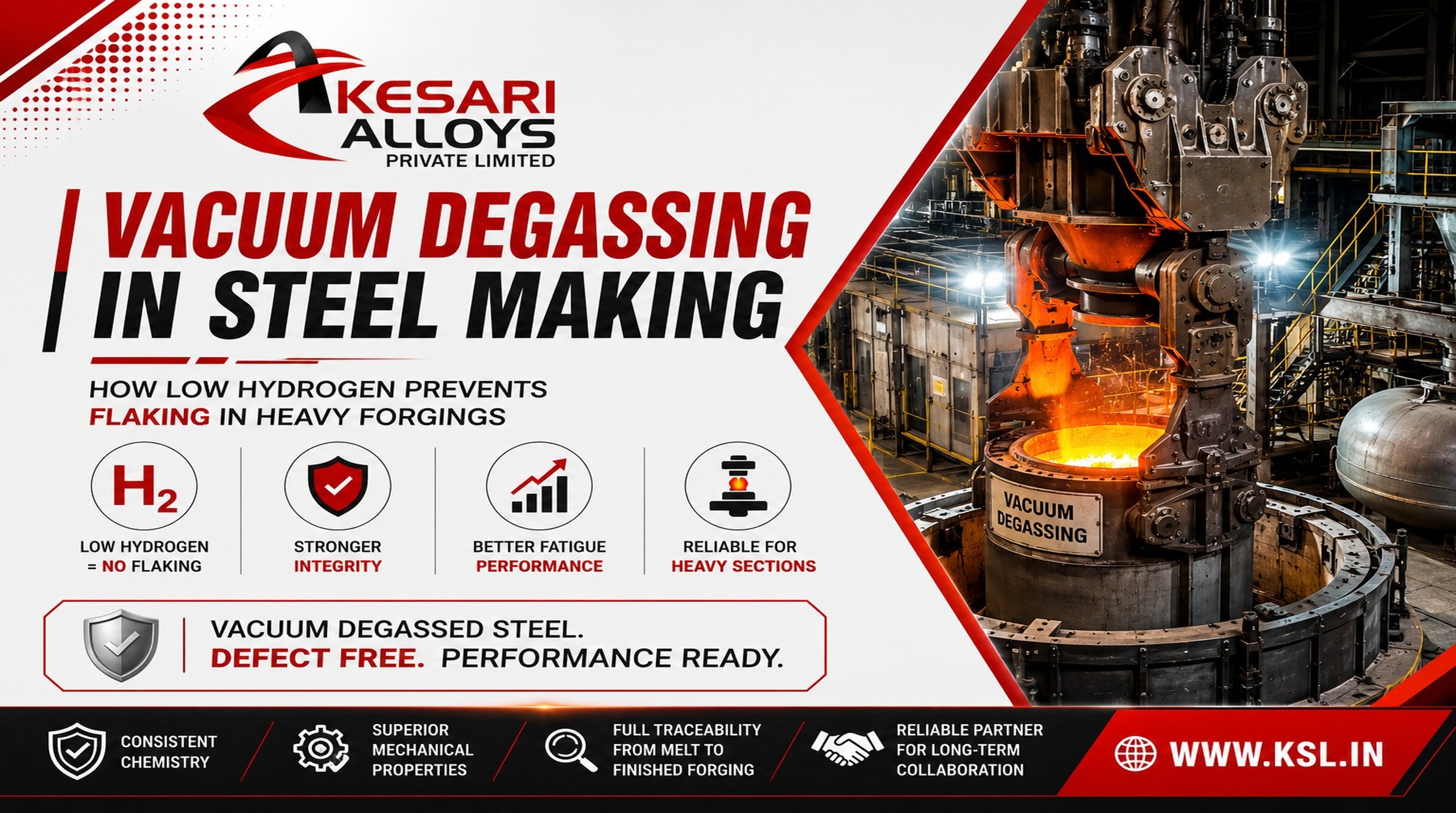
Vacuum degassing in steel making is a critical secondary metallurgy process used to reduce dissolved gases in liquid steel, especially hydrogen, oxygen and nitrogen, before casting. Vacuum degassing (VD) exposes liquid steel to a vacuum so dissolved gases, mainly hydrogen, along with oxygen and nitrogen escape before the steel is cast. In heavy forgings, hydrogen trapped in the steel collects at internal discontinuities during cooling, builds pressure, and creates internal cracks known as flakes or hairline cracks. These cannot be repaired and are usually discovered only after machining or at ultrasonic testing. Buying from a vacuum degassed forging ingots manufacturer is the practical way to prevent them.
The defect nobody sees coming
Hydrogen flaking is a particularly cruel defect, and the reason is the timing.
The forging comes out of the press looking fine. It passes visual inspection. It gets rough machined. It may even be heat treated and part-finished. Then at ultrasonic testing or worse, at final machining internal cracks appear. Fine, bright, roughly circular internal fissures scattered through the section, oriented with no obvious pattern.
By that point you have lost the material cost, the furnace time, the forging time, the machining time, and the delivery commitment. And there is no repair. Flakes are internal cracks in the body of the steel. The part is scrap.
This is why heavy forging buyers ask about hydrogen before they ask about price, and why Kesari Alloys runs a vacuum degassing system as a standard part of our melting route rather than an optional extra to be quoted separately.
Where the hydrogen comes from in the first place
Hydrogen enters liquid steel from sources that are entirely ordinary in a working melt shop:
▪ Moisture in the charge rusty, damp or oily scrap
▪ Damp refractories and ladle linings, particularly after a reline
▪ Damp or unbaked fluxes, ferroalloys and alloy additions
▪ Humidity in the atmosphere, which in Indian conditions rises sharply during the monsoon
▪ Moisture in mould coatings and mould preparation
▪ Wet tools introduced into the bath
None of this is exotic. That is precisely the problem. Hydrogen pickup is easy and constant, and preventing it requires deliberate, engineered removal rather than good intentions.
Why hydrogen causes cracks the mechanism
Hydrogen dissolves readily in liquid steel. As the steel solidifies and then cools, its solubility drops sharply. The hydrogen has to go somewhere. In a thin section, it can diffuse to the surface and escape. The distance is short and there is time.
In a heavy section, it cannot. The diffusion distance from the centre to the surface is long, and the cooling is comparatively quick. So the hydrogen collects at internal voids, inclusions and grain boundaries. There, atomic hydrogen recombines into molecular hydrogen, which cannot diffuse at all and generates internal pressure.
Combine that pressure with the residual stress from phase transformation during cooling, and the steel tears internally.
Three factors decide whether it happens on your part:
| Factor | Effect |
| Hydrogen level in the steel | The primary driver. Higher hydrogen, higher risk. |
| Section thickness | Heavier sections are dramatically more vulnerable. |
| Cooling rate after forging | Faster cooling gives hydrogen less time to diffuse out. |
You can partly manage the second and third with slow cooling in ash or sand and with hydrogen-relief annealing. But those add days to the cycle, occupy furnace capacity, and cost real money on every part.
Controlling the first is cheaper, faster and far more reliable.
What Vacuum Degassing in Steel Making Actually Does
Vacuum degassing in steel making is carried out after melting and refining, when the ladle is placed under a vacuum. Reducing the pressure above the melt lowers the partial pressure of dissolved gases, so they come out of solution and are drawn away by the vacuum system.
Argon stirring from the bottom of the ladle assists the process considerably. Rising argon bubbles create fresh liquid surfaces continuously and carry gas out of the bath, rather than relying on gas diffusing to a static surface.
The process delivers several benefits simultaneously:
| Benefit | What it means in practice |
| Hydrogen removal | The primary defence against flaking in heavy sections |
| Oxygen removal | Fewer oxide inclusions better fatigue life and cleanliness |
| Nitrogen reduction | Improved toughness, less strain ageing |
| Inclusion flotation | Non-metallics rise into the slag instead of remaining in the steel |
| Chemistry trimming | Final composition adjustment under controlled conditions |
| Temperature homogenisation | More consistent and predictable casting |
Note that hydrogen removal is the headline, but for bearing steels and fatigue-loaded components, the oxygen reduction is often the more valuable outcome.
The complete route of vacuum degassing in steel making
Vacuum degassing in steel making does not work in isolation. It works because of what happens before and after it.
Electric Melting Furnace → Argon Purging → Ladle Refining Furnace → Vacuum Degassing → Bottom Pouring / Continuous Casting
▪ The electric melting furnace melts the charge and takes the first chemistry
▪ Argon purging homogenises the bath so the sample represents the whole heat
▪ The ladle refining furnace desulphurises, deoxidises and trims composition under a synthetic slag, with temperature control
▪ Vacuum degassing removes hydrogen, oxygen and nitrogen and floats out inclusions
▪ Bottom pouring fills the ingot mould quietly from below, avoiding the splashing and reoxidation that top pouring causes undoing part of the cleanliness you just paid for
We verify the result with a simultaneous ONH gas analyser, which reports oxygen, nitrogen and hydrogen directly, alongside an optical emission spectrometer for chemistry and a PMI mobile spectrometer for positive material identification.
Which grades and applications genuinely need vacuum degassing
VD is not required on every order, and it is fair to say so.
It matters most for:
▪ Heavy forgings anything with a large ruling section, where hydrogen cannot diffuse out
▪ Alloy steels such as EN19, EN24, SAE 4140, SAE 4340, 42CrMo4 and 34CrNiMo6, which are inherently more flake-sensitive than plain carbon steels
▪ Bearing steels such as EN31 / SAE 52100, where oxygen content directly controls rolling contact fatigue life
▪ Pressure parts — ASTM A182 F11, F22, F91 and A350 LF2, LF3 in valve, boiler and refinery service
▪ Power, defence and aerospace-adjacent components inspected by ultrasonic testing
▪ Rotating parts shafts, rotors, crankshafts where a subsurface crack is a safety issue rather than a quality issue
It matters less for: light section commercial carbon steel with no critical inspection requirement.
Ask your supplier which category your order falls into rather than assuming either way.
What to check on the mill test certificate
A six-point check that takes two minutes and saves weeks.
1. Is hydrogen reported at all? Many certificates simply do not show it. That silence is itself information.
2. Is oxygen reported? Critical for bearing and fatigue-loaded applications.
3. Is the melting route stated? Look for EMF, LRF and VD named explicitly, not implied.
4. Is there an inclusion rating? To ASTM E45 or DIN 50602, where the specification calls for it.
5. Is there a heat number, and does it match the material? Every Kesari Alloys piece is marked with grade, size and heat number.
6. Was any additional hydrogen-relief treatment applied? For very heavy sections this may be specified in addition to VD, and should be recorded.
What flaking looks like when you find it
For anyone who has not seen it: flakes appear as fine, bright, roughly circular internal cracks, usually in the mid-radius or centre region of a heavy section. On a fracture face they show as flat, shiny spots against the duller surrounding fracture which is why they are sometimes called “fisheyes” or “snowflakes”.
They show up as clustered indications on ultrasonic testing, typically well inside the section rather than near the surface.
If you are seeing this pattern repeatedly on heavy alloy steel forgings, the conversation to have is with your steel supplier about hydrogen and vacuum degassing in steel making, not with your forging shop about press practice.
Frequently asked questions
What is a good hydrogen level for heavy forging steel?
Industry practice for flake-sensitive heavy sections is to keep hydrogen at low single-digit parts per million. The exact figure should be agreed against your specification and section size rather than assumed.
Can flaking be repaired?
No. Flakes are internal cracks in the body of the steel. The part is scrap.
Does slow cooling remove the need for vacuum degassing?
It reduces risk but does not eliminate it, and it adds significant cycle time and furnace occupancy. For flake-sensitive grades in heavy sections, VD is the more reliable and usually the cheaper control.
Is vacuum degassing the same as vacuum arc remelting?
No. VD treats liquid steel in the ladle before casting. VAR is a separate remelting process used for aerospace and ultra-critical applications, and costs considerably more.
Does vacuum degassing change the mechanical properties?
Not directly. Properties come from chemistry and heat treatment. What VD changes is internal soundness and cleanliness which is what decides whether the part survives inspection and service.
Do all your heats go through vacuum degassing?
Our route includes a vacuum degassing system, and we apply it according to grade, section and customer specification. Tell us your application and we will confirm what is applied to your order.
How is hydrogen measured?
Using a gas analyser on a sample taken from the melt or the solid product. We use a simultaneous ONH gas analyser, which reports oxygen, nitrogen and hydrogen together.
Does vacuum degassing help with sulphur?
Sulphur removal is principally the job of the ladle refining furnace under a synthetic slag. VD contributes to overall cleanliness and inclusion removal, but desulphurisation happens upstream.
Is hydrogen a problem in continuous cast billets too?
Far less so, because the section is smaller and hydrogen can diffuse out more readily. The risk rises with section thickness, which is why it is primarily a heavy ingot and heavy forging concern.
Why does flaking sometimes appear weeks after forging?
Hydrogen diffusion and crack propagation both take time. This delayed appearance is characteristic of the defect and is one reason it is so disruptive.
The short version
Ask what is in the steel, not just what is on the invoice. If you are forging heavy sections in alloy steel and your supplier cannot tell you the hydrogen figure, you are carrying a risk you have not priced.
Ask us for the numbers
We are happy to share our reported hydrogen and oxygen levels, and to explain exactly which stages your order will pass through. Share your grade, section and application.
Kesari Alloys Private Limited | IBR Approved | ISO 9001, 14001, 45001 | PED | AD-2000 Merkblatt
Plant: Bhiwadi, Rajasthan | Office: Sector 48, Gurugram, Haryana