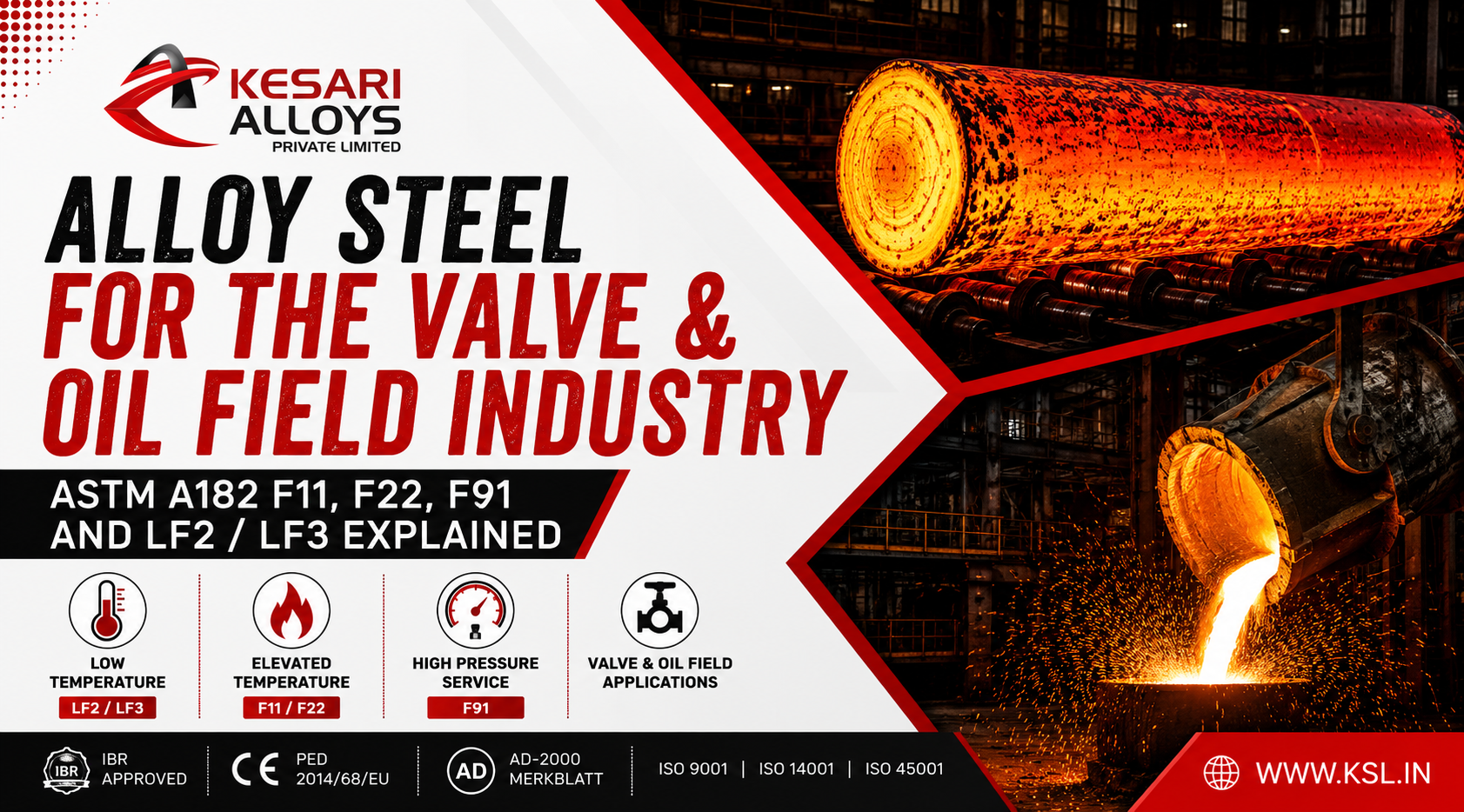
For valve and oil field forgings, grade selection is driven almost entirely by service temperature and environment. Use A350 LF2 / LF3 for low-temperature service, A182 F11 and F22 for elevated-temperature and hydrogen service in refineries, and A182 F91 for high-temperature, high-pressure steam and power applications. Where the medium contains hydrogen sulphide, the material must additionally comply with NACE MR0175 / ISO 15156. Chemistry alone never settles the choice the heat treatment condition and the impact test requirement matter just as much.
Why this sector cannot shop on price alone
A valve body is a pressure-containing part. When it fails, the outcome is not a warranty claim. It is a shutdown, a leak, a fire risk, or an environmental incident.
That is why valve and oil field buyers specify material by ASTM designation rather than by generic “alloy steel”, and why the mill test certificate carries as much weight as the quotation. It is also why suppliers into this sector are asked for approvals IBR, PED 2014/68/EU and AD-2000 Merkblatt before they are asked for a rate.
Kesari Alloys supplies forging ingots, continuous cast billets and blooms and rolled bars into the valve, oil field, power and pressure vessel sectors, and holds all three of those approvals alongside ISO 9001, ISO 14001 and ISO 45001.
This guide covers the grade families you will actually encounter on drawings, what each one is for, and the five things that go wrong when a specification is read too quickly.
The low temperature grades A350 LF2 and LF3
A350 LF2
A350 LF2 is a carbon-manganese steel supplied normalised, or normalised and tempered, with Charpy V-notch impact testing at −46 °C. It is the default grade for flanges, valve bodies and fittings in low-temperature piping across oil and gas.
The defining feature of LF2 is not tensile strength. Plenty of carbon steels reach the same tensile numbers. What LF2 buys you is notch toughness at low temperature, verified by test the assurance that the material will absorb energy rather than fracture in a brittle manner when it is cold.
That distinction matters because it changes what the mill has to do. Impact testing means additional sampling, additional test pieces, and a heat treatment route chosen to deliver toughness rather than just hardness.
A350 LF3
A350 LF3 is a 3.5% nickel steel with impact testing down to approximately −101 °C. It is used where LF2 simply cannot deliver the required toughness cryogenic service, LNG-adjacent applications and deep-cold process lines.
Nickel is the reason. It lowers the ductile-to-brittle transition temperature, keeping the steel tough far below where a plain carbon-manganese grade would fail.
LF6
A350 LF6 is a higher-strength low-temperature grade, used where LF2’s strength level is insufficient but full LF3 nickel content is not needed.
The elevated temperature grades A182 F11, F22 and F91
These are the chromium-molybdenum family, used extensively in refineries, petrochemical plants and power stations.
A182 F11 – 1.25Cr-0.5Mo
Nominally 1.25% chromium, 0.5% molybdenum. The entry point into Cr-Mo territory, used for elevated temperature and moderate hydrogen service.
A182 F22 – 2.25Cr-1Mo
Nominally 2.25% chromium, 1% molybdenum. The workhorse of hydroprocessing. The higher chromium content gives better resistance to high-temperature hydrogen attack and better creep strength than F11, which is why ASTM A182 F22 dominates heavy wall valve bodies and reactor-adjacent components.
Why chromium and molybdenum, specifically
Chromium forms stable carbides and improves resistance to hydrogen attack the mechanism where atomic hydrogen reacts with carbides inside the steel at temperature, forming methane in the microstructure and causing internal fissuring.
Molybdenum provides creep resistance, the ability to hold strength under sustained load at elevated temperature over years rather than minutes.
Together they make a steel that stays serviceable at temperatures where a plain carbon steel would slowly deform and eventually fail.
A182 F91 – modified 9Cr-1Mo-V
F91 is a modified 9% chromium, 1% molybdenum steel with controlled additions of vanadium, niobium and nitrogen. It delivers markedly higher creep strength than F22 at the same temperature, which allows designers to use thinner sections in supercritical and ultra-supercritical power plant piping and valves.
F91 is also the least forgiving grade in the family. The normalising and tempering windows are narrow, and the properties depend entirely on the cycle being followed precisely. Deviation does not produce slightly weaker material it produces material that will not meet its creep design basis, and that will not be obvious from a room-temperature tensile test.
A182 F5 and F9
F5 (5Cr-0.5Mo) and F9 (9Cr-1Mo) sit between F22 and F91 in capability and remain specified on older designs and refinery-specific applications.
A182 F1
F1 is a carbon-molybdenum grade for moderate elevated temperatures where full Cr-Mo capability is unnecessary.
Grade selection at a glance
| Grade | Nominal chemistry | Typical service condition | Common applications |
| A350 LF2 | C-Mn | Down to −46 °C | Flanges, valve bodies, fittings in low-temp piping |
| A350 LF3 | 3.5% Ni | Down to approx. −101 °C | Cryogenic valves and flanges |
| A350 LF6 | C-Mn-Ni, higher strength | Low temperature | Higher-strength low-temp fittings |
| A182 F1 | C-0.5Mo | Moderate elevated temperature | General elevated-temperature fittings |
| A182 F5 | 5Cr-0.5Mo | Elevated temperature, refinery | Refinery valves and fittings |
| A182 F9 | 9Cr-1Mo | Elevated temperature, refinery | High-temperature refinery service |
| A182 F11 | 1.25Cr-0.5Mo | Elevated temp, hydrogen service | Hydroprocessing valves, flanges |
| A182 F22 | 2.25Cr-1Mo | Higher temp, hydrogen service | Heavy wall valve bodies, reactor internals |
| A182 F91 | Mod. 9Cr-1Mo-V-Nb-N | Supercritical steam | Power plant valves, high-pressure piping |
Five things the drawing may not say but the inspector will ask
1. Sour service compliance
If the medium contains hydrogen sulphide, NACE MR0175 / ISO 15156 applies. This places limits on hardness and, in practice, constrains chemistry and heat treatment.
Confirm this at the enquiry stage. Sour service compliance cannot be retro-fitted to material that has already been made.
2. Impact testing conditions
For low-temperature grades, specify the test temperature and the required energy values. “LF2” on its own is an incomplete specification, and different projects call for different acceptance criteria.
3. Heat treatment condition
Normalised, normalised and tempered, quenched and tempered, or annealed the same chemistry gives materially different properties in each condition. State what you need rather than assuming a default.
4. Hydrogen content
For heavy sections in Cr-Mo grades, dissolved hydrogen is a genuine risk, and flaking discovered after machining is expensive. Vacuum degassing is the control. Ask what hydrogen level the mill reports on the certificate.
5. Traceability
Every piece should carry the heat number, and the certificate must trace back to that heat without a break in the chain. On pressure-containing parts this is not administrative housekeeping it is what the inspector will check first.
How Kesari Alloys supplies the valve and oil field sector
| Product | Range and use |
| Forging ingots | M1.5 to M22 (1,450 kg to 22,500 kg), square, fluted and round suited to heavy wall valve bodies and large flanges |
| Continuous cast billets and blooms | 100×100 to 250×250 SQ mm, up to 12 m suited to smaller valve components and re-rolling |
| Rolled bars | For machined fittings and small forgings |
Supporting capability:
▪ Melting route: electric melting furnace → argon purging → ladle refining furnace → vacuum degassing → bottom pouring / continuous casting
▪ Electric heat treatment with car-bottom furnaces up to 1150 °C, lengths to 6.5 m
▪ In-house chemistry, gas content and metallography on an optical emission spectrometer, simultaneous ONH gas analyser and PMI mobile spectrometer
▪ Grades across the F-series (F1, F5, F9, F11, F22, F91) and LF2, LF3, LF6, alongside EN and SAE grades and A105
▪ Every piece marked with grade, size and heat number
▪ Approvals: IBR, ISO 9001 / 14001 / 45001, PED 2014/68/EU, AD-2000 Merkblatt
▪ Registered vendor with organisations including BHEL, Bharat Forge, Adani Defence and Jindal Defence
What a complete enquiry looks like
To quote accurately and supply correctly, we need:
1. ASTM designation and class for example A182 F22 Class 3
2. Product form ingot, billet, bloom or bar, with the section required
3. Finished component weight and, for ingots, the forging ratio required
4. Heat treatment condition required at supply
5. Impact test requirement, with temperature and energy values
6. Any NACE MR0175 / ISO 15156 clause applicable
7. Certification required IBR, PED, AD-2000, third party inspection
8. Quantity and delivery schedule
Frequently asked questions
What is the difference between F11 and F22?
Chromium content. F11 is nominally 1.25% Cr, F22 is 2.25% Cr. F22 offers better creep strength and better resistance to high-temperature hydrogen attack, and is generally selected for higher temperature or more severe hydrogen service.
Why is F91 considered difficult to work with?
Its properties depend on a precise normalising and tempering cycle and on controlled V, Nb and N additions. Deviation from the specified heat treatment can significantly reduce creep strength without being obvious in a room-temperature tensile test.
Is LF2 the same as A105?
No. Both are carbon steel forging grades, but LF2 carries mandatory low-temperature impact testing and A105 does not. They are not interchangeable, and substituting one for the other is a common and serious error.
Do you supply NACE compliant material?
Sour service requirements must be stated at enquiry. Share the applicable NACE MR0175 / ISO 15156 clause and we will confirm what can be met.
What is the largest valve body forging you can supply material for?
Our ingot range extends to 22,500 kg, which covers the large majority of valve and oil field forging requirements. Share the finished weight and required forging ratio and we will recommend an ingot size.
Can F22 be supplied as a continuous cast billet?
Yes, within our section range of 100×100 to 250×250 SQ mm. For larger sections, an ingot is required.
What causes hydrogen attack, and how is it avoided?
Atomic hydrogen diffuses into the steel at temperature and reacts with carbides to form methane, causing internal fissuring. Resistance comes from chromium and molybdenum content which is exactly why F11, F22 and F91 exist.
Do low temperature grades need vacuum degassing?
It is beneficial for cleanliness and toughness, particularly in heavier sections. Confirm your requirement and we will advise what is applied.
What is the difference between A182 and A350?
They are different ASTM specifications. A182 covers forged or rolled alloy and stainless steel pipe flanges, fittings, valves and parts for high-temperature service. A350 covers carbon and low alloy steel forgings requiring notch toughness testing for piping components.
The short version
Temperature and environment choose the grade. The heat treatment condition and the impact test requirement decide whether the material actually meets the specification. And the traceability decides whether the inspector accepts it.
Send us the specification, not just the grade name
Share the ASTM designation, class, heat treatment condition, impact test requirement and any NACE clause. Our metallurgical team will confirm feasibility, recommend ingot or billet size, and quote with the certification you need.
Kesari Alloys Private Limited | IBR Approved | ISO 9001, 14001, 45001 | PED 2014/68/EU | AD-2000 Merkblatt
Plant: Bhiwadi, Rajasthan | Office: Sector 48, Gurugram, Haryana