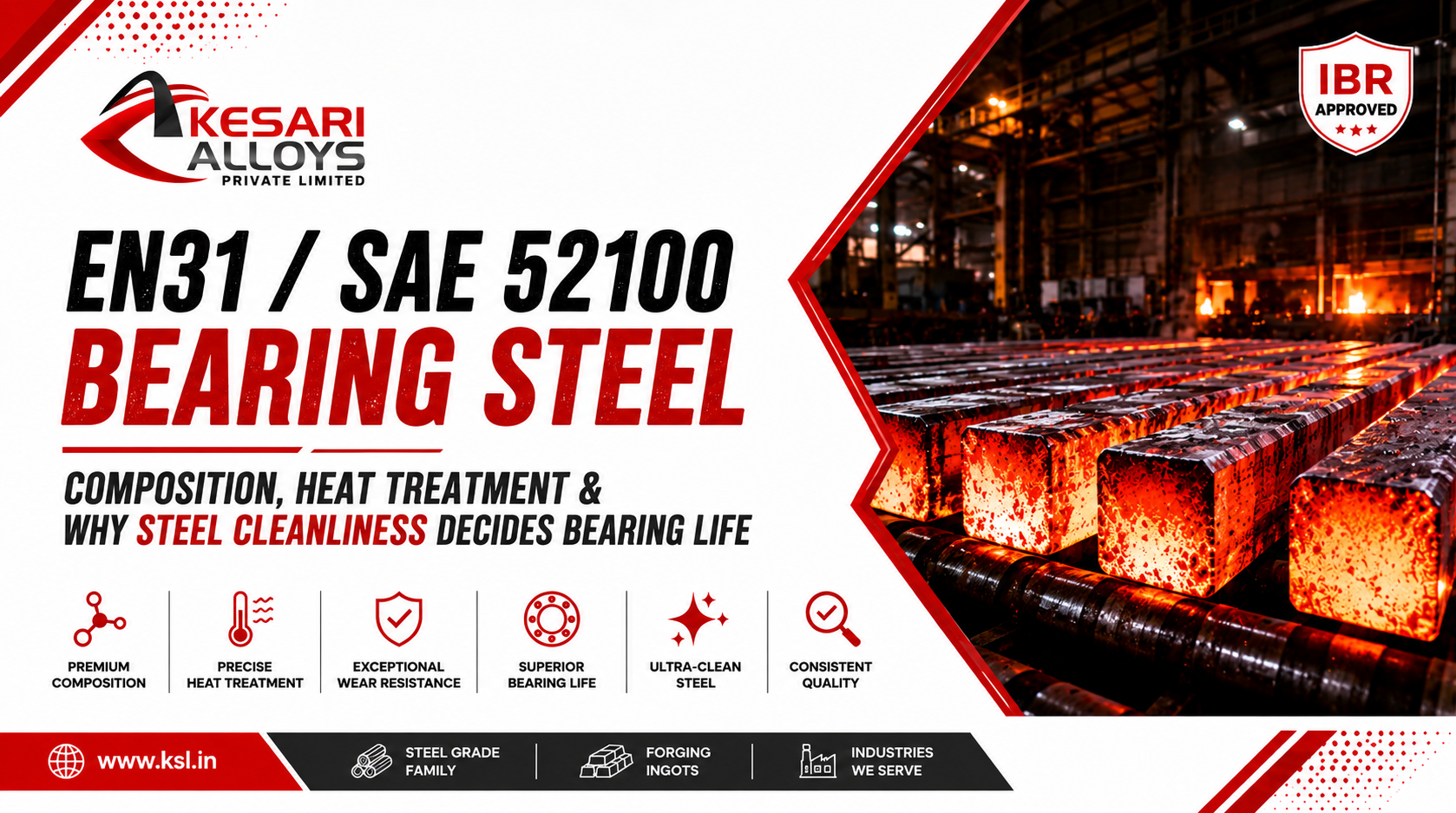
EN31 SAE 52100 bearing steel is widely used for bearing races, balls, rollers and other precision components where high hardness and fatigue resistance are required. EN31 SAE 52100 bearing steel is a high carbon, high chromium through-hardening steel used for ball and roller bearings. It is known internationally as SAE 52100, AISI 52100 or 100Cr6. It contains roughly 0.95-1.10% carbon and 1.30-1.60% chromium, hardens to 60-65 HRC, and delivers exceptional wear resistance and rolling contact fatigue life. Its real performance depends far less on chemistry which is easy to hit and far more on steel cleanliness: total oxygen content, inclusion rating and carbide distribution.
Why bearing steel is judged by a different standard
For most engineering steels the acceptance logic is simple. Chemistry inside range, mechanical properties pass, material accepted.
EN31 SAE 52100 bearing steel is not judged that way, and every buyer sourcing from an EN31 ball bearing steel ingot supplier needs to understand why.
A bearing raceway experiences rolling contact fatigue many millions of repeated compressive stress cycles concentrated at a very small contact patch. Failure does not usually begin at the surface. It begins below the surface, at a non-metallic inclusion, where stress concentrates. A crack nucleates there, propagates, and eventually a piece of the raceway spalls away.
The consequence is uncomfortable but important: two heats of EN31 SAE 52100 bearing steel with identical chemistry and identical hardness can give bearing lives that differ by several times, purely because one is cleaner than the other.
That is why bearing manufacturers audit the melt shop rather than reading only the mill test certificate. And it is why any serious discussion about SAE 52100 bearing steel has to start with cleanliness rather than composition.
Designations across international standards
| Standard | Designation |
| British (BS 970) | EN31 / 535A99 |
| American (SAE / AISI) | SAE 52100 / AISI 52100 |
| European (DIN / EN) | 100Cr6 (material number 1.3505) |
| Japanese (JIS) | SUJ2 |
| Indian (IS) | 103Cr1 |
| Chinese (GB) | GCr15 |
These are effectively the same grade with minor regional variation in permitted ranges. Always work to the specification named on the customer’s drawing rather than assuming equivalence.
EN31 / SAE 52100 chemical composition
| Element | Range (%) | Engineering function |
| Carbon (C) | 0.95 – 1.10 | Forms hard carbides; delivers the high hardness the raceway needs |
| Chromium (Cr) | 1.30 – 1.60 | Improves hardenability, forms chromium carbides for wear resistance |
| Manganese (Mn) | 0.25 – 0.45 | Deoxidiser; improves hardenability |
| Silicon (Si) | 0.15 – 0.35 | Deoxidiser; adds slight strength |
| Sulphur (S) | 0.025 max | Held low sulphide inclusions reduce fatigue life |
| Phosphorus (P) | 0.025 max | Held low promotes brittleness at grain boundaries |
Notice how tight the sulphur and phosphorus limits are compared with general engineering steels such as EN8 or EN19. That is not an accident. It points straight back to cleanliness, because sulphides and phosphorus segregation are both fatigue initiators.
The four cleanliness factors that actually decide bearing life
1. Total oxygen content
Oxygen in solid steel exists mainly as oxide inclusions. Lower total oxygen means fewer and smaller oxides, which means fewer crack initiation sites in the subsurface stress zone. This is the single most closely watched number in bearing steel procurement.
Getting oxygen down is not a matter of care during pouring. It requires ladle refining followed by vacuum degassing. Our melting route runs electric melting furnace → argon purging → ladle refining furnace → vacuum degassing, and we report oxygen, nitrogen and hydrogen directly using a simultaneous ONH gas analyser.
2. Inclusion rating
Inclusions are rated by type and severity, usually to ASTM E45 or DIN 50602. Bearing specifications typically call out separate limits for:
▪ Type A – sulphides. Deform with the steel during working, so less damaging than the others, but still limited.
▪ Type B – alumina. Hard, angular, stringer-forming. Damaging.
▪ Type C – silicates. Moderately deformable.
▪ Type D – globular oxides. Hard and non-deformable. The most damaging category for rolling contact fatigue.
Alumina and globular oxides matter most because they do not deform with the surrounding steel. Under load, the mismatch creates a stress concentration exactly where the bearing can least afford one.
3. Carbide network and banding
High carbon plus high chromium inevitably means carbides. The question is how they are distributed.
If carbides form as a continuous network at prior austenite grain boundaries, the steel becomes brittle and machinability suffers badly. Controlled cooling after forging or rolling prevents network formation, and a properly executed spheroidise anneal then produces the fine, evenly distributed spheroidal carbides the grade is supposed to have.
Carbide banding carbides concentrated in bands following the working direction is a related defect, usually traceable to segregation in the as-cast structure. Adequate reduction and good casting practice both help.
4. Decarburisation
Surface decarburisation leaves a soft skin with reduced carbon content. That skin will not harden properly and must be machined away. Excess decarb means either scrap or extra stock removal, and on ring blanks that removal is expensive.
Decarb is controlled through furnace atmosphere and by limiting soaking time at temperature.
Heat treatment route for EN31 / SAE 52100
Stage 1 : Spheroidise annealing (the usual supply condition)
Heat to approximately 780–800 °C, hold, then cool slowly through the transformation range to around 700 °C before air cooling.
The objective is a uniform distribution of fine spheroidal carbides in a ferrite matrix. Target hardness after annealing is typically 187–207 HB, which gives the machinability needed to turn ring blanks economically.
A rushed spheroidise anneal is a false economy. It shows up later as poor tool life and inconsistent response to hardening.
Stage 2 : Hardening
Austenitise at 820–850 °C, hold long enough for carbon and chromium to dissolve into the austenite but not so long that grain growth begins then quench in oil.
Overheating is the classic mistake at this stage. Too high a temperature dissolves too much carbide, which raises the carbon in solution, which raises retained austenite. Retained austenite transforms slowly in service, causing dimensional change in a component that was precision ground to microns. For a bearing, that is a failure.
Stage 3 : Tempering
Temper at 150–180 °C for stress relief while retaining hardness. Expect 60–65 HRC after tempering.
For applications operating at elevated service temperature, a higher stabilising temper or a sub-zero treatment may be specified to reduce retained austenite further. Both come at some cost in hardness, and both should be agreed against the specification rather than improvised.
Typical applications for EN31 bearing steel
▪ Ball bearing inner and outer races
▪ Tapered roller bearing cups and cones
▪ Cylindrical and spherical roller bearing rings
▪ Balls and rollers
▪ Precision spindle components
▪ Punches, dies and gauges requiring high hardness and wear resistance
▪ Cam followers and track rollers
▪ Ball screws and linear motion components
The grade travels well beyond bearings, but the bearing industry sets the cleanliness expectations that everyone else then inherits.
What Kesari Alloys supplies in EN31 / SAE 52100
We manufacture EN31 / SAE 52100 / 100Cr6 as forging ingots, continuous cast billets and blooms, and rolled bars.
| Product | Range |
| Forging ingots | M1.5 to M22 1,450 kg to 22,500 kg, square, fluted and round |
| Continuous cast billets and blooms | 100×100 to 250×250 SQ mm, up to 12 m length |
| Rolled bars | For ring blank and small component production |
Supporting capability:
▪ Melting route: EMF → argon purging → LRF → vacuum degassing → bottom pouring / continuous casting
▪ Electric heat treatment with car-bottom furnaces, up to 1150 °C, taking lengths to 6.5 m
▪ In-house chemistry, gas content and metallography reporting
▪ Every piece marked with grade, size and heat number
▪ Approvals: IBR, ISO 9001 / 14001 / 45001, PED 2014/68/EU, AD-2000 Merkblatt
What to specify when you enquire
Sending “EN31, 5 tonnes” is not a complete enquiry. To get an accurate quotation and the right material, include:
1. Grade and standard – EN31, SAE 52100 or 100Cr6, and which specification governs
2. Product form and section – ingot size, billet section or bar diameter
3. Supply condition – normally spheroidise annealed; state if otherwise
4. Hardness requirement in the supply condition
5. Inclusion rating limits, if your customer specifies them
6. Maximum oxygen content, if applicable
7. Decarburisation limit, if applicable
8. Testing and certification required
9. Annual volume, which affects scheduling
Frequently asked questions
Is EN31 the same as SAE 52100?
Yes, for practical purposes. EN31 SAE 52100 bearing steel refers to the same practical grade family, with EN31 as the British designation, SAE 52100 the American, 100Cr6 the European and SUJ2 the Japanese designation. Minor range differences exist between standards, so always work to the specification on the drawing.
What hardness does EN31 reach?
Typically 60–65 HRC after hardening and low-temperature tempering.
Why is vacuum degassing important for bearing steel?
It reduces dissolved oxygen and hydrogen. Lower oxygen means fewer oxide inclusions, and inclusions are where rolling contact fatigue cracks begin.
Can EN31 be case hardened?
No. EN31 is a through-hardening steel. If you need a hard case over a tough core, use a case hardening grade such as 20MnCr5 or SAE 8620 instead.
Is EN31 suitable for corrosive service?
No. Despite the chromium content it is not stainless. For corrosive environments, a martensitic stainless such as SS410 or a dedicated corrosion-resistant bearing grade is required.
In what condition is EN31 normally supplied?
Spheroidise annealed, for machinability. Other conditions can be discussed against order.
What causes dimensional instability in hardened EN31 parts?
Usually retained austenite from over-austenitising, which transforms slowly in service. Correct hardening temperature and, where specified, a sub-zero or stabilising treatment address it.
Why does my EN31 machine badly?
The most common causes are an incomplete spheroidise anneal, a carbide network from uncontrolled cooling after working, or hardness above the intended annealed range.
Can EN31 be welded?
It is not considered a weldable grade in the normal sense. High carbon content makes it prone to cracking. Where joining is unavoidable, specialist procedures with preheat and post-weld heat treatment are required.
What forging temperature should be used?
Forging is generally carried out from around 1050–1100 °C, finishing above the point where cracking risk rises, followed by controlled slow cooling to avoid carbide network formation. Follow your own established practice and your customer’s specification.
The short version
EN31 chemistry is easy. EN31 cleanliness is not. When you evaluate an EN31 SAE 52100 bearing steel manufacturer in India, ask about total oxygen, inclusion rating and the melting route before you ask about price because those three things, not the price, will decide how long the bearing lasts.
Talk to us about your bearing steel requirement
Share your grade, section size, inclusion rating requirement, supply condition and annual volume. Our metallurgical team will confirm what we can supply, in what condition, and to what documentation.
Kesari Alloys Private Limited | IBR Approved | ISO 9001, 14001, 45001 | PED | AD-2000 Merkblatt
Plant: Bhiwadi, Rajasthan | Office: Sector 48, Gurugram, Haryana