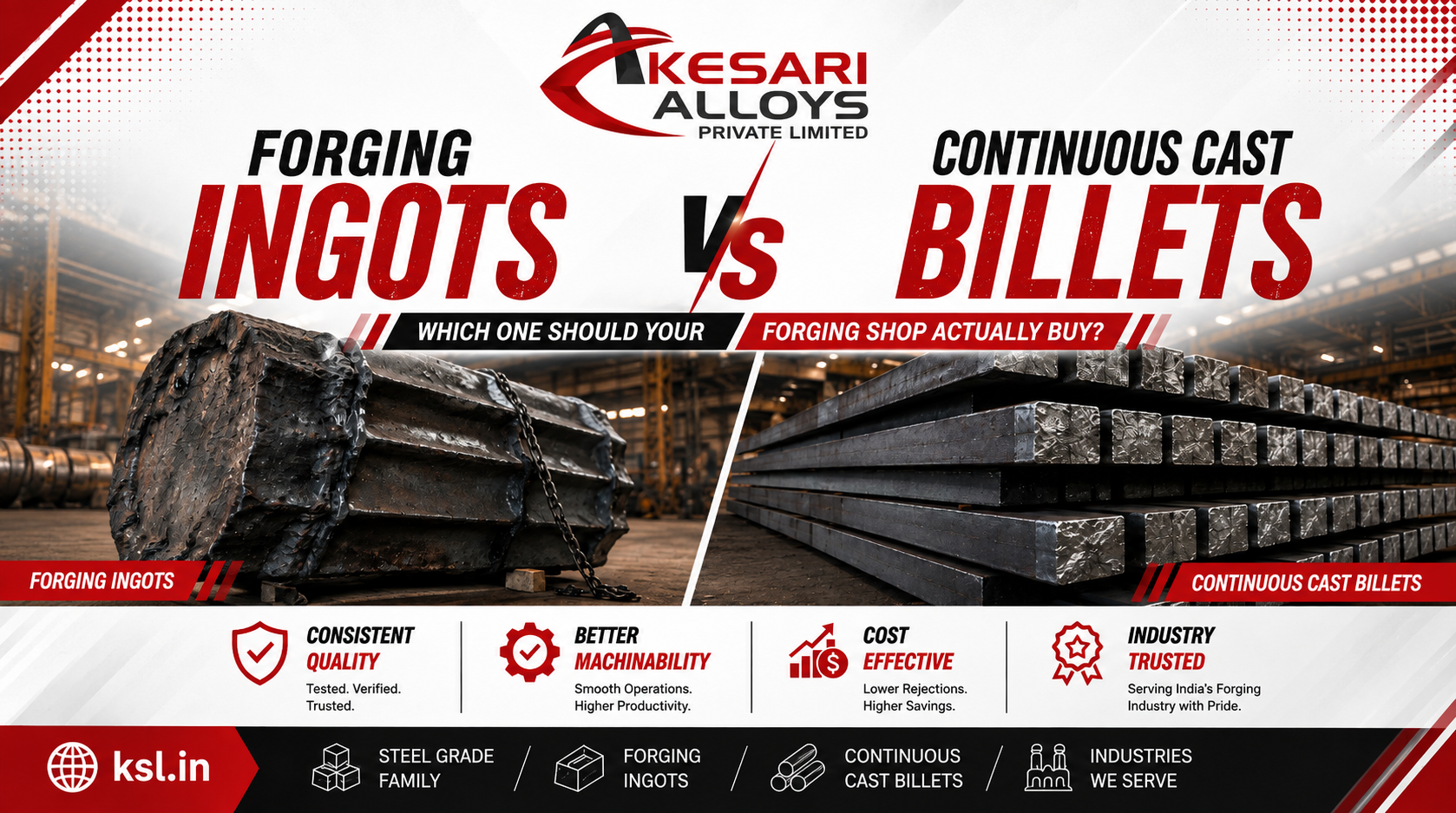
Forging ingots vs continuous cast billets is one of the most common comparisons for forging shops in India. Choosing the right material depends on component size, forging ratio, cost, yield and application. Choose forging ingots when you need large cross-sections, heavy finished weights, open die forging, ring rolling or a high forging ratio. Choose continuous cast billets and blooms when your finished part is small to medium, your process is closed die forging or re-rolling, and you want a better surface, tighter tolerance and higher yield. Most forging shops in India end up buying both matched part by part, not chosen once and applied to everything.
The question buyers ask, and the question they should ask
Almost every new enquiry that reaches us includes some version of the same line: Which is better, ingot or continuous cast billet?
It is the wrong question, and answering it honestly costs us nothing because we make both.
A forging ingot and a continuous cast billet are two different products, made by two different routes, for two different jobs. Asking which is better is like asking whether a lathe is better than a milling machine. The right question is narrower and far more useful:
For this part, at this finished weight, with this forging ratio requirement, which route gives me the lowest delivered cost per finished kilogram without failing inspection?
That question has a clear answer every single time. This guide will get you to it.
As forging ingots manufacturers in India, Kesari Alloys produces ingots from M1.5 to M22 (1,450 kg to 22,500 kg) in square, fluted and round profiles, and continuous cast billets and blooms in 100×100, 125×125, 160×160, 200×200 and 250×250 SQ mm, in weights from 75 kg to 480 kg and lengths up to 12 metres. We have no commercial reason to push one over the other — only a reason to help you pick correctly, because a customer who buys the wrong input comes back unhappy.
How a forging ingot is actually made
Understanding the difference between forging ingots vs continuous cast billets helps manufacturers choose the right raw material for each application.
Liquid steel from the electric melting furnace is refined in the ladle refining furnace, vacuum degassed where the grade demands it, and then bottom poured into cast iron moulds.
Bottom pouring matters more than most buyers realise. The steel enters from beneath and rises quietly up the mould instead of splashing down from above. That avoids reoxidation and the surface defects that top pouring can cause.
Solidification then begins at the mould wall and moves inwards. Above the ingot body sits a hot top an insulated reservoir of liquid steel that stays molten longest. As the body below cools and contracts, liquid metal is drawn down from the hot top to fill the shrinkage. The porosity therefore collects in the hot top, which is cut off and discarded.
Because cooling is slow and directional, an ingot develops a coarse as-cast structure with some centreline segregation alloying elements pushed ahead of the solidification front and concentrated toward the centre.
This is not a defect. It is inherent to ingot casting, and it is exactly why ingots are used for heavy forging: a high forging ratio breaks that structure down, disperses the segregation and closes residual porosity. Ingot casting and mechanical working are designed to work as a pair.
How a continuous cast billet is made
Liquid steel is poured into a tundish, which acts as a buffer and a final settling stage for inclusions. From there the steel flows continuously through a water-cooled copper mould. A solid shell forms almost immediately, and the strand is withdrawn, cooled further, and cut to length.
Cooling here is far faster and far more uniform than in an ingot mould.
The results follow directly:
▪ A much finer as-cast structure
▪ Better and more consistent surface condition
▪ Tight dimensional consistency, piece to piece
▪ No hot top to discard, so yield is substantially higher
▪ Minimal centreline segregation compared with an ingot
This is why forging quality steel billets have taken over so much of the small and medium forging market in India over the last two decades.
Forging ingots vs continuous cast billets the full comparison
The following comparison of forging ingots vs continuous cast billets highlights the key differences in size, yield, forging ratio and applications.
| Point of comparison | Forging Ingot | Continuous Cast Billet / Bloom |
| Section size available | Very large — up to 22,500 kg | 100 to 250 SQ mm |
| Weight range | 1,450 kg to 22,500 kg | 75 kg to 480 kg |
| Profiles | Square, fluted, round | Square section |
| Typical process fit | Open die forging, ring rolling, upsetting, heavy rolling | Closed die forging, re-rolling, upsetting, small ring rolling |
| Forging ratio needed | High 3:1 minimum, 5:1 for critical parts | Lower structure already refined |
| As-cast grain structure | Coarse, directional | Fine, uniform |
| Centreline segregation | Present, reduced by forging | Minimal |
| Surface condition | Spot ground or fully ground as required | Good as-cast surface |
| Yield from input weight | Lower hot top and bottom discard | Higher no hot top loss |
| Dimensional consistency | Moderate | High |
| Suitability for automatic feeding | Limited | Good |
| Cost per tonne of input | Lower | Higher |
| Cost per usable finished kg | Higher for small parts, lower for heavy parts | Lower for small parts, not available for heavy parts |
| Lead time character | Suited to campaign melting | Suited to regular repeat supply |
Why cost per tonne is the wrong number to compare
This is where most procurement decisions quietly go wrong, and it is worth spelling out.
An ingot almost always looks cheaper per tonne on the quotation. But you do not forge the whole ingot. You discard the hot top. You discard the bottom. You lose material to scale in the furnace. You machine away the surface. You may cut a test prolongation.
The number that actually matters is cost per usable finished kilogram, and you get it by working backwards from the part:
1. Start with the finished machined weight of your component
2. Add machining allowance
3. Add forging and scale loss
4. Add test prolongation, if your specification requires one
5. Add hot top and bottom discard for ingots only
6. Divide the total input cost by the finished weight
Run that calculation honestly for a 40 kg forged flange and again for a 4,000 kg forged shaft. In the first case the billet usually wins comfortably. In the second, the ingot wins and for a shaft that size, the billet is not even an option, because no caster produces that section.
The two products are not really competing across the whole range. They compete in a narrow band in the middle, and that is the only place this decision is genuinely difficult.
A practical selection guide
Buy forging ingots if
▪ Your finished part weighs more than roughly 250–300 kg
▪ You are open die forging shafts, rotors, blocks, rolls or large rings
▪ Your specification demands a high forging ratio for grain flow
▪ The section you need cannot be produced by continuous casting at all
▪ You are supplying pressure vessel, boiler, power or defence applications where an ingot route is specified or expected
▪ Your customer’s drawing calls for a macro etch or grain flow examination
Buy continuous cast billets or blooms if
▪ Your finished part is small to medium fasteners, gears, small flanges, couplings, pins
▪ You run closed die forging on a press or hammer with repeat dies
▪ You re-roll into bars
▪ You need consistent bar-to-bar dimensions for automatic feeding
▪ Yield matters more to you than input price per tonne
▪ You order the same grade and section repeatedly through the year
Buy both if
Many manufacturers compare forging ingots vs continuous cast billets for every new project to achieve the best balance of quality and cost. You run a mixed order book. That is the honest reality for most forging houses in India, and it is why we supply both from the same melt shop, under the same quality system, with the same grade coverage and the same heat number traceability.
What does not change, whichever route you choose
The casting route changes the shape and the as-cast structure. It does not change the steel. Whether you buy alloy steel blooms, billets or forging ingots from Kesari Alloys:
▪ Steel is melted in an electric melting furnace, homogenised with argon purging, refined in a ladle refining furnace and vacuum degassed where the grade or section demands it
▪ Every piece is marked with grade, size and heat number for full traceability back to the melt
▪ The full grade range is available carbon steel, alloy steel and stainless steel, covering EN8, EN8D, EN9, EN19, EN24, EN31, 20MnCr5, SAE 4140, SAE 4340, SAE 8620, ASTM A182 F-series, LF2, LF3, SS410 and more, across 10 grade families and over 100 grades
▪ Chemistry, gas content and metallography are tested in-house on an optical emission spectrometer, a simultaneous ONH gas analyser and a PMI mobile spectrometer
▪ Supply is backed by IBR approval, ISO 9001, ISO 14001 and ISO 45001, PED 2014/68/EU and AD-2000 Merkblatt
Three mistakes we see repeatedly
1. Comparing quotations without comparing yield. A ₹ figure per tonne means nothing until you know how much of that tonne reaches the finished part.
2. Buying billets for a part that needs a high forging ratio. The billet’s structure is already fine, so a lower ratio is metallurgically acceptable in most cases but if the customer specification names a minimum ratio, the specification wins, regardless of what the metallurgy would allow.
3. Buying ingots out of habit. Plenty of shops still buy ingots for parts that a 160 SQ mm billet would serve better, simply because that is how the shop has always done it. It is worth re-running the numbers once a year.
Frequently asked questions
Which is better: Forging Ingots vs Continuous Cast Billets?
There is no single better option. Forging ingots are the preferred choice for large, heavy components that require a high forging ratio, while continuous cast billets are better suited for small to medium-sized parts where better yield, dimensional consistency and cost efficiency are important
Is a continuous cast billet weaker than a forging ingot?
No. Mechanical properties come from chemistry and heat treatment, not from the casting route. What differs is the as-cast structure and how much forging reduction is needed to refine it.
What forging ratio should I use on an ingot?
As a general rule, 3:1 minimum for general engineering parts and 5:1 or higher for critical rotating or pressure-containing components. Always follow the customer specification or governing code where one exists.
Can I get large sections from continuous casting?
Only up to the caster’s section limit. Ours is 250×250 SQ mm. Beyond that, a forging ingot is the only practical route.
Which gives better yield, ingot or billet?
Continuous cast billets, because there is no hot top to discard. For small and medium forgings this is often the single largest cost factor.
Do billets and blooms mean the same thing?
They differ by section size. Smaller sections are generally called billets and larger sections blooms, though the dividing line varies by mill. We produce both, from 100×100 up to 250×250 SQ mm.
Is centreline segregation a rejection reason?
Not by itself. It is a normal feature of ingot casting. It becomes a problem when the forging ratio is too low to disperse it, or when it exceeds a limit named in the specification.
Can you supply the same grade as both ingot and billet?
Yes, across our grade range. Many customers take both for different parts in the same order book.
Do you supply from stock?
Availability varies by grade and size. Share your grade, section and quantity and our team will confirm lead time.
The short version
In conclusion, the choice between forging ingots vs continuous cast billets depends on the component size, forging process and overall production requirements. If the part is heavy, buy the ingot. If the part is small and repeats, buy the billet. If your order book has both, buy both and stop treating it as a single decision made once.
Talk to our metallurgical team
Send us the component drawing, the finished weight, the grade and any specified forging ratio. We will tell you honestly which route gives you the better delivered cost including when that means recommending the option we make less margin on.
Kesari Alloys Private Limited | IBR Approved | ISO 9001, 14001, 45001 | PED | AD-2000 Merkblatt
Plant: Bhiwadi, Rajasthan | Office: Sector 48, Gurugram, Haryana
Manufacturer and exporter of carbon steel, alloy steel and stainless steel forging ingots, billets, blooms and rolled bars.