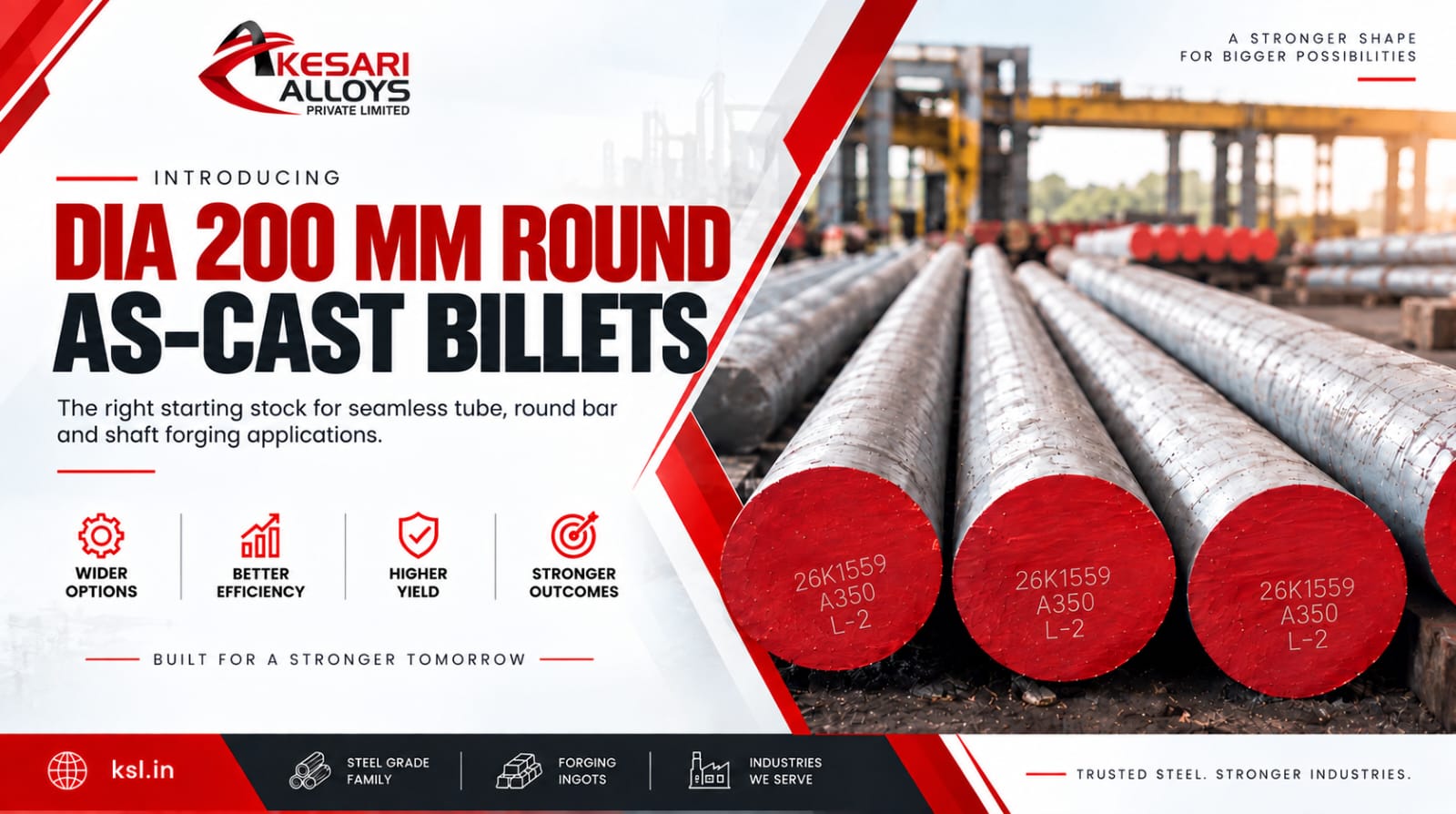
200 mm round as-cast billets are now part of Kesari Alloys’ billet and bloom range, alongside the existing square sections from 100×100 to 250×250 SQ mm. Supplied as-cast at approximately 240 kg per metre, these continuous cast round billets are designed for seamless tube and pipe production, round-bar re-rolling, and shaft or ring forging applications. A round billet is the correct starting stock for seamless tube and pipe production, round-bar re-rolling, and shaft or ring forgings, because it needs no square-to-round conversion and avoids the corner-cooling defects a square section can develop. Until now, every continuous cast section Kesari Alloys offered was square. This is the first round one.
Why a square-only billet range was a real limitation
For years, Kesari Alloys’ continuous cast billets and blooms have covered 100×100 up to 250×250 SQ mm a genuinely wide square range, and the right shape for the majority of closed-die forging and re-rolling work that draws a square section down into a bar, flange or gear blank. But square was never the right starting shape for every job.
Three categories of buyer were structurally underserved by a square-only range:
• Seamless tube and pipe mills, where the rotary piercing process (Mannesmann-type mandrel piercing) is built around a round bar being pierced through its centre. Feeding a square section into a piercing mill either doesn’t work or requires an intermediate round-cogging step that adds cost, time and a full extra reheat.
• Round-bar re-rollers, who take a billet and roll it down into a round bar for general engineering. A round billet reaches the finishing passes faster because the roughing stands don’t have to remove the corners first.
• Shaft and ring forgers, whose finished part is fundamentally round. Starting from square means the first several forging blows are simply spent squaring off the corners before the part starts taking real shape wasted press time and wasted material.
All three of these buyer types previously had two options with Kesari Alloys: buy a forging ingot (if the section was large enough to justify it) or buy a square billet and accept the yield loss and extra operation of converting it to round themselves. The 200 mm round billet removes that compromise for sections in this range.
What’s new, specifically
The new 200 mm round as-cast billets are supplied in as-cast condition at approximately 240 kg per metre, giving buyers a round starting section for tube piercing, round-bar re-rolling and round forging applications.
| Product | Size | Shape | Weight / metre | Condition |
| Round continuous cast billet (new) | DIA 200 MM | Round | 240 kg | As-cast |
| Square continuous cast billet | 100×100 SQ MM | Square | 75 kg | As-cast |
| Square continuous cast billet | 125×125 SQ MM | Square | 120 kg | As-cast |
“As-cast” means the billet is supplied exactly as it comes off the continuous casting machine cut to length, not further rolled or forged. That is standard practice for a billet that will itself be forged, rolled or pierced by the customer’s own process; it is the same condition the square billet range is already supplied in.
Why the round shape itself matters metallurgically
This isn’t just a shape preference round sections genuinely solidify and forge differently to square ones, for reasons already covered in our guide to ingot mould design.
• No corners to cool unevenly. A square section has two faces losing heat at every corner instead of one, which creates a local cooling differential and the tensile stress that causes surface cracking. A round section has no corners, so this failure mode simply doesn’t apply.
• Even die contact when forging or rolling a round part. If the finished component is round a shaft, a ring blank, a round bar starting from round stock means every forging or rolling pass is doing useful work on the final geometry, instead of the first passes being spent removing corners.
• Direct feed into rotary piercing. Seamless tube manufacture pierces a solid round billet through its centre using a mandrel between two angled rolls. The process depends on the billet already being round and reasonably concentric; a square starting section is not compatible with this route without an intermediate step.
Round billet vs square billet: How to choose
Buy round billet if
• Your process is seamless tube or pipe making by rotary piercing
• You re-roll into round bar and want to skip the corner-removal passes
• Your finished forging is fundamentally round a shaft, a ring, a round flange blank
• You currently buy square billet and forge or roll it round yourself before your main process starts
Buy square billet if
• Your finished part is drawn down into bars, blocks or rectangular sections
• You run closed-die forging with square or rectangular die impressions
• You need a section larger than 200 mm square coverage currently extends further, to 250×250 SQ mm, while round is available at 200 mm dia
If you are unsure which shape actually suits your process best, send us your component drawing or your re-rolling mill’s roughing-stand configuration and we’ll confirm.
Grades available in round billet form
The round billet is manufactured on the same continuous casting machine and through the same melting route as the square range, so grade availability follows the same coverage: carbon steel, alloy steel and stainless steel across Kesari Alloys’ ten grade families and 100+ individual grades including case-hardening grades (20MnCr5, SAE 8620) commonly used for round shaft and gear-blank forgings, and through hardened grades (EN19, SAE 4140) commonly used for round bar re-rolling.
Supporting capability unchanged
The round billet goes through the identical quality system as every other Kesari Alloys product:
• Melting route: Electric Melting Furnace → Argon Purging → Ladle Refining Furnace → Vacuum Degassing → Continuous Casting
• In-house chemistry, gas content and metallographic testing on an optical emission spectrometer, a simultaneous ONH gas analyser and a PMI mobile spectrometer
• Every piece marked with grade, size and heat number for full traceability
• Approvals: IBR, ISO 9001 / 14001 / 45001, PED 2014/68/EU, AD-2000 Merkblatt
What to specify when you enquire about round billet
1. Grade and specification
2. Length required – standard lengths up to 12 metres, or cut-to-size
3. Intended process – piercing, re-rolling or forging (this affects surface finish recommendations)
4. Surface condition required
5. Quantity and delivery schedule
Frequently asked questions
What is an as-cast round billet, and how is it different from a rolled round bar?
An as-cast billet comes directly off the continuous casting machine, cut to length, with no further rolling or forging. A rolled round bar has already been hot-rolled down to a smaller finished diameter with a rolled surface finish. Buyers who will do their own piercing, forging or re-rolling want the as-cast billet as their starting stock; buyers who need a finished bar-diameter product want the rolled bar.
What sizes and grades are available in 200 mm round as-cast billets from Kesari Alloys?
200 mm round as-cast billets are currently available at approximately 240 kg per metre, across the full carbon, alloy and stainless steel grade range also supplied in square billet form. Share your grade and required length and we will confirm availability.
Can round billet be used for forging, or only for tube-making?
Both. Round billet is the natural starting stock for any process where the finished part is round – shafts, ring blanks, round flanges as well as for seamless tube and pipe production and round-bar re-rolling.
Is round billet more expensive than square billet of the same weight?
Cost per tonne is comparable between the two shapes; the value of choosing correctly is in avoiding the yield loss and the extra operation of converting a square billet to round yourself when your process actually needs round stock.
Do you supply round billet cut to a specific length, or only in standard lengths?
Both options can be discussed. Standard continuous cast lengths run up to 12 metres; share your required cut length and quantity and we will confirm.
The short version
The billet range at Kesari Alloys was square-only until now. The new 200 mm round as-cast billets open the door to seamless tube and pipe mills, round-bar re-rollers and shaft/ring forgers who previously had no round option from us. They offer the same melting route, testing and certification as everything else we make.
Talk to our metallurgical team
Share your grade, length and intended process – piercing, re-rolling or forging – and our metallurgical team will confirm size, availability and lead time for round billet.
Kesari Alloys Private Limited | IBR Approved | ISO 9001, 14001, 45001 | PED 2014/68/EU | AD-2000 Merkblatt
Plant: Bhiwadi, Rajasthan | Office: 152, JMD Megapolis, Sector 48, Gurugram, Haryana