Quick answer
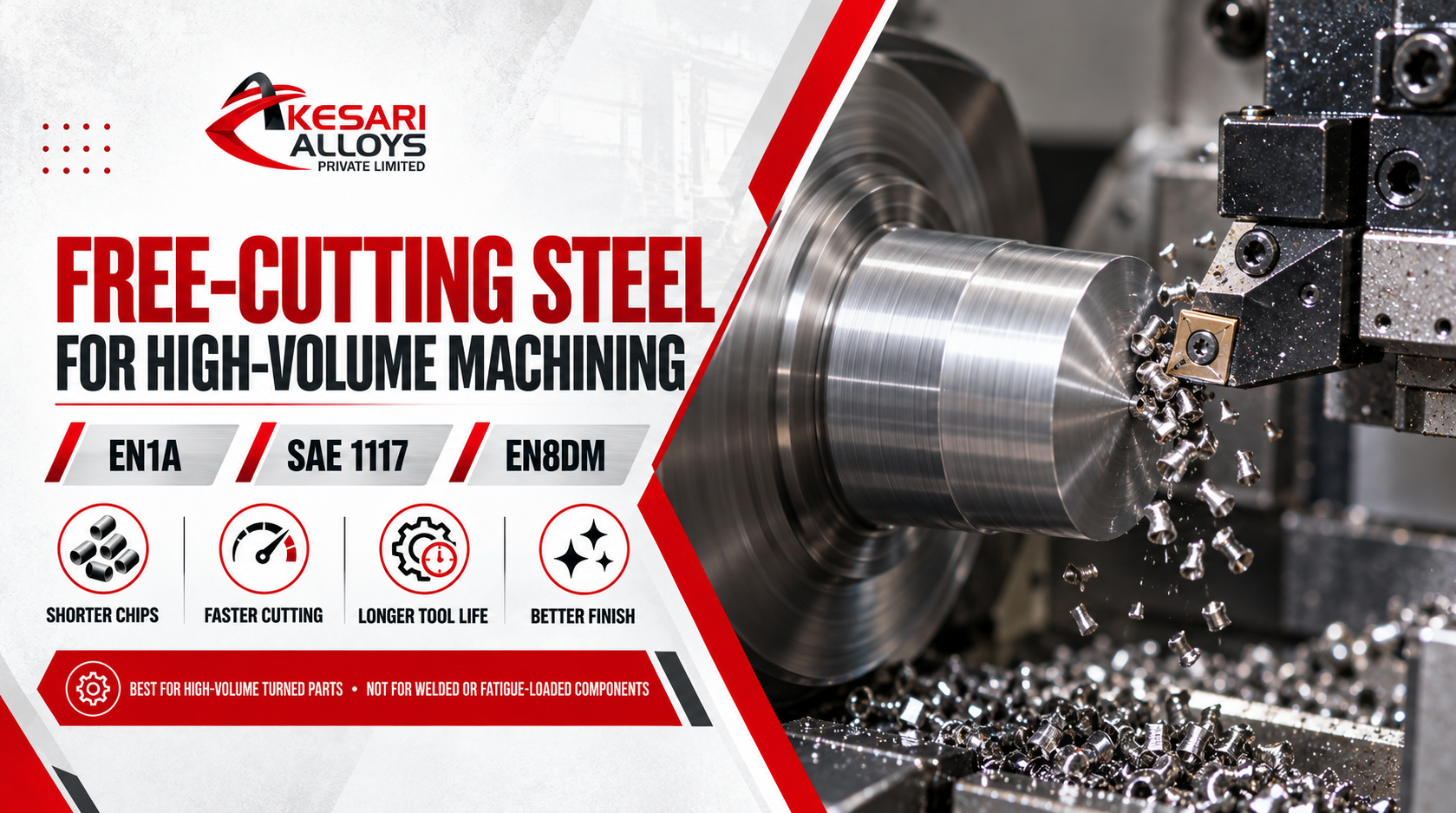
Free-cutting steel (EN1A, SAE 1117, EN8DM) has controlled sulphur – and in some grades, lead – deliberately added to make the steel break chips cleanly and machine faster on automatic lathes. The trade-off is lower weldability and slightly reduced toughness compared with an equivalent plain-carbon grade, which is why free-cutting steel is chosen for high-volume, low-stress turned components rather than welded assemblies or fatigue-loaded parts.
What makes a steel “free-cutting”
Every general engineering steel contains a small amount of sulphur and manganese, and in ordinary steel it is kept low because sulphur forms manganese sulphide (MnS) inclusions that can act as stress concentrators and reduce toughness and fatigue life. Free-cutting steel deliberately does the opposite: sulphur is raised – sometimes with a small addition of lead – specifically to increase the number and distribution of these inclusions.
On an automatic lathe or CNC turning centre, that changes everything about how the steel behaves under the tool:
• Chips break into short, manageable pieces instead of forming long stringers that tangle in the machine and have to be cleared manually
• Cutting forces and tool wear drop, allowing higher cutting speeds and longer tool life
• Surface finish improves directly off the tool, often reducing the need for secondary finishing
• Lead (where present) acts as a solid lubricant at the cutting edge, improving finish further at the highest cutting speeds
The inclusion that helps here – and hurts elsewhere
This is worth stating plainly, because it is easy to get backwards: the same manganese sulphide inclusion that is engineered into free-cutting steel is exactly the defect our guide to EN31 / SAE 52100 bearing steel identifies as the primary cause of rolling-contact fatigue failure. Type A (sulphide) inclusions are the least damaging of the four inclusion categories tracked in bearing steel cleanliness testing – deformable, and far less dangerous than the hard, angular Type B alumina or Type D globular oxides – which is exactly why sulphide can be raised deliberately in free-cutting grades without the same fatigue risk that a hard oxide inclusion would carry.
The lesson is not that sulphide is universally good or bad. It is that the right inclusion level depends entirely on what the part has to survive – millions of fatigue cycles under rolling contact, or a single-pass turning operation with no cyclic load.
Composition – what changes between the grades
| Grade | Carbon (%) | Sulphur (%) | Lead | Notes |
| EN1A | 0.07–0.15 | 0.10–0.30 | None | Low-carbon free-cutting, general purpose |
| EN1A-Pb (leaded) | 0.07–0.15 | 0.10–0.30 | 0.15–0.35 | Leaded variant, best finish at high speed |
| SAE 1117 | 0.14–0.20 | 0.08–0.13 | None | Resulphurised, higher manganese for hardenability |
| EN8DM | 0.35–0.45 | 0.08 max (controlled) | None | Medium-carbon free-cutting, higher strength than EN1A |
Notice the range: EN1A and SAE 1117 are low-carbon grades chosen purely for machinability at modest strength, while EN8DM carries enough carbon to be heat-treated for higher strength after machining – a genuinely different use case, not just a different sulphur level.
Where free-cutting steel is used
• Fasteners and threaded components produced on high-speed automatic lathes
• Bushes, spacers and precision turned spindle-type parts
• General automotive fittings and brackets that are turned, not welded, into the assembly
• Any high-volume component where machining cost dominates the part’s total cost more than material strength does
When not to specify free-cutting steel
• Welded assemblies. Sulphur content interferes with weld quality and increases the risk of hot cracking in and around the weld – plain-carbon or low-sulphur grades are the correct choice wherever welding is part of the process.
• Fatigue or impact-loaded components. The same sulphide inclusions that help machinability reduce toughness and fatigue resistance compared with an equivalent clean steel – free-cutting grades are not the right choice for shafts, gears or structural parts under cyclic or shock loading.
• Anything requiring the cleanliness levels used in bearing or pressure-part specifications – these are effectively opposite design intents.
Supply forms
Free-cutting grades are most commonly ordered as rolled bar for direct bar-feeding into automatic lathes – see our guide to alloy steel rolled bars for how bar quality and starting billet cleanliness affect downstream machining consistency. Continuous cast billet is available where the customer runs their own rolling or forging operation.
Frequently asked questions
Is EN1A the same as free-cutting mild steel?
Yes – EN1A is the British designation for a low-carbon, resulphurised free-cutting steel, sometimes referred to informally as free-cutting mild steel. A leaded variant, EN1A-Pb, is also available where the highest cutting speeds and finish are required.
Does free-cutting steel weld properly?
Not reliably. The elevated sulphur content that improves machinability also increases the risk of hot cracking during welding. If any part of the component will be welded, a standard plain-carbon or low-sulphur grade is the correct specification instead.
What is the difference between leaded and unleaded free-cutting steel?
Lead is added as a solid lubricant at the cutting edge, which further improves surface finish and tool life at high cutting speeds beyond what sulphur alone achieves. Unleaded grades still machine significantly better than standard steel, just with a smaller margin at the very highest speeds.
Can free-cutting steel be case hardened?
Low-carbon free-cutting grades such as EN1A can be case carburised, though the elevated sulphur content is a secondary consideration in surface-treatment decisions. Where case hardening is the primary requirement, a dedicated case-hardening grade such as 20MnCr5 or SAE 8620 is usually the better-suited choice.
Which free-cutting grade gives the best machinability?
Leaded grades such as EN1A-Pb generally give the best finish and tool life at high cutting speeds. Among unleaded grades, machinability is driven primarily by sulphur content and manganese-to-sulphur ratio – share your target cutting speed and tool life expectation and we can advise on grade selection.
The short version
Free-cutting steel trades a small amount of toughness for a large improvement in machining cost and speed – the right trade for high-volume turned parts, and the wrong one for anything welded, fatigue-loaded, or built to a cleanliness specification.
Talk to our metallurgical team
Share your component drawing, target production volume and whether the part is welded or heat-treated, and we’ll confirm the right free-cutting grade and supply form – billet or rolled bar.
Kesari Alloys Private Limited | IBR Approved | ISO 9001, 14001, 45001 | PED 2014/68/EU | AD-2000 Merkblatt
Plant: Bhiwadi, Rajasthan | Office: 152, JMD Megapolis, Sector 48, Gurugram, Haryana