When a re-roller specifies alloy steel billets for bearing rings, or a forge shop orders billets for critical automotive transmission components, the purchase order chemistry column tells only part of the story. A billet reading 0.38–0.45% C, 0.80–1.10% Cr, and 0.15–0.25% Mo – squarely within an AISI 4140 specification – can be either a reliable semi-finished product or a latent scrap risk, depending entirely on what happened in secondary metallurgy before the steel was cast.
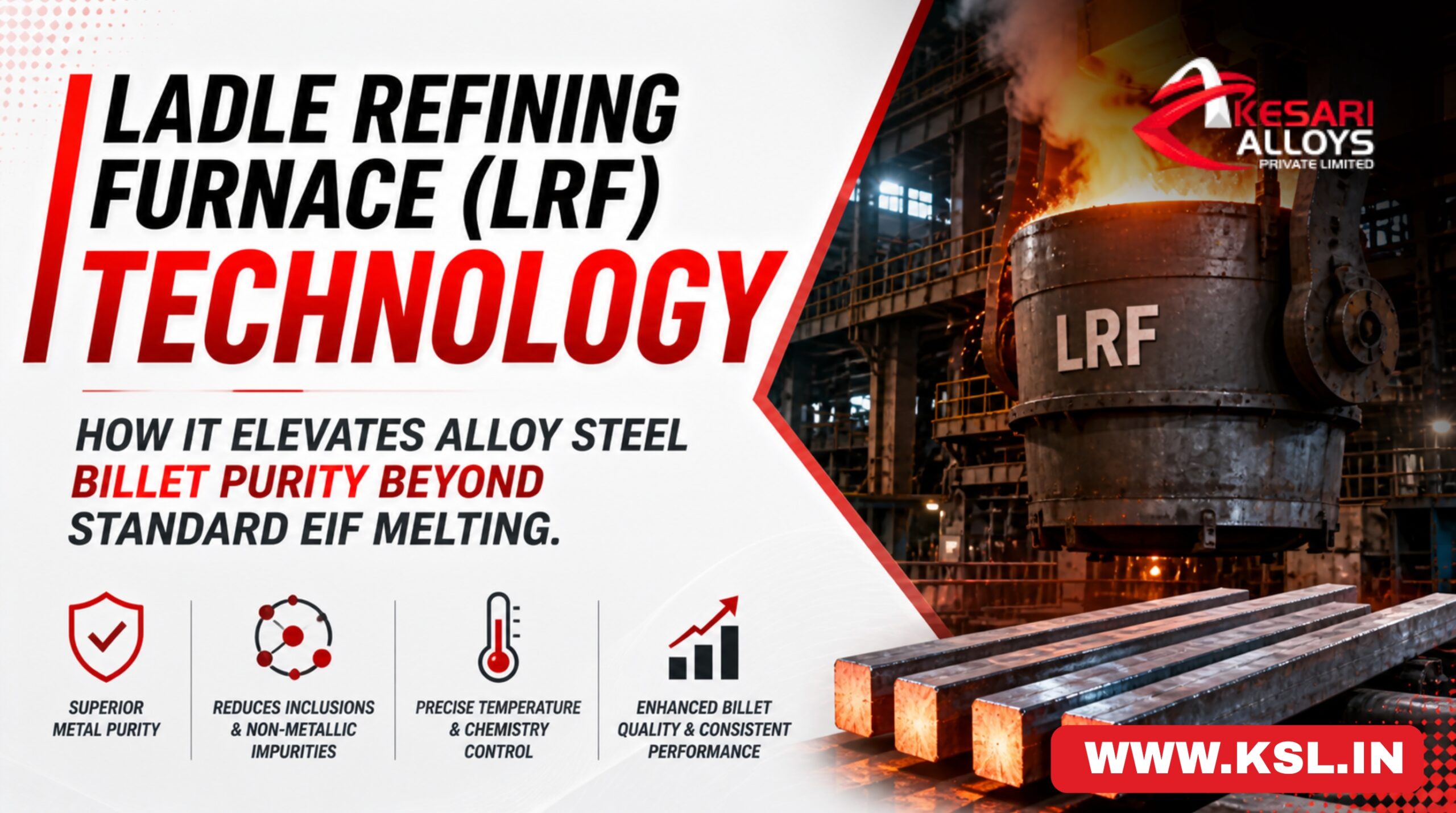
The discriminating variable is the Ladle Refining Furnace (LRF). At Kesari Alloys Private Limited, every alloy steel billet heat passes through an integrated EIF → LRF → VD → Continuous Casting sequence. This article explains, in engineering terms, why the LRF is not an optional upgrade to Electric Induction Furnace (EIF) melting – it is the stage where liquid steel is transformed from a compositionally approximate melt into a clean, inclusion-controlled, thermally homogeneous feed stock that continuous casting demands.
The Limits of EIF-Only Melting
The Electric Induction Furnace is an exceptional primary melting unit. Electromagnetic stirring produces a chemically active bath; carbon, manganese, silicon, and alloying additions dissolve rapidly and distribute evenly. Heat-to-heat cycle times are short. Grade changeovers are straightforward. For commodity carbon steel grades – re-bar, structural sections, low-specification castings – EIF melting alone is entirely adequate.
But for alloy steel billets destined for load-bearing, fatigue-critical, or pressure-containing applications, the EIF creates three categories of problem that it cannot solve from within its own process envelope:
1. Chemistry accuracy at the tight-end of specification. Alloy steel grades such as 4140, EN19, 16MnCr5, or 20MnCr5 carry chromium, molybdenum, nickel, and vanadium in specification bands as narrow as ±0.05–0.10%. After tapping, oxidation losses and slag reactions shift the chemistry. Corrective additions made at tapping are imprecise. The result is a ladle that is directionally within specification but not positioned at the optimum aim point.
2. Sulphur. Induction furnace slag practice is not designed for deep desulphurisation. Tapped sulphur levels from an EIF typically range from 0.020–0.040%. For alloy steel billets supplying forges or bearing manufacturers, contractual sulphur limits of S ≤ 0.008% – or S ≤ 0.005% for premium grades – are unreachable without a separate refining stage.
3. Non-metallic inclusions. The EIF does not provide the combination of reducing slag chemistry, sustained argon stirring, and sufficient refining time to float alumina, silica, and complex oxide inclusions out of the melt. These inclusions – if not removed or modified before casting – are locked into the solidified billet structure as stringers and clusters that become crack initiation sites under rolling, forging, or service stress.
The LRF addresses all three. Not incrementally – structurally.
The Four Functions of the LRF in Alloy Steel Billet Production
1. Temperature Homogenisation
Steel tapped from the EIF into a ladle is neither isothermal nor compositionally uniform. Thermal gradients of 15–30 °C exist between the top and bottom of the ladle, and the melt at the ladle walls is cooler than the core. These gradients create differential solidification behaviour during continuous casting – the root cause of centreline segregation, surface cracks, and rhomboidity in cast billets.
The LRF re-heats the steel via submerged arc heating between graphite electrodes, while argon purging through ladle floor plugs continuously circulates the melt. The combination brings the bath to a precisely controlled superheat – typically 30–50 °C above the liquidus – and eliminates temperature stratification before the ladle enters the Vacuum Degassing station or the caster.
For buyers: temperature uniformity at the LRF exit directly determines macro-segregation levels in the as-cast billet. Centreline carbon segregation ratios (C_max/C_nominal) in LRF-processed billets are consistently lower than in EIF-only cast material – a critical parameter for billets that will be rolled into bars for induction hardening or case carburising.
2. Final Chemistry Trimming to Aim Point
The LRF is where the compositional aim point – not merely the specification window – is targeted. Wire injection (ferro-alloy cored wires), solid additions through a dedicated chute, and precise argon stir-driven mixing allow the secondary metallurgist to position each element at its optimal aim composition within the specification band.
For a grade such as EN24 (AISI 4340) – with Ni at 1.30–1.70%, Cr at 0.90–1.30%, Mo at 0.20–0.35% – the difference between landing at the low end and the mid-to-high end of each range translates directly into hardenability (Jominy J-distance), tensile strength after heat treatment, and impact toughness at sub-zero temperatures. LRF chemistry control makes this precision targeting repeatable heat-to-heat, not occasional.
At Kesari Alloys, full Optical Emission Spectrometer (OES) analysis is performed at the LRF stage to confirm the final ladle chemistry before any further processing. This is the chemistry reported on the Mill Test Certificate.
3. Deep Desulphurisation
Sulphur in steel exists primarily as manganese sulphide (MnS) inclusions. These inclusions are deformable; during rolling or forging they elongate into stringers aligned with the working direction. Transverse mechanical properties – particularly Charpy impact energy and reduction in area in the through-thickness direction – are directly degraded by MnS stringer density.
The LRF achieves deep desulphurisation through a high-basicity, low-oxygen synthetic slag (CaO-Al₂O₃-SiO₂ system with CaO/SiO₂ basicity > 3.0) combined with sustained argon stirring. The thermodynamic driving force for sulphur transfer from the steel to the slag is maximised when:
- Slag basicity is high (slag activity of sulphur is low).
- Steel oxygen activity is low (achieved through aluminium deoxidation prior to LRF treatment).
- Metal-slag interfacial area is maximised (achieved by argon-driven recirculation).
Under these conditions, Kesari Alloys routinely achieves S ≤ 0.005% in alloy steel billet heats – a level that requires no compromise on the part of the downstream forger or re-roller specifying to DIN, BS, ASTM, or customer-proprietary standards.
4. Inclusion Flotation and Modification
Deoxidation with aluminium kills the steel – reducing free oxygen and precipitating alumina (Al₂O₃). Without further treatment, these alumina particles agglomerate into clusters (dendrites and networks) that neither float efficiently nor deform during rolling. They fracture instead, creating angular inclusion debris in the worked product.
The LRF enables two inclusion control strategies:
Flotation – sustained argon stirring keeps inclusions mobile and in contact with the overlying reducing slag. Inclusions migrate to the slag-metal interface and are absorbed into the slag phase over the LRF treatment time (typically 20–40 minutes for alloy grades). The longer the treatment time, the lower the residual inclusion count in the liquid steel before casting.
Calcium treatment – calcium (injected as calcium-silicon or calcium-aluminium cored wire) reacts with alumina inclusions to form liquid calcium aluminates (CaO·Al₂O₃ compositions that are molten at steelmaking temperatures). Liquid inclusions are spherical, float readily, and – if they remain in the steel – deform plastically during rolling rather than fracturing. The result is a billet with globular, low-harm inclusions rather than angular, high-harm clusters.
For bearing steel grades (AISI 52100 / EN31), where total oxygen specification is frequently contractually set at ≤ 15 ppm, and for gear steels (16MnCr5, 20MnCr5, EN36C) where fatigue life under bending and contact stress governs component life, LRF inclusion control is not a quality enhancement – it is a delivery prerequisite.
The LRF–VD Cascade: Why Sequence Is Non-Negotiable
A point that is sometimes misunderstood in billet procurement is that LRF and Vacuum Degassing (VD) are not alternative routes to the same outcome – they are sequential refinements addressing different impurity species.
The LRF removes sulphur and inclusions and positions chemistry. It does not significantly reduce dissolved hydrogen or nitrogen; in fact, argon stirring at atmospheric pressure can introduce minor nitrogen pick-up if the slag cover is insufficient.
The VD station, which follows LRF treatment in Kesari Alloys’ process sequence, reduces dissolved hydrogen to < 2 ppm and total oxygen to < 20 ppm by exploiting the low partial pressures achievable at ≤ 0.25 mbar. But VD is most effective when it receives a clean, desulphurised, inclusion-treated melt from the LRF – because a dirty melt entering the VD tank will have its inclusion removal efficiency compromised by the turbulent outgassing that occurs during initial pump-down.
The process intelligence at Kesari Alloys is built into the sequence design: LRF conditions the steel for VD, and VD completes what LRF cannot accomplish regarding dissolved gas removal. The alloy steel billet that exits this combined route is categorically different from a billet produced by EIF casting alone – not better by degree, but better by kind.
Grades Where LRF Processing Is the Baseline Specification
The following alloy steel billet grades produced at Kesari Alloys are standard LRF (and LRF+VD) route material. Buyers specifying these grades should treat LRF processing as a non-negotiable minimum:
- Chromium-molybdenum steels – AISI 4130, 4140, 4150 / F-11, F-22 (pressure vessel, valve, flange applications).
- Nickel-chromium-molybdenum steels – 4340 / EN24, EN25 (high-tensile shaft, aerospace, defence, wind energy).
- Bearing steels – AISI 52100 / EN31 (angular contact bearings, tapered rollers, precision balls).
- Case-hardening steels – 16MnCr5, 20MnCr5, En36C (gear, pinion, camshaft applications).
- Spring steels – EN47, 55Cr3 (automotive and railway suspension).
- Chromium steels – EN18 (general engineering, axles, spindles).
For carbon steel grades used in non-critical re-rolling, LRF processing is available but not universally applied. The decision is driven by the downstream application and the buyer’s specification.
Process Documentation: What Buyers Should Request
For a steel buyer qualifying Kesari Alloys as an alloy steel billet source, the following process records are available as part of the material test report package:
- LRF treatment log – entry temperature, arc heating time, alloy addition records, argon flow, exit temperature and chemistry.
- OES analysis – full multi-element spectrometric analysis at LRF exit, confirming aim-point chemistry.
- Desulphurisation record – sulphur at EIF tap vs. sulphur at LRF exit, for heats where deep desulphurisation is specified.
- VD cycle record – vacuum level vs. time, confirming ≤ 0.25 mbar achievement.
- ONH gas analysis – simultaneous oxygen, nitrogen, and hydrogen on production ladle samples.
- Billet inspection records – surface quality, dimensional compliance, heat number traceability.
This documentation architecture is supported by Kesari Alloys’ ISO 9001, ISO 14001, ISO 45001, IBR, PED 2014/68/EU, and AD-2000 MERKBLATT certification scope – each of which requires process traceability at the liquid steel stage, not merely at the finished product stage.
Conclusion: The LRF Is Where Alloy Steel Billet Quality Is Built
A mill test certificate confirms that the chemistry arrived at the right destination. The LRF is how it got there – cleanly, precisely, and with the inclusion population, sulphur level, and thermal uniformity that continuous casting of alloy steel billets demands.
For steel buyers specifying inclusion cleanliness, tight sulphur limits, aim-point chemistry compliance, and downstream forgability or rollability of alloy grades, the question to ask any billet supplier is not only “what is your chemistry?” but “what does your secondary metallurgy look like, and can you document it?”
At Kesari Alloys, the answer to both questions is the same: an integrated EIF → LRF → VD → Continuous Casting route, documented heat-by-heat, certified to international standards, and available in over 100 carbon and alloy steel grades from 100×100 mm to 250×250 mm square section.
Kesari Alloys Private Limited (KSL) is an IBR-approved, ISO 9001 / ISO 14001 / ISO 45001 / PED 2014/68/EU / AD-2000 MERKBLATT certified manufacturer of alloy steel and carbon steel billets/blooms, forging ingots, and rolled bars. Headquartered in Gurugram, Haryana, India, with manufacturing at Bhiwadi, Rajasthan, KSL supplies billets in square sections from 100×100 mm to 250×250 mm, up to 12 meters in length, across alloy steel, carbon steel, and stainless steel grades worldwide.
For technical enquiries or material specifications, contact: info@ksl.in| +91 981 0112 977 Website:www.ksl.in