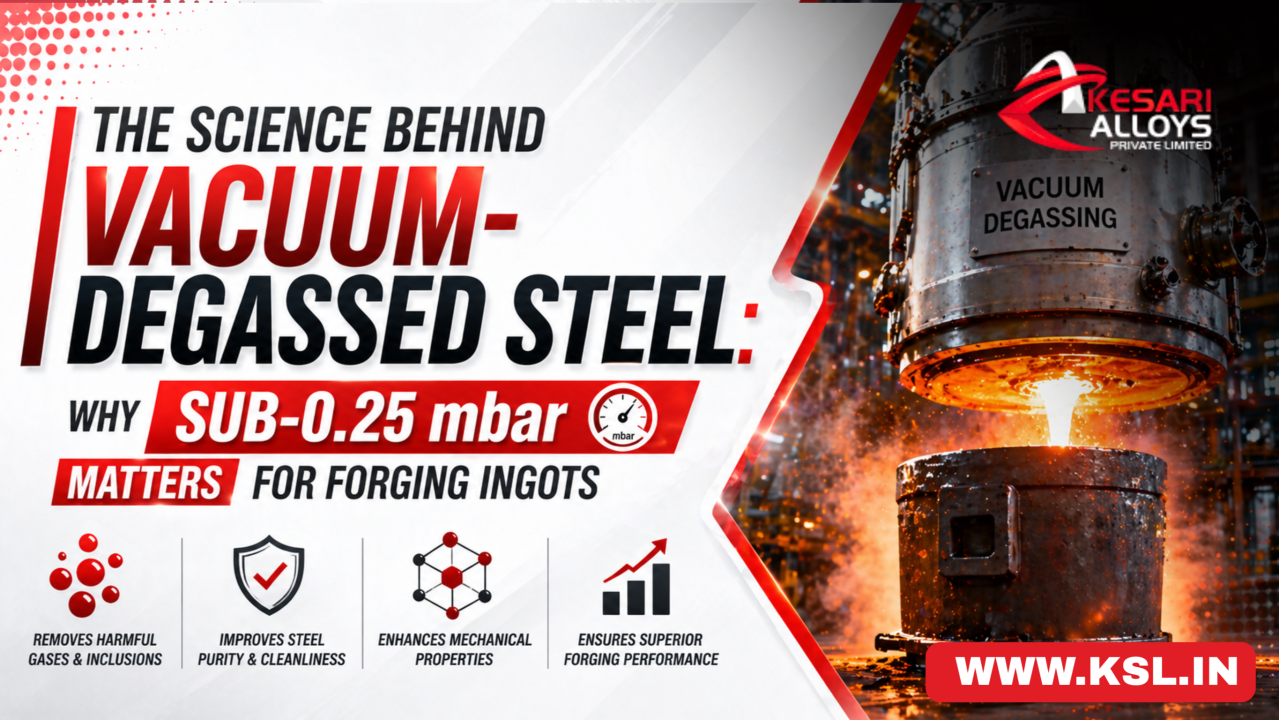
If you are specifying forging ingots for critical applications – pressure vessels, oil & gas flanges, power generation rotors, or high-load automotive drive-train components – the number that should occupy your attention is not the yield strength printed on the mill test certificate. It is the vacuum level achieved during secondary metallurgy, expressed in millibar, and maintained for the duration of the degassing cycle.
At Kesari Alloys Private Limited, our Vacuum Degassing (VD) system reaches sub-0.25 mbar in under five minutes, a threshold that separates engineering-grade steel from commodity-grade castings. This article explains the physical chemistry behind that specification, what happens inside the steel when you miss it, and why procurement engineers and metallurgists at tier-one forges should treat vacuum level as a primary qualification criterion – not a footnote in the supplier audit checklist.
What Vacuum Degassing Actually Does to Liquid Steel
Steel, in its molten state, is not a pure alloy. It is a reactive solution that dissolves atmospheric gases – primarily hydrogen (H), nitrogen (N), and oxygen (O) – from scrap, electrodes, slag, and the furnace atmosphere. These dissolved gases are soluble at steelmaking temperatures (1550–1620 °C) but precipitate as the metal cools and solidifies during casting.
The result, in the absence of adequate degassing, is a forging ingot riddled with:
- Hydrogen flakes – internal hairline cracks caused by hydrogen embrittlement during cooling.
- Blow holes and porosity – nitrogen and oxygen bubbles trapped in the solidifying matrix.
- Oxide inclusions – alumina (Al₂O₃) and silica (SiO₂) stringers that act as stress-concentration sites under cyclic loading.
- Elevated total oxygen content – reducing toughness and fatigue life, particularly in alloy steel grades used for bearing, tool, and spring applications.
Vacuum degassing works by exploiting a fundamental thermodynamic principle: Sievert’s Law, which states that the solubility of a diatomic gas in liquid metal is proportional to the square root of its partial pressure above the melt. Reduce the partial pressure of hydrogen over liquid steel from atmospheric (≈1 bar) to sub-0.25 mbar – a factor greater than 4,000 – and the equilibrium hydrogen content plummets from approximately 6–7 ppm to below 1.5 ppm. The same principle governs nitrogen and, in combination with calcium or aluminium treatment in the Ladle Refining Furnace (LRF), facilitates the flotation and removal of oxide inclusions.
The sub-0.25 mbar threshold is not arbitrary. It is the pressure level at which the partial pressures of H₂, N₂, and CO fall low enough to drive dissolved gas out of solution at a commercially useful rate, within a cycle time that does not compromise the temperature window for subsequent casting.
The EIF → LRF → VD Route: Why Process Sequence Is Everything
Kesari Alloys operates a fully integrated Electric Induction Furnace (EIF) → Ladle Refining Furnace (LRF) → Vacuum Degassing (VD) melt shop for its premium forging ingot grades. Each stage is indispensable; the sequence is not interchangeable.
Stage 1: EIF – Melting and Bulk Chemistry Control
The induction furnace provides precise electromagnetic stirring, ensuring homogeneous melt chemistry before tapping. Carbon, manganese, silicon, and alloying additions (chromium, molybdenum, nickel, vanadium) are charged to target composition. Immersion pyrometry and carbon-silicon analysis confirm the melt is within specification before transfer to the ladle.
At this stage, dissolved gases are high. Hydrogen can be 5–8 ppm; oxygen sits at 80–150 ppm for un-deoxidised heats. The EIF is a melting unit, not a refining unit – its role is primary chemistry.
Stage 2: LRF – Temperature Homogenisation, Desulphurisation and Inclusion Modification
In the Ladle Refining Furnace, the steel undergoes:
- Argon stirring for temperature and composition homogenisation.
- Synthetic slag practice for desulphurisation, targeting S < 0.005% for critical forging grades.
- Calcium treatment (or aluminium wire injection) to modify alumina inclusions into globular calcium aluminates that float to the slag – preventing stringered inclusions in the final forging.
- Final alloy trimming to bring the heat within the narrow compositional band demanded by standards such as EN 10083, ASTM A182, or customer-proprietary specifications.
The LRF also ensures the melt enters the VD station at the correct superheat – typically 30–50 °C above the liquidus – because degassing is an endothermic process that strips heat from the steel. Entering the VD tank too cold means premature skull formation before adequate degassing is achieved.
Stage 3: VD – Sub-0.25 mbar Degassing
The ladle is sealed inside the vacuum tank and the pumping system engages. At Kesari Alloys, this system reaches operating vacuum (≤ 0.25 mbar) in under five minutes, a response time that is critical for two reasons:
- It maximises the effective degassing window. A steel temperature loss rate in a covered ladle is approximately 1–2 °C per minute. A slow pump-down wastes this thermal budget before meaningful degassing begins.
- It minimises nitrogen re-absorption. During the initial pump-down, turbulent outgassing from the steel surface creates a localized high-pressure gas zone above the bath. A fast pump clears this zone quickly, preventing nitrogen back-absorption.
Argon bubbling through purge plugs at the ladle floor maintains melt circulation throughout the VD cycle, creating a constantly renewed melt surface where dissolved gas can escape. The combination of low partial pressure, large active surface area, and continuous circulation is what drives hydrogen down to ≤ 1.5 ppm and total oxygen to ≤ 15–20 ppm in premium alloy steel heats.
What the Numbers Mean for Your Forging Operation
For a metallurgist qualifying a new ingot supplier, the 0.25 mbar specification translates directly into the following measurable outcomes in the forged and heat-treated component:
Hydrogen < 1.5 ppm: Eliminating the Flake Risk
Hydrogen flaking is one of the most catastrophic – and insidious – failure modes in heavy forging ingots. Flakes form during cooling after forging as hydrogen supersaturation causes internal cracking along austenite grain boundaries and low-energy cleavage planes. In large cross-section forgings (>300 mm diameter), slow cooling rates exacerbate the problem.
For alloy steel grades such as 4140, 4340, En24, or F-22 – all of which are hydrogen-sensitive due to their hardenability – a hydrogen content above 2.5 ppm entering the forging ingot is widely regarded as the threshold for flake risk in heavy sections. Sub-0.25 mbar VD practice routinely achieves ≤ 1.5 ppm, providing a robust safety margin that eliminates the need for costly extended slow-cool (SSC) post-forge cycles, or at minimum, significantly reduces their duration.
Oxygen ≤ 15–20 ppm: Fatigue Life and Impact Toughness
Total oxygen content is the primary determinant of inclusion cleanliness in aluminium-killed steel. Each 10 ppm increment in total oxygen corresponds to a measurable reduction in Charpy impact energy and rotating beam fatigue life. For bearing-quality steels (52100/SUJ2), oil-country tubular goods (AISI 4130, 4145H), and pressure vessel grades (F-11, F-22), total oxygen is often a contractual specification in the material purchase order.
The LRF+VD combination – with proper aluminium/calcium treatment – achieves total oxygen levels competitive with electric arc furnace (EAF) + LF + VD routes used by large integrated mills, at the production flexibility that induction-based melt shops offer for small-to-medium heat sizes and rapid grade changeovers.
Sulphur < 0.005% and Controlled Inclusion Morphology
While vacuum degassing does not directly remove sulphur, the LRF desulphurisation that precedes it is enabled by the same slag chemistry designed to support VD practice. Low sulphur, combined with calcium treatment for inclusion shape control, means that the MnS stringers which degrade transverse ductility and machinability in conventional steels are replaced by discrete, globular sulphides that have minimal impact on mechanical anisotropy.
For forged flanges, rings, and discs – where the procurement specification demands full through-thickness mechanical property compliance in all three directions – this is not a marginal improvement. It is the difference between passing and failing a transverse Charpy requirement.
Why Process Transparency Matters in B2B Procurement
Senior procurement engineers at forging houses and end-user EPC contractors have learned, often through costly non-conformance events, that mill test certificates are necessary but not sufficient. A certificate showing chemistry within specification says nothing about the degassing vacuum level achieved, the VD cycle time, the argon flow rate, or whether the calcium treatment achieved the intended inclusion morphology.
When qualifying Kesari Alloys as a forging ingot supplier, the process documentation available includes:
- VD cycle records – vacuum level vs. time logs for each heat.
- LRF treatment records – temperature, chemistry at key stages, argon consumption.
- OES (Optical Emission Spectrometer) heat analysis – full multi-element spectrometric analysis for each heat.
- ONH Gas Analyser results – simultaneous oxygen, nitrogen, and hydrogen determination on production samples.
- Ultrasonic testing reports – in accordance with ASTM standards for forging ingots supplied for critical applications.
This traceability architecture is mandated by the company’s ISO 9001, ISO 14001, ISO 45001, IBR (Indian Boiler Regulations), PED 2014/68/EU, and AD-2000 MERKBLATT certifications – the latter two being EU pressure equipment and German pressure vessel standards that explicitly require process documentation at the ingot manufacturer level for code-stamped equipment.
Grades Where Sub-0.25 mbar Degassing Is Non-Negotiable
Not every grade demands VD treatment. Carbon steel grades for non-critical structural forgings are routinely produced without vacuum degassing. However, for the following families within Kesari Alloys’ production portfolio, VD is standard practice:
- Chromium-molybdenum alloy steels (AISI 4130, 4140, 4150, F-11, F-22) – for pressure vessels, flanges, valve bodies.
- Nickel-chromium-molybdenum steels (4340, En24, En25, En36C) – for high-tensile shafts, landing gear, wind energy main shafts.
- Bearing steels (AISI 52100 / EN31) – where total oxygen specification is typically contractually mandated at ≤ 15 ppm.
- Spring and torsion bar steels (En47, En45) – where hydrogen flaking under cyclic stress is a primary fatigue initiator.
- IBR-certified pressure vessel grades (SA105, CL grades) – where traceability to VD practice is required for code compliance.
Specifying Vacuum-Degassed Forging Ingots: A Checklist for Procurement Engineers
When issuing a request for quotation or a material purchase order for forging ingots against critical specifications, the following process parameters should be explicitly called out – not left to mill discretion:
- Melt route – specify EIF/EAF + LRF + VD as a minimum.
- VD level – specify ≤ 0.25 mbar (or ≤ 1 mbar with extended cycle if supplier cannot achieve 0.25 mbar – and factor in the corresponding risk premium).
- Hydrogen limit – specify ≤ 1.5 ppm on production ladle samples, not just finished product.
- Total oxygen limit – specify per ASTM A534 or customer specification, typically ≤ 20 ppm for alloy steel.
- Sulphur limit and inclusion shape control – specify S ≤ 0.005% with calcium treatment for bearing and toughness-critical grades.
- Process records as deliverables – VD cycle logs, ONH results, and LRF treatment records should be listed as mandatory documentation in the material test report package.
- Third-party certification – IBR, PED, or AD-2000 approval scope at the ingot manufacturer level, not just the end-product fabricator.
Conclusion: Vacuum Level Is a Structural Specification
In the metallurgy of forging ingots, vacuum level during degassing is not a process parameter that lives exclusively in the melt shop supervisor’s log. It is a structural specification – as consequential to the final forging’s mechanical integrity as heat treatment temperature or reduction ratio.
The sub-0.25 mbar capability at Kesari Alloys, achieved in under five minutes through an integrated EIF + LRF + VD melt route, is the technical foundation on which ingot cleanliness, hydrogen safety margins, inclusion morphology, and process traceability are all built. For metallurgists qualifying a supply chain for pressure-retaining, fatigue-loaded, or safety-critical forgings – and for procurement engineers negotiating specification compliance – this is the number that matters.
Kesari Alloys Private Limited (KSL) is an IBR-approved, ISO 9001 / ISO 14001 / ISO 45001 / PED 2014/68/EU / AD-2000 MERKBLATT certified manufacturer of carbon steel, alloy steel, and stainless steel forging ingots, continuous cast billets/blooms, and rolled bars. Headquartered in Bhiwadi, Rajasthan, India, KSL supplies forging ingots from 60 kg to 12,000 kg across 100+ grades to automotive, oil & gas, energy, railways, and heavy engineering industries worldwide.
For technical enquiries or material specifications, contact: info@ksl.in | +91 981 0112 977 Website: www.ksl.in