If you’re sourcing raw material for open die forging, ring rolling, or upsetting, you’ve likely come across the term forging ingots. But what exactly are they? How are they made? And — most importantly — how do you choose the right one for your production requirements?
This guide breaks it all down. Whether you are a procurement manager, a forging house owner, or a plant engineer, here is everything you need to know before placing your next order.
What Is a Forging Ingot?
A forging ingot is a block of steel — or other metal — cast into a specific shape that makes it suitable for downstream processing such as forging, rolling, or upsetting. The cross-section of an ingot may be square, rectangular, round, octagonal, or polygonal, depending on the end application.
Ingots are produced by pouring molten metal into cast iron molds and allowing it to solidify under controlled conditions. The resulting block retains the metallurgical characteristics of the steel grade and is designed to be deformed, shaped, and refined further in a forge shop or rolling mill.
How Are Forging Ingots Manufactured?
The manufacturing of forging quality ingots is a precision-driven process. Here is a step-by-step overview:
1. Melting
Steel scrap, alloy additions, and ferro-alloys are melted together in an Electric Induction Furnace (EIF). The chemistry of the heat is carefully controlled to match the target steel grade.
2. Ladle Refining (LRF)
The molten steel is transferred to a Ladle Refining Furnace, where the chemical composition is fine-tuned. Slag treatment is performed to reduce impurities such as sulphur and phosphorus.
3. Vacuum Degassing (VD) — Optional but Recommended
For critical applications, the steel undergoes Vacuum Degassing to remove dissolved hydrogen, nitrogen, and oxygen. This step dramatically improves the internal cleanliness of the ingot and is especially important for aerospace, defence, and pressure vessel-grade forgings.
4. Teeming (Pouring into Molds)
The refined liquid steel is poured — or teemed — into cast iron ingot molds. Historically, this was done by top pouring; modern facilities use a combination of top and bottom pouring depending on the grade and mold design.
5. Solidification and Stripping
The steel solidifies in the mold. The mold is then stripped away, and the ingot is inspected for surface and internal quality before moving to the forge shop.
Types of Forging Ingots by Steel Grade
Different industrial applications demand different steel grades. Here is a quick reference:
1. Carbon Steel Ingots
Carbon steel ingots are the most widely used category. They range from low to high carbon content and are ideal for general-purpose forging, large structural forgings, and automotive components. Medium carbon grades balance ductility and strength, making them suitable for shafts, gears, and press forgings.
2. Alloy Steel Ingots
Alloy steel ingots contain additional elements such as chromium, nickel, molybdenum, vanadium, or manganese to achieve specific mechanical properties. These are used where higher strength, toughness, hardenability, or corrosion resistance is required — such as in oil & gas, power generation, and heavy engineering.
3. Stainless Steel Ingots
Stainless steel forging ingots are used where corrosion resistance is non-negotiable — for example, in pharmaceutical equipment, food processing machinery, chemical plants, and marine applications.
Ingot Shapes and Their Applications
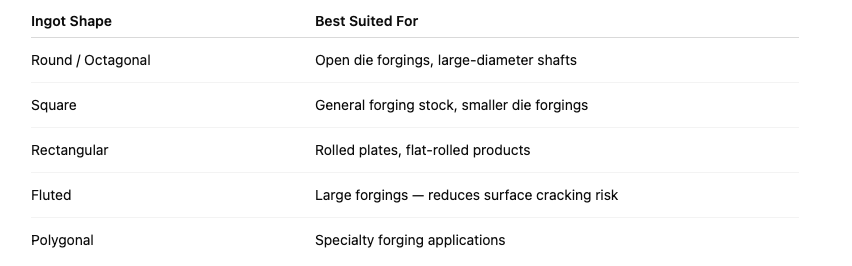
For forgings, round and octagonal ingots are preferred — particularly for larger sizes — because they reduce the risk of surface cracking during the forging operation.
Why Ingot Quality Directly Impacts Your Forgings
The quality of your forging ingot is not just a procurement detail — it is a production variable. Here is why it matters:
1. Internal Soundness
Voids, porosity, and shrinkage pipes inside an ingot lead directly to defects in your finished forgings. A well-controlled mold design and proper risering are essential to minimize these internal defects.
2. Grain Structure
The grain structure formed during solidification determines the mechanical properties of the final forging. Proper mold design, pouring temperature, and cooling rate all influence the grain.
3. Surface Quality
Surface cracks on the ingot can propagate during forging, leading to rejections. Proper mold taper, controlled pouring speed, and correct mold lubrication help prevent surface defects.
4. Chemical Consistency
Inconsistent chemistry from heat to heat causes variation in your heat treatment response, hardness, and machinability. Always source from a manufacturer with certified heat-wise test reports.
Common Ingot Defects to Watch Out For:
- Shrinkage cavity (piping) — top zone void due to metal contraction
- Segregation — uneven distribution of alloying elements
- Surface cracks — caused by thermal stress during solidification
- Blowholes — gas entrapment during pouring
Key Applications of Forging Ingots
Forging ingots serve as the raw material base for a vast range of critical components across industries:
- Gears and pinions — for automotive and industrial gearboxes
- Flanges and pipe fittings — for oil, gas, and petrochemical pipelines
- Valves and valve bodies — for high-pressure applications
- Bearings and bearing rings — produced via ring rolling
- Fasteners and bolts — for structural and pressure vessel use
- Machine tool components — spindles, dies, and press platens
- Shafts and axles — for power transmission
- Surgical and medical parts — requiring stainless steel grades
What to Look for When Buying Forging Ingots
Buying forging ingots is not just about price per tonne. Here is a practical checklist for industrial buyers:
1. Certifications
Always verify IBR (Indian Boiler Regulations) approval for pressure-related applications. ISO 9001 certification is a baseline quality indicator. For export orders, ask for mill test certificates (MTC) compliant with EN 10204 3.1 or 3.2.
2. Process Capability
Ask whether the manufacturer uses LRF + VD processing. Vacuum degassed ingots offer significantly better cleanliness and are mandatory for several critical forging grades.
3. Grade Range
A wide grade portfolio — from low carbon to high alloy and stainless steel — indicates a well-equipped melt shop and flexibility for your sourcing needs.
4. Size and Weight Range
Confirm that the manufacturer can supply ingots in the weight and cross-section you need for your forge press capacity. Ask about minimum and maximum ingot weights.
5. Testing and Inspection
Ultrasonic testing (UT), macro examination, and chemical analysis are standard requirements. Make sure the supplier can provide traceable documentation for every heat.
6.Consistency
The best manufacturers maintain consistent chemistry, weight, and surface quality across multiple heats. Ask for heat-wise records or approval history.
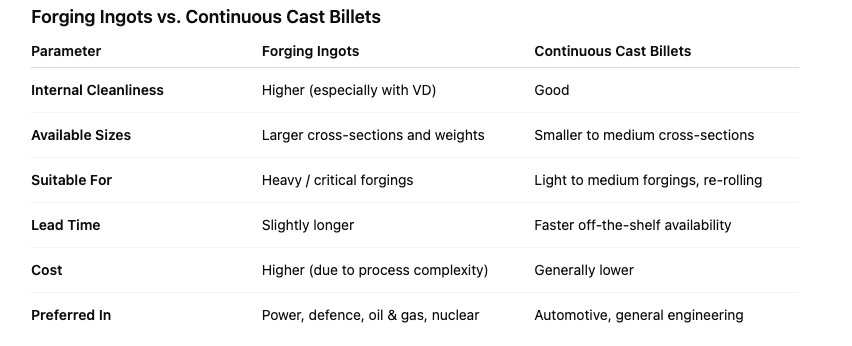
Insight: If your requirement involves critical applications, large components, or superior metallurgical integrity, forging ingots are the better choice. For cost efficiency and faster availability in standard applications, continuous cast billets are more practical.
Why Source Forging Ingots from Kesari Alloys?
At Kesari Alloys, we have been manufacturing forging quality steel ingots for nearly two decades from our facility in Bhiwadi, Rajasthan. Our ingots are trusted by ring rollers, forge shops, and engineering manufacturers across India and globally.
Here is what sets us apart:
- 🏭 IBR Approved — for carbon and alloy steel ingots in pressure applications
- 🏆 ISO 9001 Certified — quality management at every stage of production
- 🔬 EIF + LRF + VD Process — delivering superior internal cleanliness
- 📦 1,000+ size variants — in carbon steel, alloy steel, and stainless steel
- 📋 100+ steel grades available across our ingot, billet, and bar product lines
- ✅ Rigorous inspection — every ingot goes through a multi-stage quality check before dispatch
- 🤝 Certified member of the All India Induction Furnaces Association
From gears and flanges to valves and bearing rings, our forging ingots are the raw material foundation for the components that keep industries running.
Frequently Asked Questions (FAQs)
Conclusion
Forging ingots are the bedrock of the steel forging industry. Choosing the right ingot — the right grade, the right process route, the right supplier — determines the quality and consistency of everything downstream.
Whether you are a small forge shop looking to improve your input material or a large OEM seeking a reliable, certified supplier, understanding forging ingots at this level of detail will make you a smarter buyer.
Ready to discuss your forging ingot requirements? Get in touch with the Kesari Alloys team today →