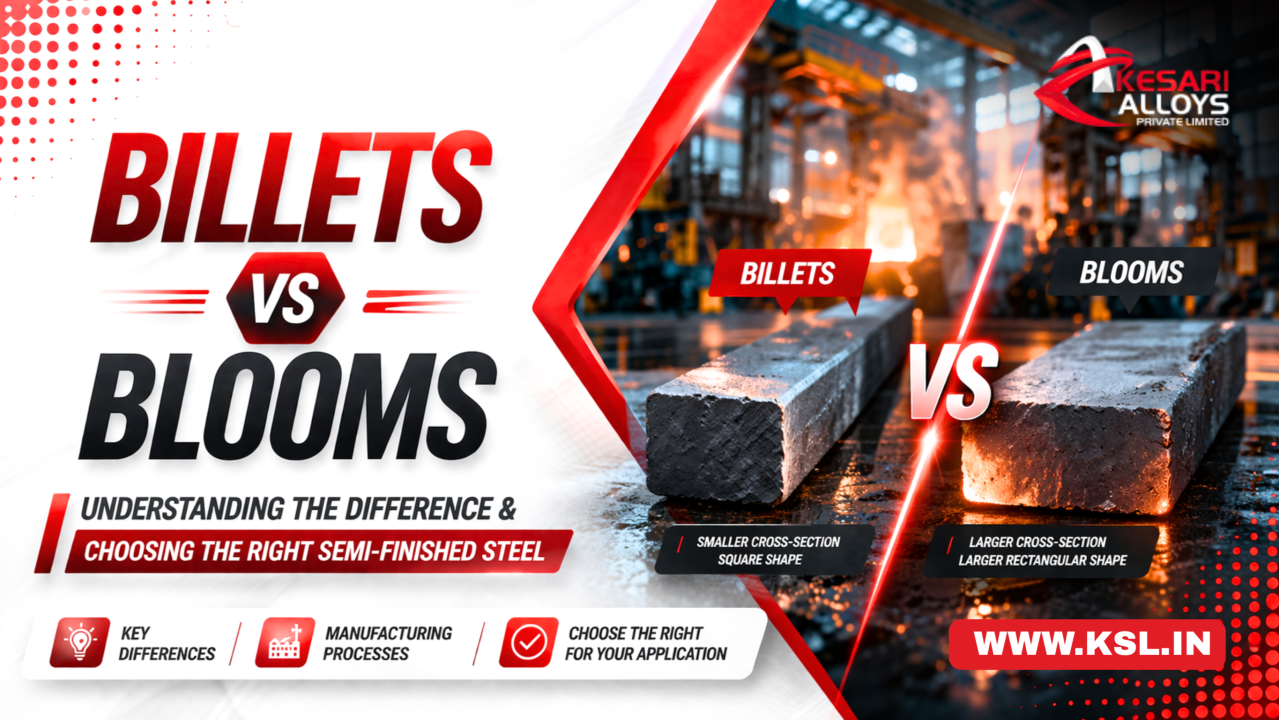
If you work in forging, ring rolling, re-rolling, or bar manufacturing, you deal with semi-finished steel products every day. But when a supplier asks whether you need billets or blooms, do you know exactly what differentiates the two — and which one your process actually requires?
The terms are often used interchangeably in casual conversation, but in practice they refer to distinct product forms with different cross-section sizes, different downstream applications, and different process considerations. Getting this wrong at the sourcing stage can mean mismatches with your rolling mill or forge press, unnecessary material waste, or production delays.
This guide clears it all up. By the end, you will know exactly what billets and blooms are, how they are made, where each one belongs in the industrial value chain, and how to choose the right one for your application.
What Are Semi-Finished Steel Products?
Before diving into the billet vs bloom comparison, it helps to understand where these products sit in the steelmaking chain.
Steel is made in one of two primary forms after the molten stage:
Cast Ingots — Molten steel is poured into individual cast iron molds and allowed to solidify. The resulting block is a forging ingot — a semi-finished product that must be further worked (forged, rolled, or upset) before it becomes a finished component.
Continuous Cast Products — Molten steel is continuously solidified through a strand casting machine to produce a stream of solid semi-finished steel in defined cross-sections. These products — billets, blooms, and slabs — emerge from the caster and are cut to the required length.
Billets and blooms are both continuous cast semi-finished products. They are the intermediate stage between the melt shop and the finished product — whether that finished product is a rolled bar, a forging, a ring, or a structural section.
What Is a Billet?
A billet is a continuously cast semi-finished steel product with a square or rectangular cross-section below 200mm × 200mm. In practice, most billets used in industrial applications fall in the range of 80mm × 80mm to 160mm × 160mm square, though exact sizes vary by manufacturer and application.
Billets are long, solid steel bars — typically available up to 12 meters in length — and they serve as the primary feedstock for:
- Bar and rod rolling mills — producing round bars, square bars, angles, and sections
- Wire rod mills — drawing down to wire products
- Light to medium forgings — where the section size matches the forge press capacity
- Ring rolling — for smaller-diameter rings and flanges
- Cold and warm forming — for fasteners, bolts, and precision parts
Because of their smaller cross-section, billets cool more uniformly during continuous casting, which results in a consistent, fine-grained microstructure throughout the cross-section. This makes them particularly well-suited for bar rolling and smaller precision forgings where dimensional consistency and surface quality are critical.
What Is a Bloom?
A bloom is a continuously cast semi-finished steel product with a square or rectangular cross-section at or above 200mm × 200mm. Blooms are essentially the larger sibling of billets — same continuous casting process, larger cross-section.
Typical bloom sizes range from 200mm × 200mm up to 450mm × 450mm square or equivalent rectangular sections. Like billets, they are available in lengths up to 12 meters and can be cut to required piece weights.
Blooms serve as feedstock for:
- Heavy bar and section rolling mills — producing large-diameter rounds, heavy structurals, and railway sections
- Medium to heavy forgings — where larger cross-sections are required for the forging ratio
- Heavy ring rolling — for large-diameter flanges, rings, and bearing races
- Bloom-to-billet rolling — where the bloom is first rolled down to billet size before further processing
Because blooms have a larger cross-section, they carry more mass per unit length, making them the preferred feedstock when you need a higher reduction ratio in rolling — which promotes better internal soundness in the final product — or when your forge press requires a heavier starting piece.
Billets vs Blooms: Head-to-Head Comparison
How Are Billets and Blooms Made? The Continuous Casting Process
Both billets and blooms are produced via the continuous casting (also called strand casting) process. Understanding this process helps you appreciate why the product quality is so closely tied to the process controls applied by the manufacturer.
Step 1 — Melting
Steel scrap and alloy additions are melted in an Electric Induction Furnace (EIF). The heat is carefully controlled to achieve the target steel chemistry.
Step 2 — Ladle Refining (LRF)
The molten steel is transferred to a Ladle Refining Furnace for fine chemistry adjustment, temperature homogenization, deep sulphur removal (desulfurization), and removal of non-metallic inclusions (inclusion flotation). This step is critical for achieving clean, consistent liquid steel.
Step 3 — Vacuum Degassing (VD)
For grades requiring very high internal cleanliness — particularly alloy steel grades for critical forgings — the steel is subjected to vacuum degassing. This removes dissolved hydrogen, nitrogen, and oxygen from the liquid steel. Oxygen levels are brought below 20 PPM and hydrogen below 2 PPM in a well-controlled process.
Step 4 — Continuous Casting
The refined liquid steel is transferred to the caster. From the ladle, steel flows into a tundish — a holding vessel that acts as a buffer and smooths the flow — and then through ceramic tubes into water-cooled copper molds, where solidification begins. The continuously solidifying strand is withdrawn and cut to length by a torch cutter.
The cross-section of the copper mold determines whether the product is a billet or a bloom. A billet caster uses smaller mold sections; a bloom caster uses larger ones.
Step 5 — Marking and Inspection
Each billet or bloom is marked with its heat number, grade, and size — ensuring full traceability from the melt shop to your production floor. Surface inspection is carried out to confirm the product is free from surface defects and cracks before dispatch.
Steel Grades Available in Billet and Bloom Form
A well-equipped continuous casting facility can produce billets and blooms across a wide range of steel grades. At Kesari Alloys, our billets and blooms are available in:
Carbon Steel Grades
Standard grades such as En8A, En8B, En8C, En8D, En9, C-45, C-50, SA105, CL I through CL VI, and AISI 1008 through 1040 series — used across automotive, construction, infrastructure, and general engineering.
Alloy Steel Grades
A comprehensive range including En15A, En15B, En19, En24, En25, En36C, En47, 16MnCr5, 20MnCr5, AISI 4130, 4140, 4150, 8620, 52100, F-11, F-12, F-22, and many more — covering the full spectrum of forging, case-hardening, and heat-treatable grades used in oil & gas, power generation, automotive, and heavy engineering.
Stainless Steel Grades
Including austenitic, martensitic, and duplex series for pharmaceutical, food processing, chemical, and marine applications.
Billets vs Blooms: Which One Does Your Process Need?
Use this practical decision guide when placing your next order:
Choose Billets When:
Your rolling mill uses smaller pass schedules. If your bar rolling mill is designed for 80–160mm input sections, billets are the correct feedstock. Using a bloom would require you to pre-roll it down to billet size first — adding cost and process steps.
You are producing small to medium diameter bars and rods. For finished rounds in the 20–80mm diameter range, a billet provides the right starting material and reduction ratio to achieve good internal soundness in the finished bar.
Your forgings are light to medium weight. For forgings up to approximately 20–30 kg per piece, billets provide an efficient, near-net-weight starting stock that minimises material waste.
You need fast, frequent deliveries in standard sizes. Billets are generally more readily available in standard sizes due to higher production volumes. For fast-moving, high-frequency orders, billet stock is easier to maintain.
Your process involves cold or warm forming. Fastener manufacturers, cold heading plants, and precision forming shops almost always use billets — the tighter dimensional tolerances and consistent surface quality suit their tooling requirements.
Choose Blooms When:
Your forging press requires a heavier starting piece. Large open die forgings — shafts, discs, rings, and heavy flanges — require a starting piece with sufficient mass. A 300mm × 300mm bloom weighing several hundred kilograms per metre is the right input for a heavy forge press.
You need a higher reduction ratio in rolling. Rolling a bloom down to a finished bar produces a higher total reduction ratio than rolling from a billet. Higher reduction breaks down the as-cast grain structure more completely, resulting in better internal soundness and more uniform mechanical properties in the finished bar — particularly important for critical structural and engineering applications.
You are producing large-diameter bars and sections. For finished rounds above 100–120mm diameter, a bloom is the correct starting size. A billet simply does not have enough cross-section to provide adequate reduction.
Your ring rolling involves large-diameter rings. For flanges, bearing races, and rings in the 500mm+ diameter range, blooms are the standard input material.
You are rolling heavy structural sections. Rail sections, heavy beams, large angles, and structural hollow sections are rolled from blooms, not billets.
Quality Parameters to Check When Sourcing Billets and Blooms
Regardless of whether you are buying billets or blooms, here are the key quality parameters your procurement team should always verify:
✅ Chemical Analysis (Heat-Wise MTC)
Every heat should come with a mill test certificate showing the chemical composition of the cast steel. Verify that the carbon, manganese, sulphur, phosphorus, and alloying element levels are within the specification tolerance for your grade.
✅ Surface Condition
Billets and blooms should be free from surface cracks, seams, laps, and deep scale pockets. Surface defects will propagate into the finished bar or forging. Ask for visual inspection records or surface testing documentation.
✅ Internal Cleanliness
For alloy steel grades used in critical forgings, internal cleanliness — measured by inclusion content and freedom from porosity — is essential. Products processed through LRF + VD will have significantly superior internal cleanliness compared to basic EIF-only material.
✅ Dimensional Accuracy
Consistent cross-section dimensions and length accuracy reduce material waste in your cutting and forging operations. Confirm the manufacturer’s dimensional tolerances before ordering.
✅ Radioactive Contamination Clearance
For export orders and critical industrial applications, billets and blooms should be certified free from radioactive contamination. This is a non-negotiable requirement for many international buyers.
✅ Heat Number Traceability
Every piece should be marked with its heat number, grade, and size — enabling full traceability from the melt shop to your finished product. This is mandatory for certified forgings and pressure components.
✅ Heat Treatment Condition
Some applications require billets and blooms in an annealed condition to improve machinability or to allow cold sawing or shearing. Confirm whether you need as-cast or heat-treated material before placing your order.
Common Applications: Billets and Blooms Across Industries

Why Kesari Alloys for Your Billets and Blooms Requirement
At Kesari Alloys, our continuous casting plant is engineered specifically for producing high-quality billets and blooms across carbon steel, alloy steel, and stainless steel grades. Our process — EIF + LRF + Vacuum Degassing + Continuous Casting — delivers the internal cleanliness and chemical consistency that forging, rolling, and ring rolling operations demand.
What you get when you source from Kesari Alloys:
- 📐 100+ grades available in continuous cast billet and bloom form — carbon steel, alloy steel, and stainless steel
- 📏 Wide size range in square and rectangular sections to match your mill or press requirements
- 📋 Up to 12 meters length — reducing material handling and improving productivity at your end
- 🔬 EIF + LRF + VD process — oxygen below 20 PPM, hydrogen below 2 PPM for critical grade orders
- ✅ Free from surface defects, cracks, radioactive elements, mercury and lead contamination
- 🏭 Heat-treated (annealed) condition available for grades requiring soft supply condition
- 🔖 Heat number marked on every piece — full traceability guaranteed
- 📄 Full MTC documentation with heat-wise chemical analysis and mechanical properties
- 🚚 Reliable, on-time delivery — trusted by forge shops, ring rollers, and re-rolling mills across India and globally
- 🏆 IBR Approved | ISO 9001 Certified | Member — All India Induction Furnaces Association
Frequently Asked Questions
Q1. What is the key size boundary between a billet and a bloom? The industry-standard boundary is 200mm × 200mm cross-section. Products below this are generally classified as billets; products at or above this size are classified as blooms. However, definitions can vary slightly between manufacturers and standards bodies.
Q2. Can billets and blooms be used directly for forging without rolling first? Yes. Depending on the forging size and the forge press capacity, billets and blooms can be used directly as forging input material. The starting piece is heated to forging temperature and then shaped under the press or hammer.
Q3. Are Kesari Alloys’ billets and blooms available in heat-treated condition? Yes. Billets and blooms can be supplied in annealed condition where required for cold sawing, shearing, or grades with higher hardness in the as-cast state.
Q4. What is the difference between a continuous cast billet and a forging ingot? A forging ingot is cast individually in a cast iron mold and is generally larger and heavier — suited for very large, critical forgings. A continuous cast billet or bloom is produced in a continuous casting machine, is more dimensionally consistent, and is better suited for rolling and lighter forgings. Ingots typically offer superior cleanliness in the very largest sections, especially with VD processing.
Q5. Do you supply billets and blooms for export orders? Yes. Kesari Alloys exports to buyers in Asia, the Middle East, and beyond. We provide all standard export documentation including mill test certificates, packing lists, and radioactive contamination clearance certificates.
Q6. Can I order billets and blooms in custom lengths and sizes? Yes. Our billets and blooms are custom-made in terms of dimensions, metallurgy, and piece weight. Share your specific requirements with our sales team and we will confirm what is achievable.
Conclusion
Billets and blooms are both essential semi-finished steel products — but they are not the same thing, and using the wrong one for your process leads to avoidable problems in rolling, forging, and finishing.
Billets — smaller cross-sections, ideal for bar rolling, wire rod, light forgings, and precision forming. Blooms — larger cross-sections, designed for heavy bar rolling, large forgings, ring rolling, and structural sections.
The right choice comes down to your finished product size, your mill or press capacity, and the reduction ratio you need to achieve the right internal structure. When in doubt, talk to your steel manufacturer — a good supplier will help you select the right starting form before the order is placed, not after.
Need billets or blooms in carbon steel, alloy steel, or stainless steel? Get in touch with the Kesari Alloys team →