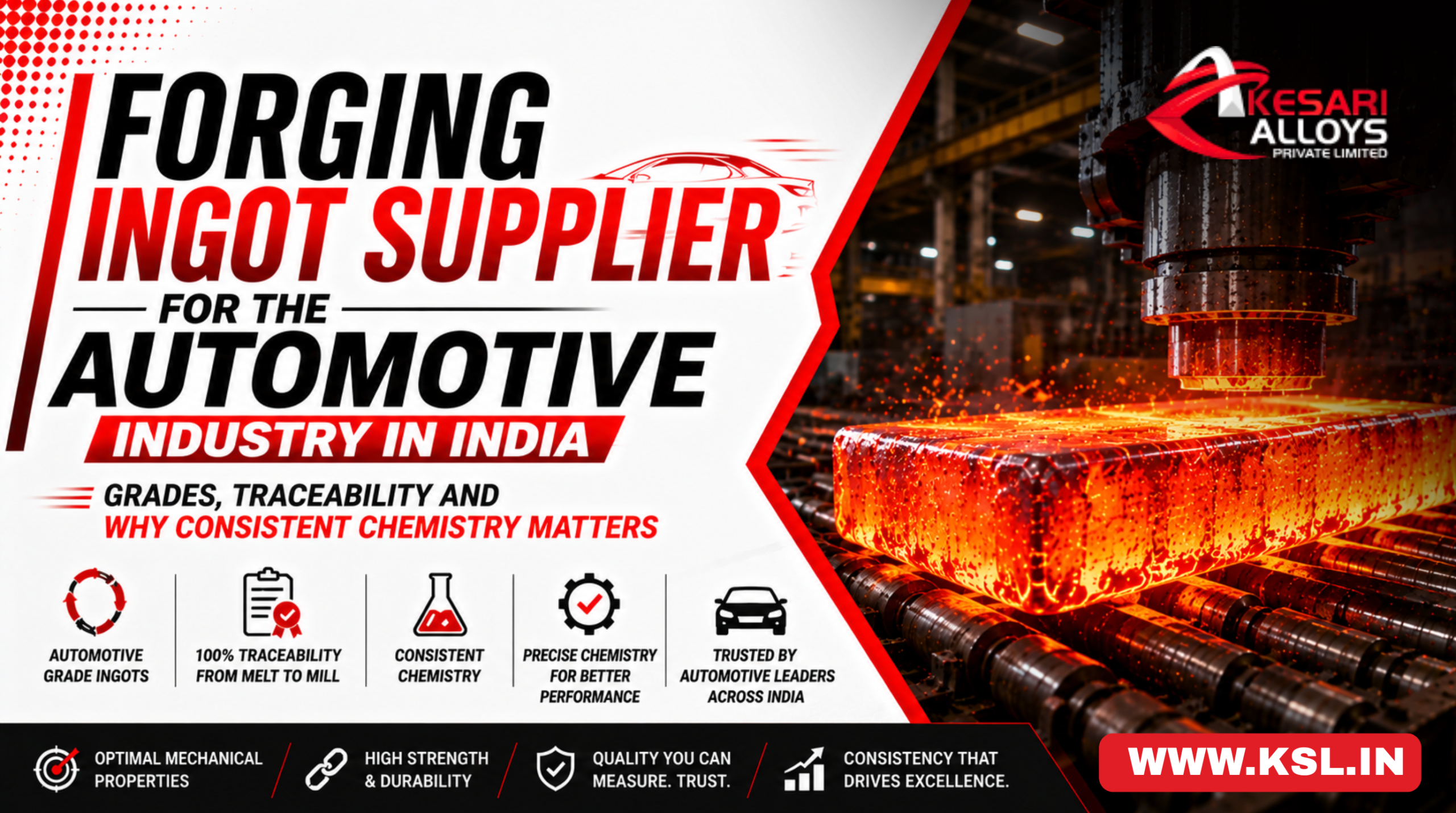
Every crankshaft, connecting rod, gear and axle begins life long before the forging press – it begins as liquid steel in a melt shop. For automotive forge shops, the quality of that starting material decides everything downstream: die life, rejection rates, machinability, and ultimately the fatigue life of a component that will see millions of load cycles.
India is now one of the world’s largest hubs for automotive forgings, supplying OEMs at home and abroad. That growth has raised the bar on what forge shops expect from their raw material partners. Here is what to look for in a forging ingot supplier for automotive applications.
Common Alloy Steel Grades for Automotive Forgings
| Component | Commonly Specified Grades |
|---|---|
| Crankshafts | En19 / 42CrMo4, EN8 / C45, 38MnVS6 (micro-alloyed) |
| Connecting rods | C70S6 (fracture-split), 16MnCr5, 38MnVS6 |
| Gears & transmission parts | 20MnCr5, 16MnCr5, SAE 8620, EN353 |
| Axles & shafts | EN8D, En19 / 42CrMo4, EN24 / 4340 |
| Steering & suspension | 41Cr4, SAE 1541, 42CrMo4 |
Grade selection is the OEM’s job; delivering that grade heat after heat, within tight chemistry bands, is the steelmaker’s job.
Why Consistent Chemistry Matters for Crankshafts and Connecting Rods
Automotive forging is a high-volume, tightly tuned process. Forge shops set their furnace temperatures, die designs and heat-treatment cycles around an expected hardenability band. When carbon or alloy content drifts from heat to heat – even within the standard’s full tolerance – problems follow:
- Inconsistent heat-treatment response: hardness scatter across batches, forcing re-tempering or rejection.
- Machinability swings: tool life drops, cycle times rise, and CNC lines lose output.
- Fatigue performance risk: crankshafts and con-rods are safety-critical; chemistry drift translates directly into life variation.
- UT rejections: high gas content (hydrogen, oxygen) causes flakes and inclusions detected at ultrasonic testing – after forging cost is already sunk.
This is why leading forge shops specify not just a grade but a melting route: EAF + Ladle Refining + Vacuum Degassing, with closed (protected) casting.
Traceability: What Automotive Buyers Should Demand
- Heat-wise mill test certificates (EN 10204 3.1) with actual ladle chemistry, not typical values.
- Gas analysis: oxygen, nitrogen and hydrogen (ONH) values reported per heat.
- Spectrometer verification: chemistry confirmed on an Optical Emission Spectrometer; PMI checks available at dispatch.
- Ingot/billet marking: heat number traceable from ingot to forged component – essential for IATF-aligned automotive quality systems.
- Radioactive contamination testing: increasingly required for export-bound automotive forgings.
Ingot Quality: The Details That Matter
For automotive forgings, ask how the ingot is made – not just what grade it is:
- Bottom pouring: reduces splashing and re-oxidation, giving cleaner ingot surface and fewer inclusions.
- Vacuum degassing: low hydrogen (protection against flaking in heavy sections) and low oxygen (cleaner steel, better fatigue life).
- Close casting: liquid steel shielded from atmosphere through teeming.
- Controlled heat treatment: annealing/normalizing in temperature-controlled furnaces for uniform structure before forging.
Kesari Alloys: A Raw-Material Partner for Automotive Forge Shops
Kesari Alloys Private Limited manufactures alloy steel forging ingots, continuous cast billets/blooms and rolled bars for the automotive forging industry. Our melt shop runs electric furnaces with ladle refining and a vacuum degassing system reaching 0.25 millibar in under five minutes; all ingots are bottom poured and close cast. In-house testing covers OES spectrometry, simultaneous ONH gas analysis, PMI verification and radioactive contamination testing. We are ISO 9001, ISO 14001 and ISO 45001 certified, IBR approved, and PED 2014/68/EU and AD-2000 Merkblatt compliant – and our steel already goes into forgings for India’s leading automotive and engineering names.
Planning your next quarter’s raw material? Call +91 98101 12977 or email info@ksl.in for grade-wise offers with full traceability.
FAQs
Q1. Which automotive forging grades does Kesari Alloys supply? EN8/C45, En19/42CrMo4, EN24/4340, 16MnCr5, 20MnCr5, SAE 8620, micro-alloyed grades and customized chemistries – as ingots, billets/blooms or rolled bars.
Q2. Can you hold tighter chemistry bands than the standard? Yes. Restricted ranges (e.g., narrowed C or Cr bands) can be agreed at order stage for heat-treatment consistency.
Q3. Do you support heat-wise traceability for IATF-aligned systems? Yes – every ingot/billet carries heat identification with a matching 3.1 certificate.
Q4. What ingot sizes are available? Multiple ingot sizes and billet sections are produced; share your forging input size and we will recommend the optimum.
Internal Links: Products → Forging Ingots page; Testing Technology page; Certifications page; Industries Served (Automobile)
Request a Quote → ksl.in/contact.php | WhatsApp: +91 98101 12977
Kesari Alloys Private Limited | IBR Approved | ISO 9001 Certified | Bhiwadi, Rajasthan, India Manufacturer & Exporter of Carbon Steel, Alloy Steel & Stainless Steel Ingots, Billets, Blooms & Rolled Bars