Quick answer
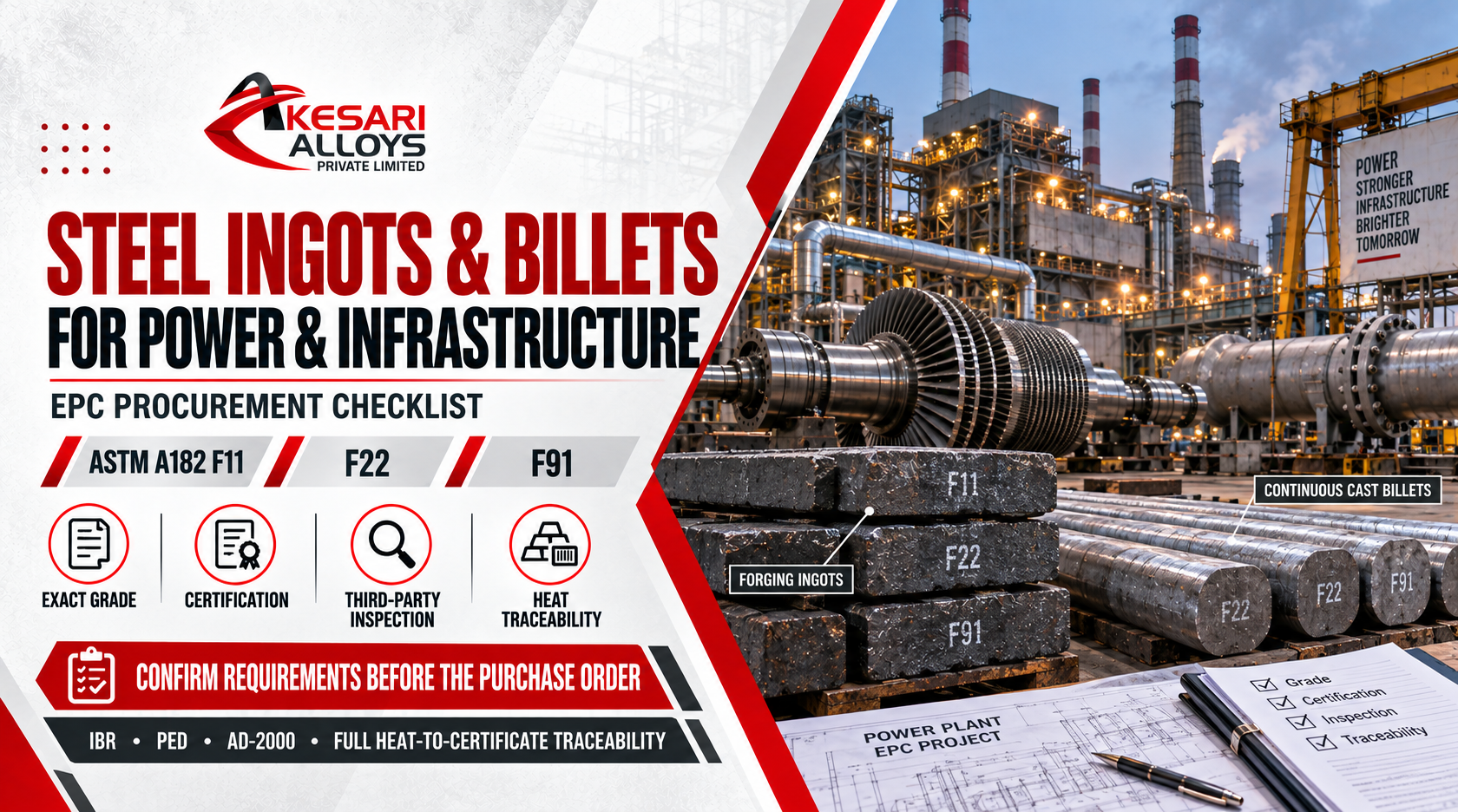
Power and heavy-infrastructure buyers typically need chromium-molybdenum grades (ASTM A182 F11, F22, F91) for steam and high-temperature service, IBR-compliant material wherever a boiler or steam pressure part is involved, and full heat-to-certificate traceability to satisfy EPC quality audits – the same technical bar as the oil & gas and valve sector, applied to power-plant and structural components instead of piping. Certification requirements (IBR, PED, AD-2000) and grade selection should both be confirmed at the enquiry stage, before the purchase order is issued.
A named sector with its own procurement rhythm
Power generation, heavy engineering and infrastructure & forging are three of the five industries Kesari Alloys serves, and buyers in this sector work differently from a typical forging-shop customer. Orders are usually tied to a specific project and EPC (engineering, procurement and construction) schedule rather than routine repeat production, documentation requirements are set by the project specification rather than the mill’s standard practice, and a single missed certification requirement can hold up an entire fabrication milestone, not just one part.
This guide brings together grade selection and certification requirements already covered in depth elsewhere on this site, organised specifically around how a power or infrastructure EPC procurement team actually needs to use them.
Where forged and cast steel shows up in power and infrastructure projects
| Component type | Typical grade family | Why |
| Boiler drums, headers, steam pipe fittings | ASTM A182 F11 / F22 / F91 | Elevated-temperature strength and hydrogen-attack resistance for steam service |
| Turbine and generator shafts | Through-hardened alloy steel (SAE 4140/4340, EN19/EN24 family) | High strength and toughness in large forged sections |
| Structural forgings and heavy fabrication components | Carbon and carbon-manganese steel | Cost-effective strength for non-pressure structural parts |
| Valve bodies and fittings in steam or hydrocarbon service | A350 LF2/LF3, A182 F-series | Low-temperature toughness or elevated-temperature service, per application |
For the full technical breakdown of the A182 F-series and A350 LF grades – including which grade suits which service temperature and why NACE MR0175/ISO 15156 compliance matters for sour service – see our dedicated guide to alloy steel for the valve and oil field industry. The grade logic is identical; only the end application differs.
The certification stack, in EPC procurement terms
Our guide to IBR approval explains what each certification actually verifies. For an EPC buyer specifically, the practical question is which certificate your project actually requires:
| If your component… | You need |
| Goes into a boiler or a steam pressure part registered under the Indian Boilers Act | IBR approval – this is a legal requirement, not optional |
| Is sold into or used in equipment destined for the European market | PED 2014/68/EU |
| Must meet German pressure vessel technical rules (common on European OEM-specified projects) | AD-2000 Merkblatt |
| Needs an audited quality/environmental/safety management system as part of vendor qualification | ISO 9001 / 14001 / 45001 |
These four requirements are independent of each other – holding one does not imply the others, and a project may require more than one simultaneously. Confirm exactly which certifications your specific project specification calls for before the enquiry goes out, not after.
Why vendor approval matters more in this sector than most
EPC contractors and power-sector OEMs typically maintain formal approved-vendor lists, and getting onto one is a considerably higher bar than holding a certificate – it means the material has already been through incoming inspection repeatedly, across multiple heats, over an extended period. Kesari Alloys is a registered vendor with organisations including BHEL, Bharat Forge, Adani Defence, Jindal Defence, CHW Forge and Sunil Forging. If you are evaluating suppliers for a power or infrastructure project, ask for the approved-vendor list directly – it tells you more about real-world performance than a certificate alone.
An EPC procurement checklist
1. Confirm the exact grade and ASTM/EN/IS specification called out in the project drawing or specification document
2. Confirm which certifications the project actually requires (IBR, PED, AD-2000, ISO) – check the project spec, don’t assume
3. Confirm heat treatment condition required at supply
4. Confirm whether third-party inspection is required, and by whom, before material is dispatched
5. Confirm heat-number traceability requirements match your project’s documentation standard
6. Build lead time around your project schedule, particularly if the order falls in the Oct–Nov festive-season window – see our guide to planning Q3 procurement
Frequently asked questions
What steel grades are typically specified for power plant components?
Chromium-molybdenum grades (A182 F11, F22, F91) dominate high-temperature steam service such as boiler and turbine piping components, while through-hardened alloy steels (4140/4340, EN19/EN24 family) are typical for large structural forgings such as turbine and generator shafts. The exact grade always follows the project specification.
Is IBR approval required for all power-sector steel, or only boiler-specific parts?
IBR applies specifically to material going into a boiler or a steam pressure part registered under the Indian Boilers Act. General structural or non-pressure components in the same power plant do not require it. Confirm against your specific component’s service before assuming either way.
Can Kesari Alloys supply material with third-party inspection for EPC projects?
Share your project’s third-party inspection requirement (agency and scope) at the enquiry stage and we will confirm what can be accommodated.
What is the difference between power-sector and oil & gas steel requirements?
The underlying grade families overlap significantly – both rely heavily on the A182 Cr-Mo series and IBR/PED certification – but the specific components, service temperatures and applicable codes differ by project. Our guide to the valve and oil field industry covers the grade logic in detail; the same logic applies here with different end components.
How does vendor approval status affect a new EPC project enquiry?
An existing approved-vendor relationship with your EPC contractor or with organisations like BHEL can simplify and speed up qualification for a new project, since incoming-inspection history already exists. Ask your supplier for their approved-vendor list as part of your evaluation.
The short version
Power and infrastructure procurement runs on project specifications, not routine repeat orders – which makes confirming the exact grade, certification stack and inspection requirement at the enquiry stage far more important than it is for standard forging-shop buying. The underlying grades and certifications are the same ones covered in our IBR and valve-industry guides; this is how an EPC buyer should actually use them.
Talk to our metallurgical team
Share your project specification, required grade and certification stack, and our metallurgical team will confirm feasibility, documentation and lead time.
Kesari Alloys Private Limited | IBR Approved | ISO 9001, 14001, 45001 | PED 2014/68/EU | AD-2000 Merkblatt
Plant: Bhiwadi, Rajasthan | Office: 152, JMD Megapolis, Sector 48, Gurugram, Haryana