Quick answer
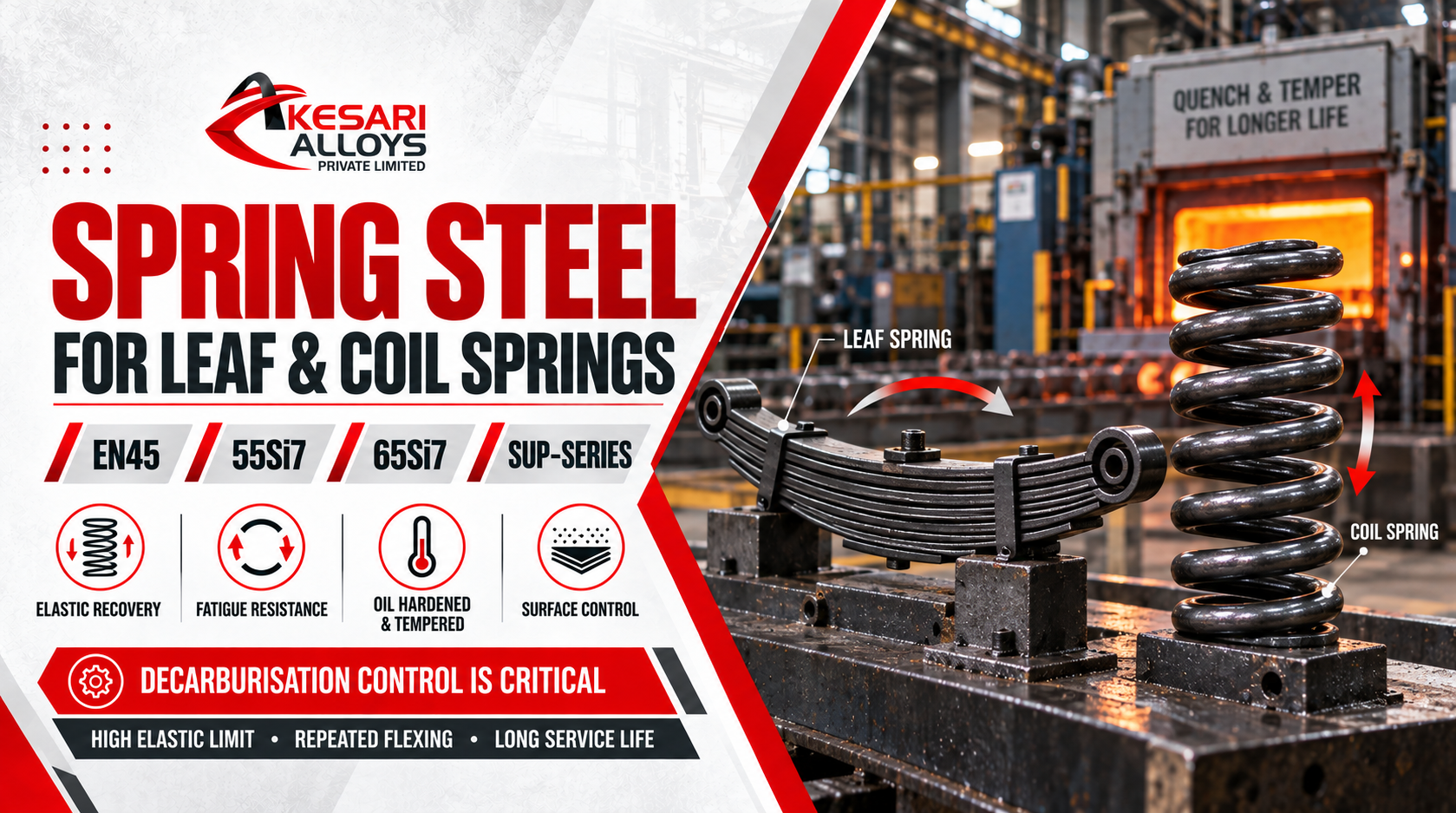
Spring steel (EN45, 55Si7, 65Si7, SUP-series) uses silicon-manganese alloying combined with a precise quench-and-temper cycle to raise the elastic limit high enough that a part returns fully to shape after repeated flexing instead of taking a permanent set. Grade and section choice depend mainly on whether the spring is a heavy-duty automotive leaf spring or a smaller, more precisely toleranced coil spring – and surface decarburisation control matters more here than in almost any other steel family, because a decarburised skin fails in fatigue almost immediately under cyclic flexing.
What actually makes a steel “spring steel”
A spring’s entire job is to deform elastically and then return exactly to its original shape, over and over, for millions of cycles. That requires two properties most engineering steels don’t need to combine: a high elastic limit (the stress a part can take before it starts to deform permanently) and enough toughness to survive that stress cyclically without cracking.
Silicon is the key alloying addition. It raises the elastic limit significantly beyond what carbon content alone would achieve, without the loss of ductility that simply adding more carbon would cause. Manganese contributes hardenability, ensuring the section hardens evenly through its thickness during heat treatment. The combination, correctly heat treated, is what lets a leaf spring flex under a vehicle’s full load thousands of times a day without gradually sagging.
Composition and heat treatment by grade
| Grade | Carbon (%) | Silicon (%) | Manganese (%) | Typical heat treatment |
| EN45 | 0.50–0.60 | 1.50–2.00 | 0.70–1.00 | Oil hardened and tempered |
| 55Si7 | 0.50–0.60 | 1.50–2.00 | 0.60–0.90 | Oil hardened and tempered |
| 65Si7 | 0.60–0.70 | 1.50–2.00 | 0.60–0.90 | Oil hardened and tempered |
| SUP-series (e.g. SUP9, SUP11A) | 0.50–0.60 | 0.15–2.00 (grade-dependent) | 0.65–1.00 | Oil hardened and tempered; SUP11A adds chromium |
The step from 55Si7 to 65Si7 is a deliberate increase in carbon for higher strength and elastic limit at the cost of slightly reduced ductility – a trade-off decided by section thickness and duty cycle, not simply “which is better.”
Why decarburisation is more damaging here than almost anywhere else
Our guide to EN31 bearing steel explains decarburisation as a defect that leaves a soft skin requiring extra machining. In spring steel, decarburisation is a more serious problem for a different reason: a spring’s maximum stress occurs at the surface, not the centre.
• A leaf or coil spring flexes under bending or torsional load, and bending/torsional stress is always highest at the outer surface and effectively zero at the neutral axis in the centre.
• A decarburised surface layer has lower strength and lower hardness exactly where the stress is highest.
• Under millions of flex cycles, that mismatch initiates a fatigue crack at the surface far earlier than it would in a fully carburised, correctly hardened section – often long before the bulk of the part shows any sign of distress.
• This is why spring steel specifications frequently carry a maximum decarburisation depth as a hard acceptance criterion, and why furnace atmosphere control during heat treatment is treated as a primary quality parameter rather than a secondary one for this grade family specifically.
Applications by grade and duty
| Application | Typical grade choice | Why |
| Heavy-vehicle leaf springs | 65Si7, SUP9 | Higher carbon for higher elastic limit under sustained heavy load |
| Passenger vehicle leaf/coil springs | 55Si7, EN45 | Balance of strength and ductility for lighter duty cycles |
| Precision coil springs (valve, clutch) | 55Si7, chromium-alloyed SUP grades | Tighter tolerance and consistency requirements |
| Railway buffer and draft-gear springs | 55Si7, 65Si7 | High cyclic load tolerance over long service life |
| Agricultural implement springs | 55Si7, EN45 | Cost-effective fatigue resistance for field conditions |
What to specify when ordering
1. Grade and governing standard
2. Required hardness range in the supplied condition
3. Maximum permissible decarburisation depth, if your specification sets one
4. Supply condition – oil hardened and tempered is standard for this family; state clearly if a different condition is needed
5. Section size and finished spring geometry, so forging ratio and starting stock can be confirmed
Frequently asked questions
What is the difference between 55Si7 and 65Si7?
The main difference is carbon content – 65Si7 carries more carbon than 55Si7, giving a higher elastic limit and strength at a small cost in ductility. 65Si7 is generally preferred for heavier-duty leaf springs, while 55Si7 suits lighter-duty and more ductility-sensitive applications.
Is EN45 the same as spring steel used for leaf springs?
EN45 is one of several spring steel grades used for leaf springs, alongside 55Si7 and the SUP-series. Grade selection depends on the specific duty cycle, load and standard called out on the drawing, rather than there being one single “leaf spring steel.”
Why does decarburisation matter so much for spring steel specifically?
A spring’s peak bending or torsional stress occurs at the outer surface, exactly where a decarburised layer is weakest. That combination causes fatigue cracks to initiate far earlier than in a fully hardened section, which is why decarburisation depth is often a hard acceptance criterion for spring steel specifications.
Can spring steel be supplied as continuous cast billet for re-rolling?
Yes – spring steel grades are available as continuous cast billet for customers who re-roll into their own bar sizes, as well as forging ingot for larger sections. Share your required section and grade and we’ll confirm.
What hardness range is typical after heat treatment?
This varies by grade and application, typically in the 42–48 HRC range for oil hardened and tempered spring steel, though the exact target depends on the specification and duty cycle. Confirm the hardness range required on your drawing at the enquiry stage.
The short version
Spring steel’s job is entirely about surviving repeated flexing without taking a permanent set, and that makes surface quality – specifically decarburisation control – as important as bulk chemistry. Grade choice comes down to duty cycle: heavier load and longer fatigue life pushes toward higher-carbon 65Si7 or SUP9; lighter duty and better ductility favours 55Si7 or EN45.
Talk to our metallurgical team
Share your spring type, duty cycle and any decarburisation or hardness specification, and our metallurgical team will confirm the right grade and supply form.
Kesari Alloys Private Limited | IBR Approved | ISO 9001, 14001, 45001 | PED 2014/68/EU | AD-2000 Merkblatt
Plant: Bhiwadi, Rajasthan | Office: 152, JMD Megapolis, Sector 48, Gurugram, Haryana