Quick answer
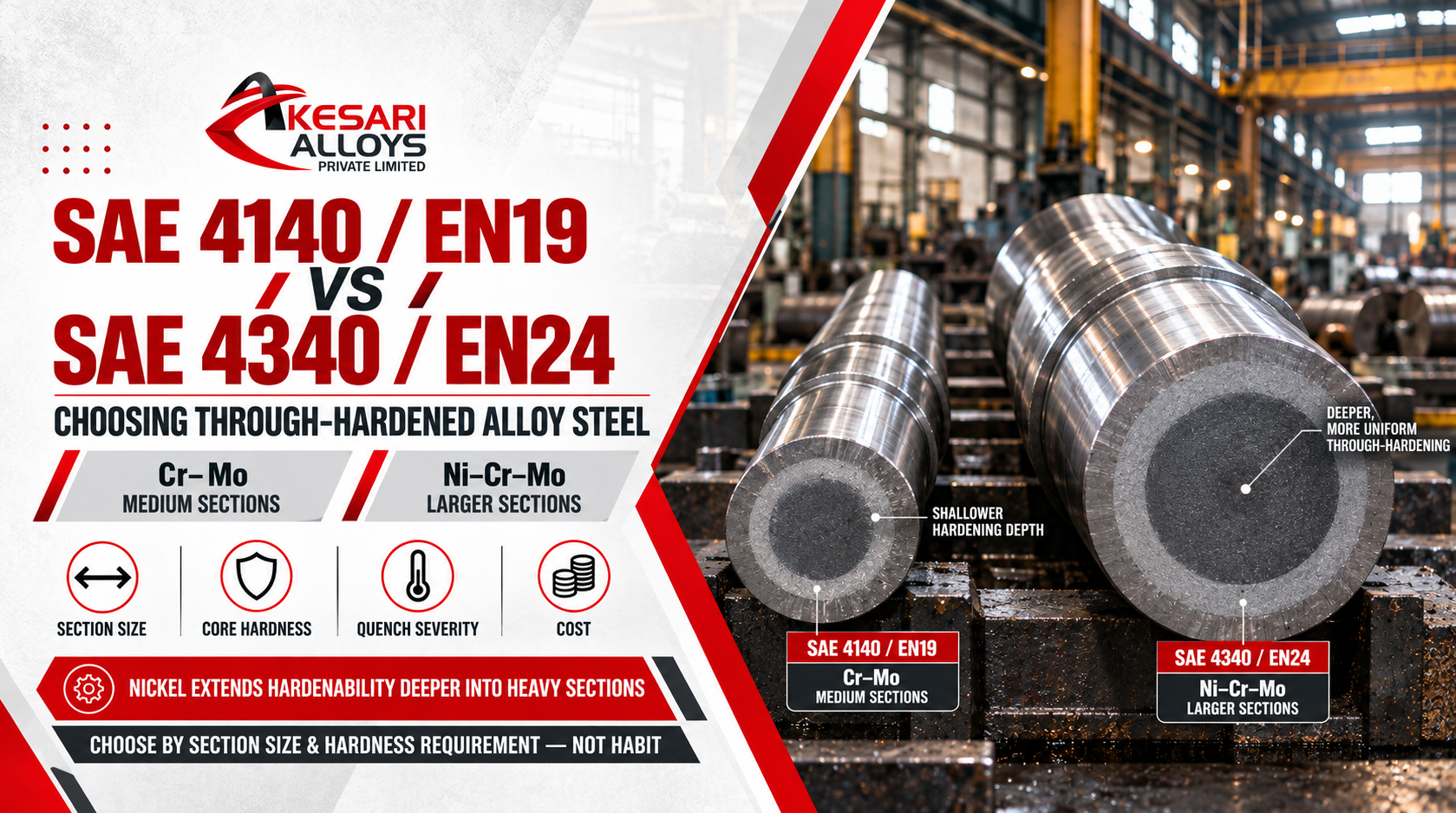
SAE 4140 and EN19 (both chromium-molybdenum steels) suit medium-section shafts and structural forgings needing good strength and toughness at moderate cost. SAE 4340 and EN24 add nickel, which raises hardenability significantly and lets larger sections through-harden without a severe water quench – the right choice when section thickness, or the need for a slower and safer oil quench, is the deciding factor rather than raw strength alone. EN19 is broadly the British-standard equivalent of SAE 4140, and EN24 of SAE 4340, though the specification on the drawing should always govern.
Two families, one underlying decision
These four grades are routinely treated as interchangeable in casual conversation – “4140 or EN19, whichever’s available” – and that habit causes real problems. They are two families, not four unrelated grades, and the decision between the families comes down to one metallurgical question: does this section need to through-harden at a thickness where a chromium-molybdenum steel’s hardenability runs out?
Composition comparison
| Grade | Carbon (%) | Chromium (%) | Molybdenum (%) | Nickel (%) |
| SAE 4140 | 0.38–0.43 | 0.80–1.10 | 0.15–0.25 | – |
| EN19 | 0.35–0.45 | 0.90–1.40 | 0.20–0.35 | – |
| SAE 4340 | 0.38–0.43 | 0.70–0.90 | 0.20–0.30 | 1.65–2.00 |
| EN24 | 0.36–0.44 | 1.00–1.40 | 0.20–0.35 | 1.30–1.80 |
The defining difference across the table is the nickel column. 4140 and EN19 have none; 4340 and EN24 carry roughly 1.3–2.0%. Everything downstream – hardenability, section-size capability, quench severity, and typically cost – follows from that one difference.
Hardenability, explained without a Jominy curve
Hardenability is not the same thing as maximum hardness – it’s how deep into a section that hardness can actually be achieved. A thin section of almost any hardenable steel will through-harden easily. A thick section is a different problem: the centre cools slowly no matter how aggressively you quench the surface, and if the steel’s hardenability isn’t high enough, the centre transforms to a softer structure while the surface hardens fully.
• 4140 / EN19 have moderate hardenability from chromium and molybdenum alone. They through-harden reliably in small-to-medium sections, typically with an oil quench, but hardenability runs out as section size increases.
• 4340 / EN24 add nickel specifically to extend hardenability much further into thick sections. This is the practical reason to choose the nickel-bearing grade: not because it’s simply “stronger,” but because a large-diameter shaft in 4140 may harden fully at the surface and stay soft at the core, while the same section in 4340 through-hardens properly.
• The nickel addition also allows a less severe quench (oil rather than water) to still achieve full hardening in a heavier section – which matters directly for quench-crack risk on complex or asymmetric geometries.
Typical applications
| Grade | Typical use |
| SAE 4140 / EN19 | Medium-diameter shafts, couplings, general structural forgings, tooling where moderate strength and toughness at reasonable cost is the target |
| SAE 4340 / EN24 | Large-diameter shafts and axles, high-load gears, connecting rods, aerospace-adjacent and heavy-duty structural forgings where section size or shock loading demands the extra hardenability and toughness |
Common substitution mistakes
1. Treating EN19 and SAE 4140 as fully interchangeable without checking the exact specification – the composition ranges overlap closely but are not identical, and a customer’s drawing may call out a specific standard for a reason (existing qualification, export destination, code compliance).
2. Specifying 4140/EN19 for a section too thick for its hardenability, discovering at final inspection that the core hardness doesn’t meet the drawing requirement – this should be checked against section size before ordering, not after forging.
3. Over-specifying 4340/EN24 out of habit for a section that 4140/EN19 would through-harden perfectly well, paying for hardenability the part doesn’t need.
4. Assuming heat treatment condition is implied – normalised, quenched-and-tempered and annealed conditions give materially different properties from the same chemistry; state the condition required rather than assuming a default.
Where these grades sit relative to our other guides
These through-hardened grades sit alongside two other decisions covered elsewhere: case-hardening grades such as 20MnCr5 and SAE 8620 (see our comparison guide) are the right choice instead of this family when the part needs a hard wear-resistant case over a tough core rather than uniform through-hardness. And because these are alloy grades in section sizes that are often heavy, hydrogen control matters – see our guide to vacuum degassing for why flake-sensitive alloy steels in this family specifically benefit from a controlled melting route.
Frequently asked questions
Is EN19 the same as SAE 4140?
They are closely equivalent chromium-molybdenum grades with overlapping composition ranges, but they are not identical specifications. Always work to the exact standard named on the customer’s drawing rather than assuming direct interchangeability.
Is EN24 the same as SAE 4340?
Similarly, EN24 and SAE 4340 are closely equivalent nickel-chromium-molybdenum grades, with EN24 typically carrying somewhat higher chromium. Confirm the governing specification before substituting one for the other.
Which grade should I use for a large-diameter shaft that needs to through-harden?
This depends on the section diameter and the hardness required at the core. As a general rule, once a section is large enough that 4140/EN19 cannot reliably through-harden at the core, 4340/EN24 is the correct family to move to. Share your section size and hardness requirement and we can advise.
Can these grades be supplied as both forging ingot and continuous cast billet?
Yes, across the range covered in our comparison of forging ingots vs continuous cast billets – the right product form depends on your finished part size and forging ratio requirement, not the grade itself.
Why does nickel improve hardenability instead of just adding strength?
Nickel slows the transformation of austenite to softer structures during cooling, which allows hardness to develop deeper into a section before the centre has a chance to transform. This is a hardenability effect, distinct from – though related to – the strength and toughness nickel also contributes.
The short version
4140/EN19 and 4340/EN24 are two families separated by one alloying decision – nickel – that determines how deep into a section the steel can actually through-harden. Section size and hardness requirement should decide which family you specify, not habit or availability.
Talk to our metallurgical team
Send your section size, hardness requirement and heat treatment condition, and our metallurgical team will confirm which grade and family is the right fit – and whether it’s better supplied as ingot or billet.
Kesari Alloys Private Limited | IBR Approved | ISO 9001, 14001, 45001 | PED 2014/68/EU | AD-2000 Merkblatt
Plant: Bhiwadi, Rajasthan | Office: 152, JMD Megapolis, Sector 48, Gurugram, Haryana