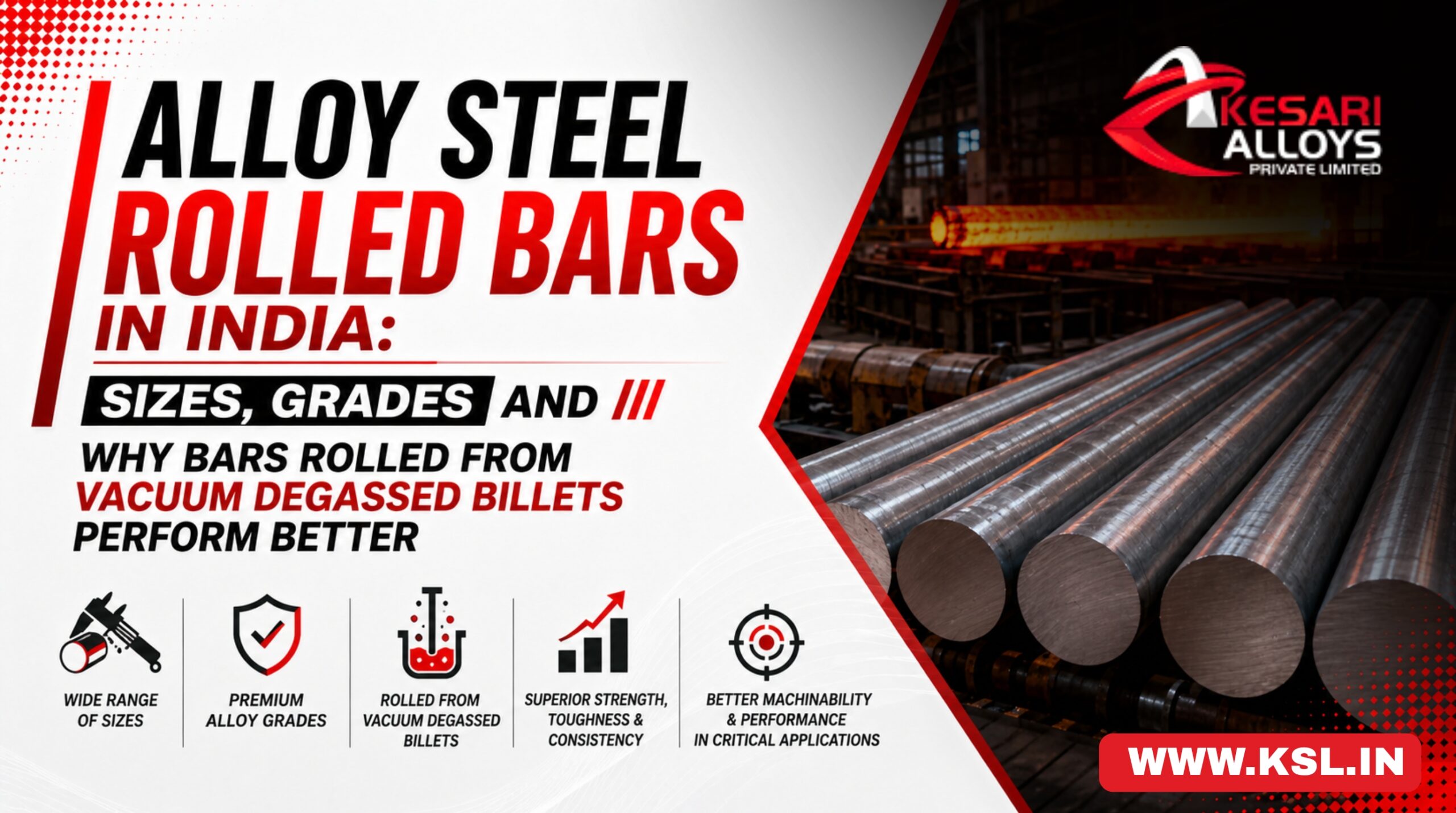
For machine shops and component manufacturers, the quality of a finished part is often determined by a choice made months earlier at the melt shop. While many suppliers offer Rolled Bars and Alloy Steel Round Bars, there is a significant performance gap between a generic bar and one engineered from a vacuum-degassed (VD) route.
As a leading alloy steel round bars manufacturer India, Kesari Alloys provides high-performance rolled products that serve as the backbone for critical industrial components. This guide explores the technical advantages of our rolled bars and why the “melt route” is the most important specification you can provide.
1. Where Rolled Bars Sit in the Product Chain
The journey of a high-quality rolled bar begins with ladle refining and vacuum degassing. At Kesari Alloys, liquid steel is processed through our Electric Induction Furnace (EIF), refined in a Ladle Refining Furnace (LRF), and then subjected to a deep vacuum. This refined steel is cast into VD route round bars or billets, which are then hot-rolled into finished bar shapes. This integrated process ensures that every bar can be traced back to a specific, certified heat.
2. Why the Melt Route Matters More Than the Rolling Mill
The rolling mill defines the shape, but the melt route defines the soul of the steel. Inclusions, gas content, and chemistry consistency are all set “upstream” before the steel even reaches the rolling stands.
- Inclusion Level: Our EAF + LRF + VD route produces exceptionally clean steel.
- Gas Content: Hidden enemies like hydrogen can cause internal flakes. Our VD system reaches 0.25 millibar in under five minutes, bringing hydrogen levels to less than 2 PPM and oxygen below 25 PPM.
- Chemistry Consistency: We hold tighter chemistry bands than standard specifications to ensure uniform response during subsequent heat treatment.
3. Manufacturer vs. Stockist: The Traceability Advantage
Sourcing from an alloy steel round bars manufacturer India rather than a stockist eliminates the “documentation gap.” When you buy from Kesari Alloys, you get:
- Direct Accountability: We melted the steel, refined it, and rolled it.
- Full Traceability: Every bar is linked to a heat-wise EN 10204 3.1 certificate.
- Customization: We can tailor the chemistry (e.g., narrowed C or Cr bands) to your specific machining or hardening needs.
4. Grades Available at Kesari Alloys
We manufacture a wide range of hot rolled alloy steel bars and carbon steel bars India to meet diverse engineering requirements.
| Family | Typical Grades |
|---|---|
| Carbon Steel | EN8 / C45, EN9, SAE 1018, SAE 1020 |
| Alloy Steel (Cr-Mo) | EN19 round bar / SAE 4140 rolled bar, EN24 / AISI 4340 |
| Case Hardening | 20MnCr5, 16MnCr5, SAE 8620, EN353 |
| Specialty | EN31 (bearing steel), Stainless Steel (Martensitic & Austenitic) |
5. Size Range and Supply Conditions
Kesari Alloys offers high-precision sizes designed for ring rolling, forging, and direct machining.
- Size Range: 25mm to 180mm diameter.
- Lengths: Standard 5-6 meter lengths or customized cut-to-length options.
- Supply Conditions: As-rolled, Annealed, Normalized, or Hardened & Tempered (Q&T).
- Tolerance: Dimensional compliance to h11/h12 tolerances.
6. Testing Behind Every Bar
To ensure internal integrity and chemical accuracy, every batch undergoes rigorous in-house testing:
- Optical Emission Spectrometry (OES): Verification of exact elemental composition.
- Simultaneous ONH Gas Analysis: Ensuring Oxygen, Nitrogen, and Hydrogen are within strict limits.
- Digital Ultrasonic Testing (UT): Checking for internal flaws or center-line porosity.
- Documentation: EN 10204 3.1 mill test certificates with actual heat values.
7. High-Performance Applications
Our rolled bars are trusted by machine shops and OEMs for components where fatigue resistance is non-negotiable:
- Automotive: Transmission shafts, gears, axles, and wheel hubs.
- Hydraulics: Cylinder rods and pump shafts.
- General Engineering: Fasteners, bolting, guide rails, and structural pins.
- Power & Energy: Turbine components and pressure-retaining pins.
8. How to Enquire for the Fastest Quotation
To help our technical team provide an accurate quote quickly, please include the following in your enquiry:
- Grade: (e.g., EN19, SAE 4140, 20MnCr5)
- Size: Diameter in mm
- Quantity: Total tonnage or number of bars
- Condition: (e.g., As-rolled, Annealed, or Q&T)
- End Use: Brief description of the component to be manufactured
Contact Details:
- Email: info@ksl.in
- Phone: +91 98101 12977
- Website: ksl.in
9. Frequently Asked Questions (FAQ)
Q: What is the difference between Black Bars and Bright Bars?
A: Black bars are hot-rolled and have a dark scale on the surface. Bright bars are secondary-processed (drawn or peeled) to achieve a smoother finish and tighter tolerances.
Q: What are the standard tolerance levels?
A: We typically supply with h11 or h12 tolerances, suitable for most industrial machining applications.
Q: What is the Minimum Order Quantity (MOQ)?
A: MOQs depend on the grade and current production schedule; please contact us with your specific requirements for confirmation.
Q: Why choose the VD route for round bars?
A: The VD (Vacuum Degassing) route is essential for preventing internal flakes and ensuring the steel is clean enough to pass stringent ultrasonic testing.