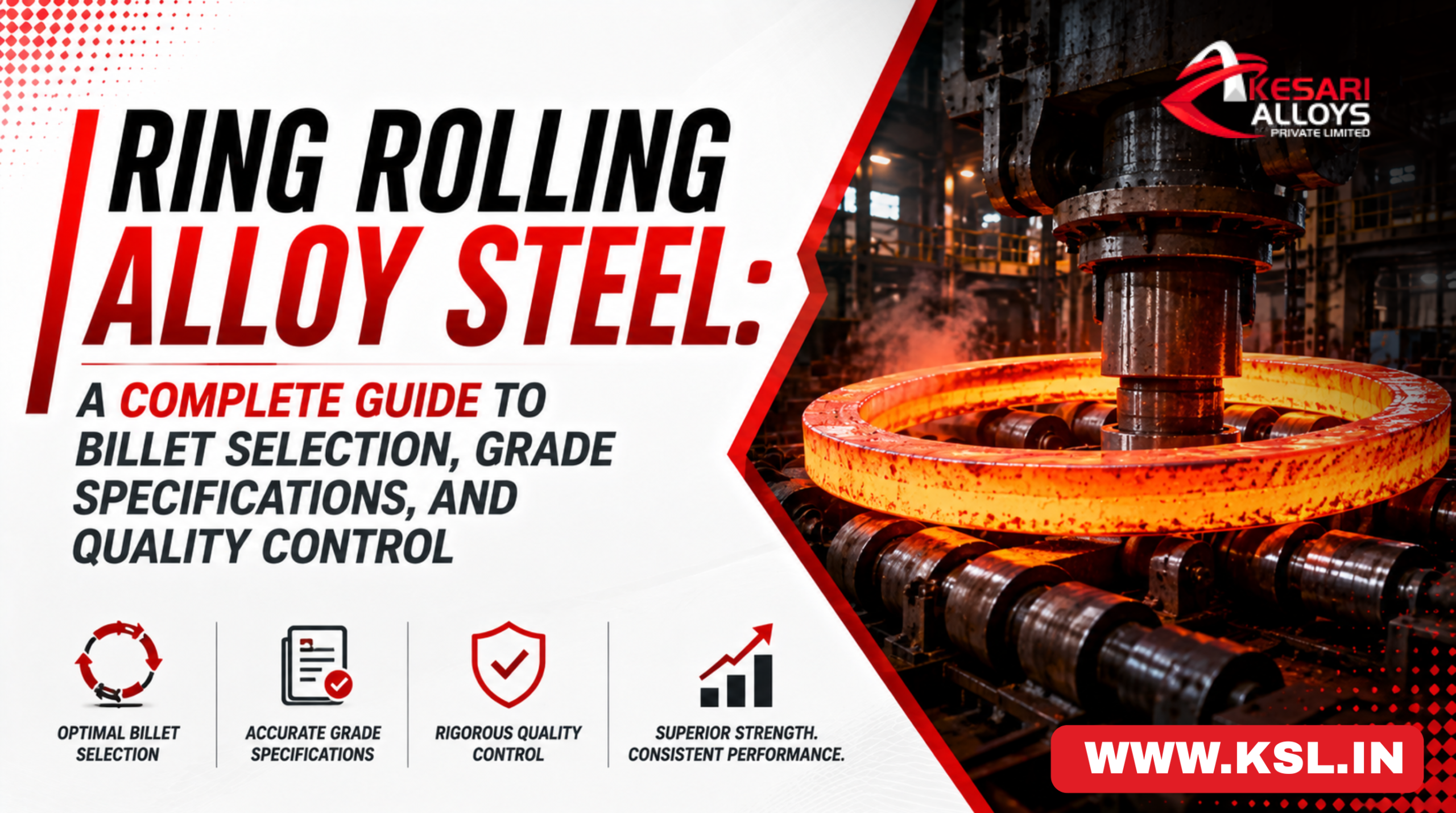
Ring rolling is one of the most material-efficient and microstructurally precise processes in metal forming. Starting from a pierced billet preform – the ring blank – the ring rolling mill reduces the wall thickness, increases the diameter, and controls the height of a rotating ring workpiece between driven rolls. The process produces seamless rolled rings with continuous circumferential grain flow aligned with the ring geometry, high dimensional accuracy, and mechanical properties that are superior in the hoop direction to any alternative production method for ring-shaped components.
The quality of the finished ring – its dimensional accuracy, its mechanical properties, its UT cleanliness, and its heat treatment response – is determined at the billet. The billet is the starting material from which the ring blank is upset and pierced before rolling. Its chemistry, cleanliness, dimensional consistency, and surface condition directly control every downstream process step and every quality attribute of the finished ring.
This guide covers the complete technical picture of billet selection and specification for ring rolling applications, the alloy steel grades that are most widely used and what makes them suitable, and the quality control requirements that ring rolling manufacturers should demand from their billet suppliers.
The Ring Rolling Process Sequence and Where the Billet Fits
Understanding why the billet matters requires understanding the full ring rolling sequence:
- Billet cut to weight – the billet is cropped or sawn to a precise piece weight calculated from the ring blank geometry. Weight accuracy determines the ring dimensions after rolling.
- Upsetting – the cut billet is heated and upset (axially compressed) to increase its diameter and reduce its height to the correct preform geometry for piercing.
- Piercing – the upset disc is pierced to create the central hole of the ring blank. The volume of steel punched out as the slug is lost; the volume remaining becomes the ring blank.
- Ring rolling – the ring blank is placed on the ring rolling mill, where the main roll and mandrel roll engage the ring wall, reduce its thickness, and grow the ring diameter. Axial rolls control the height. Rolling continues until the ring reaches the target dimensions.
- Heat treatment – the finished ring is heat treated (normalised, or quenched and tempered) to achieve the specified mechanical properties.
- NDT and inspection – UT, dimensional, surface, and mechanical property testing to specification.
The billet enters this sequence at step one and influences every subsequent step. Weight accuracy at step one determines dimensional yield at step four. Inclusion content at step one determines UT acceptance at step six. Chemistry at step one determines heat treatment response at step five. There is no corrective action available between the billet and the finished ring that can compensate for a billet that is wrong.
Billet Selection Criteria for Ring Rolling
1. Chemical Composition and Grade – Match to the Ring Application
The billet grade determines the mechanical properties achievable in the finished ring and the heat treatment required to achieve them. Grade selection is driven by the service requirements of the ring component – the stress state, the temperature, the environment, and the fatigue or wear requirements. The billet chemistry must be within the specified range for the grade, with tight control on the elements that most affect ring rolling and heat treatment behaviour: carbon (hardenability and strength), chromium and molybdenum (hardenability, creep resistance), nickel (toughness at sub-zero temperature), and sulphur (ductility, inclusion population).
2. Internal Cleanliness – Inclusion Content and Hydrogen Level
Ultrasonic testing of finished rings is a standard inspection requirement for virtually all structural, aerospace, oil and gas, bearing, and power generation ring applications. UT detects internal discontinuities: inclusions, porosity, hydrogen flakes, and segregation bands. The UT rejection threshold is set by the customer specification. The frequency of UT rejections in finished rings is determined almost entirely by the cleanliness of the starting billet.
Vacuum-degassed billets – produced via EAF + LRF + VD – have hydrogen below 2 PPM and oxygen below 20 PPM, with a dramatically lower inclusion population than non-VD material of the same nominal grade. For ring rolling applications with tight UT requirements (aerospace, defence, bearing, pressure vessel), VD-processed billets are not optional – they are the minimum quality standard. Non-VD billets produce higher UT rejection rates in finished rings, directly increasing scrap costs and delivery delays.
3. Piece Weight Accuracy – Dimensional Yield Control
Ring rolling is a volume-conserving process: the volume of steel in the ring blank determines the volume of steel in the finished ring. Weight variation in the cut billet directly produces dimensional variation in the finished ring. For a ring specification with tight wall thickness and height tolerances, the allowable piece weight variation in the starting billet may be as small as 0.5–1.0% of the target weight. Achieving this requires billets with consistent cross-sectional area and density – products of controlled continuous casting and precise rolling.
Billets with inconsistent cross-section (oval, rhomboidal, or section-tapered) produce variable piece weights from length-cut blanks, even when the cut length is held constant. This is one of the most common causes of dimensional rejects in ring rolling, and it originates entirely in the billet supply.
4. Surface Condition – Upstream of the Upsetting and Piercing Operations
Surface seams, laps, and cracks on the starting billet are subjected to the tensile hoop stress generated at the equatorial surface during upsetting. Surface defects that are present but subcritical on the billet surface can open into cracks during upsetting, and those cracks propagate through the piercing and ring rolling steps, appearing as surface or near-surface indications on the finished ring. Clean-surface billets – dressed at the source, inspected before dispatch – prevent this defect mechanism.
5. Reduction Ratio from Ingot – Structural Integrity Requirement
Some ring rolling specifications for critical applications (pressure vessel rings, aerospace bearing rings, nuclear component rings) specify a minimum reduction ratio from the original ingot to ensure that the as-cast structure of the ingot has been fully broken down before the billet enters the ring rolling sequence. This minimum ratio – often 3:1 to 5:1 – must be documented in the billet MTC and certified by the steel manufacturer. Billets produced from a controlled ingot-to-billet rolling sequence with documented reduction ratios provide this certification.
Steel Grades for Ring Rolling: Application-by-Application Guide
| Grade | Standard | Forging / Rolling Temp | Heat Treatment | Ring Rolling Applications |
|---|---|---|---|---|
| EN8 / C-45 / AISI 1040 | IS 1570, ASTM A29 | 1100–1280°C | Normalise or N+T | General engineering rings, agricultural equipment, low-stress flanges |
| EN19 / 4140 / 42CrMo4 | BS EN 10083, IS 5517 | 1100–1250°C | Q+T to 280–340 HB | Gear blanks, coupling rings, oil & gas flanges, gearbox rings |
| EN24 / 4340 | BS 970, ASTM A829 | 1050–1200°C | Q+T to 300–380 HB | High-strength aerospace rings, defence structural rings |
| 16MnCr5 / 20MnCr5 | DIN 17210, EN 10084 | 1100–1250°C | Case harden + temper | Gear rings, case-hardened bearing races, transmission rings |
| AISI 52100 / EN31 | ASTM A295, BS 970 | 1050–1180°C | Harden + temper | Bearing inner and outer race rings for ring rolling – VD billets mandatory |
| F-11 / F-22 / F-91 | ASTM A182 | 1100–1200°C | N+T or anneal | Pressure vessel rings, boiler flanges – IBR-approved billets |
| SS 304 / 316 / 316L | ASTM A276, IS 6603 | 1050–1200°C | Solution anneal | Corrosion-resistant flanges, pressure vessel rings, marine applications |
| SS 410 / 420 | ASTM A276 | 1050–1180°C | Harden + temper | Valve rings, pump components, moderate-corrosion service rings |
Quality Control Requirements: What to Demand From Your Billet Supplier
Heat-Wise MTC With Full Elemental Analysis
Every heat of billet used in ring rolling should be supplied with a heat-wise material test certificate covering full elemental chemical analysis (not just the grade-defining elements), mechanical properties from the heat in question, and – for VD-processed material – records of the degassing cycle and the post-degassing hydrogen measurement. Batch-wise or generic certifications are not acceptable for ring rolling applications where UT rejection traceability requires heat-level documentation.
Dimensional Inspection and Cross-Section Consistency
Billet cross-section dimensions – width, height or diameter, squareness or ovality – should be measured and recorded at the billet mill. For ring rolling billets, cross-section consistency along the length of the billet is equally important to the absolute dimensions: a billet that is 100 mm square at one end and 98 mm at the other produces variable piece weights from every cut. Request dimensional inspection records with your billet delivery documentation.
Surface Inspection – Before Dispatch, Not at Your Incoming Bay
Surface inspection of billets before dispatch from the mill – visual inspection for seams, laps, and cracks, with dressing of any identified surface defects – is significantly more efficient than finding surface defects at your incoming inspection stage or, worse, after upsetting. Specify surface inspection and dressing as a supply condition in your purchase order, and confirm it is documented in the MTC.
UT of the Billet – For Critical Applications
For the most demanding ring rolling applications – aerospace, defence, nuclear, bearing rings for high-speed applications – billet-level ultrasonic testing before dispatch provides a final check on internal cleanliness and catches any large inclusions or segregation bands before they enter your production sequence. Kesari Alloys can supply billets with billet-level UT inspection to agreed acceptance criteria, with UT records supplied with the MTC.
Kesari Alloys supplies ring rolling billets in carbon steel, alloy steel, and stainless steel grades, produced via EAF + LRF + VD with full heat-wise MTC, surface inspection, and dimensional certification. Our billets are supplied to ring rolling manufacturers across India for bearing, gear, flange, and pressure vessel ring applications.
Enquire for ring rolling billet availability, grade coverage, and technical specifications at Ksl.in →
Kesari Alloys Private Limited | IBR Approved | ISO 9001 Certified | Bhiwadi, Rajasthan, India Manufacturer & Exporter of Carbon Steel, Alloy Steel & Stainless Steel Ingots, Billets, Blooms & Rolled Bars