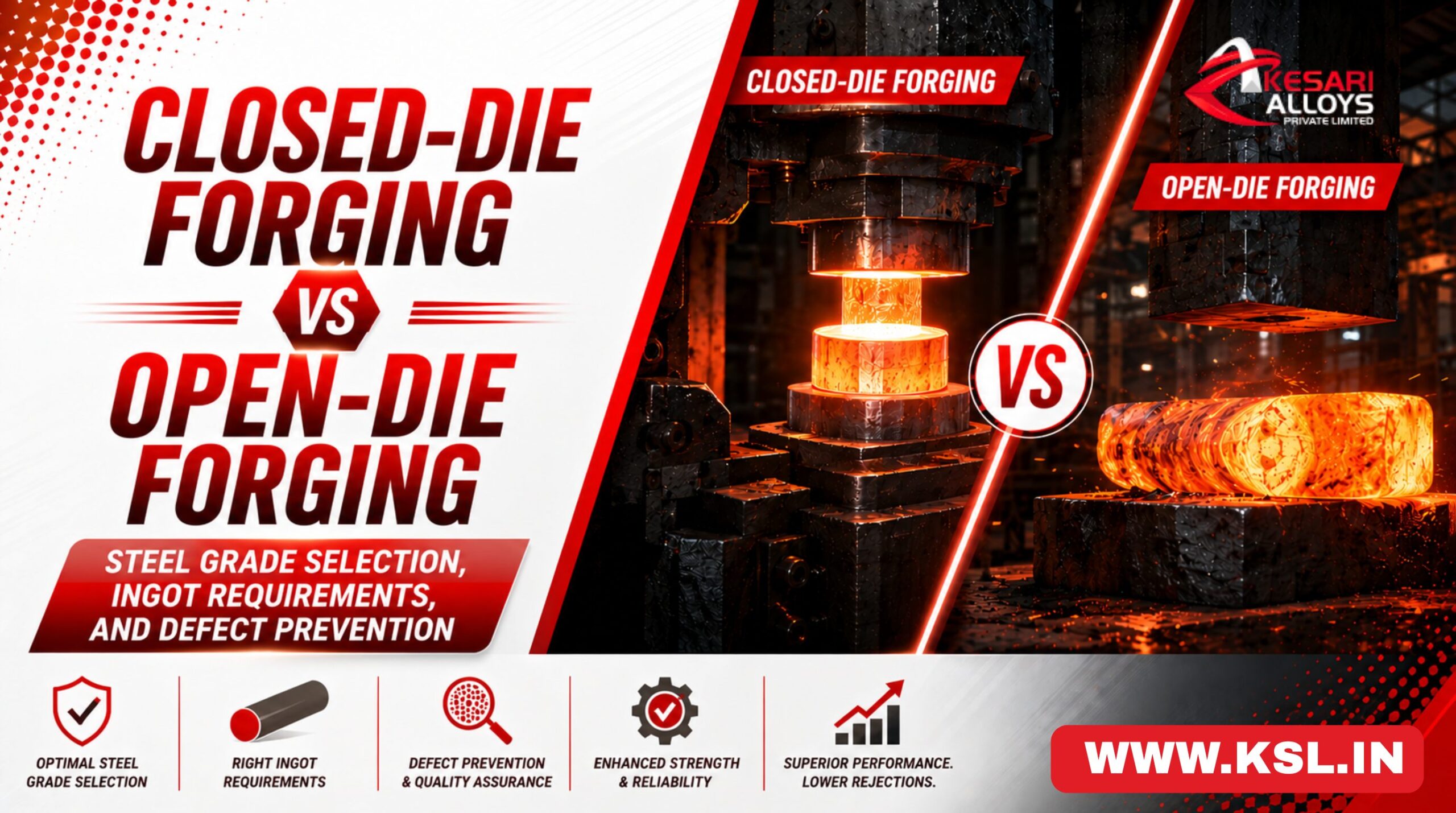
Forging is not a single process. The term covers a wide family of deformation operations – each with its own tooling, process parameters, starting material requirements, and failure modes. Of this family, two processes dominate industrial forging worldwide: open-die forging and closed-die forging. They differ fundamentally in how they shape metal, what starting material they require, which steel grades they are suited to, and what defects they are each prone to.
For a forge shop manager specifying starting material, or a process engineer designing a production sequence, understanding these differences is not academic – it directly determines the ingot or billet specification to purchase, the grade to select for a given application, and the quality controls to put in place to prevent the defects that each process is susceptible to.
This guide covers both processes in technical depth, with a focus on the material decisions that govern outcomes.
Open-Die Forging: Process, Starting Material, and Grade Selection
How Open-Die Forging Works
In open-die forging, the workpiece is deformed between flat or simply shaped dies that do not enclose the material. The material flows freely in the lateral direction – unconstrained by die walls. The press or hammer applies compressive force; the operator manipulates the workpiece between strokes, rotating and repositioning it to achieve the required shape. The process is iterative: successive compressions from different orientations gradually shape the workpiece from its starting form (ingot, bloom, or large billet) to the required forged geometry – a shaft, a disc, a slab, a ring preform, a nozzle blank.
Open-die forging is the primary production route for large, heavy, and complex shapes that cannot be economically produced by closed-die tooling – either because the component is too large (shaft forgings for power generation, pressure vessel shells, propeller shafts), too varied in geometry (custom flanges, complex nozzle forgings), or produced in quantities too small to justify closed-die tooling investment.
Starting Material for Open-Die Forging
Open-die forging almost always starts from ingots or large blooms. The large, as-cast ingot carries the as-cast microstructure – columnar grains, macro-segregation, central pipe – that the open-die forging process is specifically designed to break down. The ratio of the ingot cross-section to the finished forging cross-section (the reduction ratio) is a key quality parameter: many specifications for critical open-die forgings require a minimum total reduction ratio of 3:1 to 5:1 from the ingot to ensure that the as-cast structure is fully converted to a wrought microstructure with the required property homogeneity.
Ingot quality for open-die forging is critical. The ingot must be vacuum-degassed (VD) to remove dissolved hydrogen – hydrogen content above 2 PPM in a large ingot creates the risk of hydrogen flaking, a delayed internal cracking phenomenon that causes catastrophic internal defects in large forgings that may not be detected until ultrasonic testing after final heat treatment. Macro-segregation must be minimised through controlled solidification and appropriate ingot geometry for the intended reduction. The top (riser) and bottom of the ingot must be cropped to remove the shrinkage pipe and the cold-shut zone before forging begins.
Grade Selection for Open-Die Forging
The grade families most commonly processed by open-die forging reflect the large component sizes and demanding service requirements of the applications it serves:
- Cr-Mo creep-resistant grades (F-11, F-22, F-91) for pressure vessel shells, nozzle forgings, and heavy flanges for power and process plant
- Ni-Cr-Mo high-strength grades (EN24 / 4340, EN30B) for large shaft forgings, heavy structural forgings, and defence components
- Carbon and low-alloy grades (EN8, C-45, EN19 / 4140) for general heavy engineering – rolls, mandrels, large gears, press tooling
- Stainless grades (316, 304, 410) for large flanges and vessel forgings in chemical and pharmaceutical service
Grade selection for open-die forging must account for the wide temperature range over which the workpiece will be processed – a large ingot will cool significantly during a multi-stroke open-die sequence, and the forge shop must know the minimum forging temperature for the grade and ensure it is not breached before a reheat. High-alloy grades with narrow forging temperature windows require more careful temperature management and more frequent reheats.
Closed-Die Forging: Process, Starting Material, and Grade Selection
How Closed-Die Forging Works
In closed-die forging (also called impression die forging), the workpiece is placed in a die set that contains the negative impression of the finished forging. Press or hammer force closes the dies, forcing the heated steel to fill the die cavity completely. Flash – excess metal that flows out of the die parting line – is trimmed in a subsequent operation. The result is a near-net-shape forging with close dimensional tolerances, a well-defined grain flow pattern, and consistent geometry from piece to piece.
Closed-die forging is the standard production route for medium-volume forgings in the automotive, aerospace, oil and gas, and general engineering industries: connecting rods, crankshafts, gear blanks, flanges, valve bodies, aircraft structural components, and a vast range of precision-profile forgings where dimensional consistency and repeatable mechanical properties are required.
Starting Material for Closed-Die Forging
Closed-die forging almost always starts from billets – cut to a precise length and weight that matches the die cavity volume plus flash allowance. Billet weight accuracy is critical: an underweight billet produces an underfilled die impression and a scrapped forging; an overweight billet produces excessive flash, increases die wear, and may overload the press. Dimensional consistency of the billet cross-section determines the blank cutting yield – billets with tight dimensional tolerance produce more consistent piece weights from every cut.
Surface condition of the billet matters in closed-die forging. Surface seams or laps on the billet can be folded into the forging die impression, creating surface defects in the finished forging that may not be detected until machining or NDT. Clean-surface, inspection-ready billets from a quality-controlled supply source reduce the risk of surface-origin defects in closed-die forgings.
Grade Selection for Closed-Die Forging
The grade families used in closed-die forging reflect the medium-component sizes and the broad range of mechanical property requirements of the industries it serves:
- EN8 / C-45 / AISI 1040 – general engineering forgings, truck components, agricultural equipment: excellent forgeability, wide temperature window, cost-effective
- EN19 / 4140 / 42CrMo4 – the most widely used alloy steel in closed-die forging: flanges, gearbox components, shafts, automotive structural parts requiring quench-and-temper properties
- EN24 / 4340 – high-strength automotive and aerospace forgings: connecting rods, transmission components, aircraft structural preforms requiring maximum strength after heat treatment
- 16MnCr5 / 20MnCr5 – case-hardening grades for gear blanks and ring preforms where high surface hardness combined with tough core is required
- AISI 52100 / EN31 – bearing ring preforms for ring rolling following closed-die preforming: demanding grade requiring VD-processed, low-inclusion starting material
Defect Prevention: By Process and Starting Material
| Defect | Open-Die or Closed-Die? | Root Cause | Prevention – Process | Prevention – Starting Material |
|---|---|---|---|---|
| Hydrogen Flaking | Open-die (large forgings) | Dissolved hydrogen > 2 PPM in large ingot | Slow cooling or annealing after forging | VD-processed ingots, H2 < 2 PPM |
| Macro-Segregation Banding | Both (more severe in OD from ingot) | Chemical segregation in starting ingot | Maximum reduction ratio from ingot | Controlled solidification, correct ingot geometry |
| Surface Laps / Folds | Closed-die (billet surface defects folded in) | Surface seams on starting billet | Pre-forge billet inspection and dressing | Clean surface billets, surface inspection at source |
| Die Underfill | Closed-die | Underweight billet; low forging temperature | Accurate piece weight control; correct temp | Consistent billet cross-section and weight per metre |
| Internal Cracking | Both | Cold core; high inclusions; H2 embrittlement | Full thermal soak; correct reduction sequence | VD, low inclusion, clean chemistry billets/ingots |
| Equatorial Surface Cracking | Open-die (upsetting stage) | Tensile hoop stress; low ductility; low temp | Correct H/D ratio; lubrication; temperature | High ductility VD billets, low inclusion content |
| Flash-Line Cracks | Closed-die | Flash too thin; incorrect flash land geometry | Die design optimisation | Consistent piece weight; correct grade ductility |
The Starting Material Quality Standard That Both Processes Demand
Despite their differences, open-die and closed-die forging share one requirement: the starting material must be clean, consistent, and correctly specified for the grade and the process. The consequences of starting material quality failures are different in each process – hydrogen flaking in a large open-die forging versus surface laps in a closed-die forging – but the cost of those failures is equally severe: scrapped forgings, rework, delivery delays, and customer claims.
Vacuum-degassed ingots and billets with controlled chemistry, clean surfaces, and full heat-wise MTC documentation are the input quality standard for both process types. The differences are in size and form: ingots for open-die, billets for closed-die – but the quality requirements for both are non-negotiable.
Kesari Alloys supplies EAF + LRF + VD ingots for open-die forging and clean, dimensionally consistent billets for closed-die forging, across 100+ steel grades with full heat-wise MTC documentation. Our technical team can advise on grade selection, ingot geometry, reduction ratio requirements, and billet specification for your specific forging application.
Speak with the Kesari Alloys technical team about your forging material requirements at ksl.in →
→
Kesari Alloys Private Limited | IBR Approved | ISO 9001 Certified | Bhiwadi, Rajasthan, India Manufacturer & Exporter of Carbon Steel, Alloy Steel & Stainless Steel Ingots, Billets, Blooms & Rolled Bars